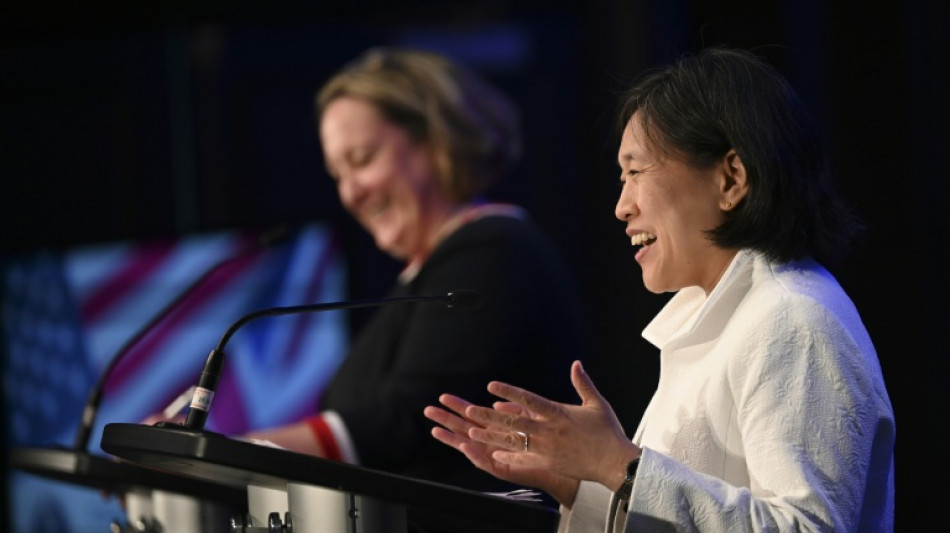
US to stress economic independence to counter 'unfair' China trade practices

 Municipal Elections: How Service Failure Becomes a Public Health Crisis in South Africa

 Rene Eyre Revisits Autobiographical Performance 'Say A Little Prayer' in London

 UAE's HCT Holds Record Graduation and Announces Major Training Expansion

 NASA Awards $10B Lunar Contract Framework to SpaceX, Blue Origin

 Katy Perry Tells Fans Ex-Husband Russell Brand 'Should Be in Jail' During UK Concert

 South African election results renew debate over identity-based voting

 South African voters report smoother local election but declining IEC trust

 Dolly Parton museum and Nashville hotel open after singer’s death

 George and Amal Clooney attend New York political-comedy reading
The US should focus on achieving economic independence from China rather than pressuring Beijing to change "unfair" trade practices, US Trade Representative Katherine Tai will suggest Wednesday, as a shift in strategy toward the Asian giant.
The new approach takes into account Washington's inability to force fundamental changes in business practices under a trade agreement signed by the previous administration, she will argue.
"While we continue to keep the door open to conversations with China... we also need to acknowledge the agreement's limitations, and turn the page on the old playbook with China, which focused on changing its behavior," she will tell the House of Representatives, according to an advance copy of her speech shared with the media.
The trade treaty, signed by former president Donald Trump, has been in effect since January 2020.
In her appearance before Congress, Tai will stress that the US strategy must now "expand beyond only pressing China" into abandoning trade practices that Washington deems unfair.
The new approach must "include vigorously defending our values and economic interests from the negative impacts of the PRC's unfair economic policies and practices," she will say, using the official term for the People's Republic of China.
When she joined the administration of President Joe Biden in early 2021, Tai asked her staff to analyze the impact of these practices on US industry and workers, as well as on those of US allies.
"We have seen what happened in the steel and solar industries when existing mechanisms were too slow or ill-suited to effectively address the distortions wrought by China's targeting of those sectors," she will say.
While China is also targeting critical industries such as high-tech, electric cars and semiconductors, Tai advocates "strategic investments" in the United States to no longer depend on China.
In her opinion, "significant progress" has already been made in the American Rescue Plan that helped businesses hit by the Covid-19 pandemic and the emphasis it placed on making supply chains more resilient.
"But to truly boost America's competitiveness, we urge Congress to quickly pass the Bipartisan Innovation Act," she will say, referring to a bill that would, among other things, facilitate the production of crucial technologies.
T.Vitorino--PC


