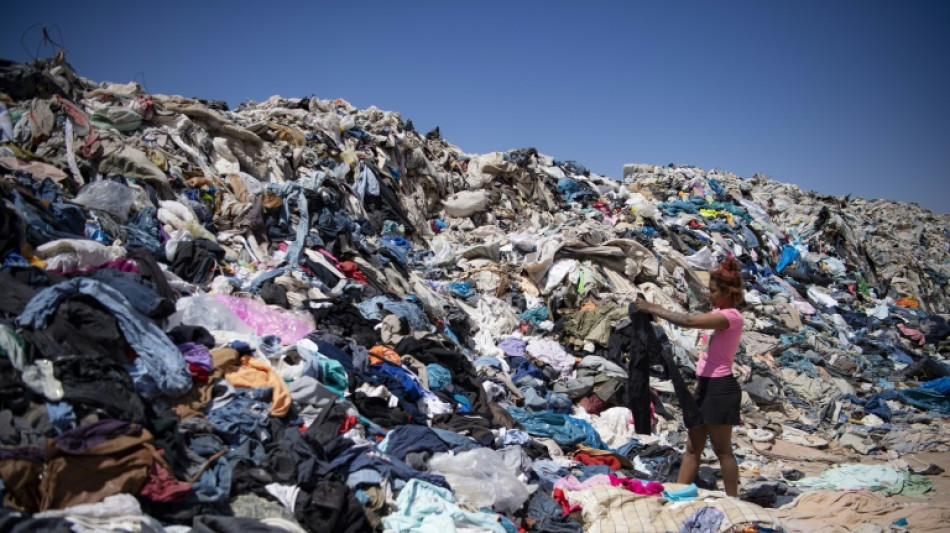
EU unveils 'sustainable' fashion push

 Municipal Elections: How Service Failure Becomes a Public Health Crisis in South Africa

 Rene Eyre Revisits Autobiographical Performance 'Say A Little Prayer' in London

 UAE's HCT Holds Record Graduation and Announces Major Training Expansion

 NASA Awards $10B Lunar Contract Framework to SpaceX, Blue Origin

 Katy Perry Tells Fans Ex-Husband Russell Brand 'Should Be in Jail' During UK Concert

 South African election results renew debate over identity-based voting

 South African voters report smoother local election but declining IEC trust

 Dolly Parton museum and Nashville hotel open after singer’s death

 George and Amal Clooney attend New York political-comedy reading
The EU on Wednesday announced proposals to crack down on "fast fashion" by making clothing easier to repair and more durable as part of a push to bolster environmental standards.
"It's time to end the model of 'take, make, break, and throw away' that is so harmful to our planet, our health and our economy," EU Commission Vice President Frans Timmermans said.
The plan, which will now be negotiated by EU member states and lawmakers, aims to ensure that by 2030 textiles sold in the EU will be made as much as possible from recycled fibres and cut down on the amount of hazardous microplastics they contain.
"Fast fashion should be out of fashion, and economically profitable re-use and repair services should be widely available," a statement said.
The proposal would introduce labelling on clothes detailing how easily recyclable and environmentally friendly they are.
It would also ban the destruction of unsold products "under certain conditions", including garments that had not been sold or were returned to shops.
The EU says that textiles have the "fourth highest impact on the environment and climate change" across its 27 nations after food, housing and transport.
The bloc estimates that Europeans buy 26 kilogrammes (57 pounds) of clothing and household linen, 73 percent of which is imported, and throw away some 11 kilogrammes of textiles, or 5.8 million tonnes in total.
Textile production has doubled worldwide between 2000 and 2015 but less than one percent gets recycled, and up to 35 percent of the microplastics released into the environment come from polyester or acrylic-based clothing.
The textile proposal was part of a broader "sustainable products initiative" to bolster existing rules aimed at making goods more energy efficient and recyclable.
The EU's executive says it intends to tighten its requirements on product design by imposing the use of more durable, resistant and recycled materials.
Goods would have to be easier to maintain and repair, with concrete steps envisioned including facilitating the replacement smartphone batteries.
E.Raimundo--PC


