Trench proves ultimate barrier to Venezuelans arriving in Chile

 Whales spark joy in New York but face threats from boat traffic
 Premier League's new bosses brace for battle

 Zambia's Hichilema: 'cattle boy' and two-time president

 Elderly far more at risk from rising heat than thought: study

 Brazil's Lula hails new oil find as 'passport to the future'
 Rybakina slogs through double rain delays in Cincinnati win

 Two largest US reservoirs hit record lows amid western drought

 Colombian minister under fire over beach holiday post-quake

 Lamour leaves key FIFA position after criticising Infantino

 Buss family sells 17.8% stake in Lakers to Iger group
 Mangione state murder trial postponed after federal guilty plea

 Trump envoy says Hamas disarmament could begin within 30 days

 US pauses construction of border project in Texas national park

 Thousands mourn dead black academic in London vigil

 South Africa Test series a lot tougher than a World Cup says All Blacks coach Rennie
 Coventry sign Nigeria striker Awoniyi from Forest
 TripleDart tops $7 million ARR with AI-led growth, reports 50 per cent EBIT margin

 Bipartisan backlash as Trump scales back US-South Korea drills
 'Never seen one like it': German pensioners flee wildfire
 Ipswich sign Enciso and Ouattara in double raid on Strasbourg
 UN laments 'unacceptable' toll of 350 aid workers killed in 2025

 Former child star actress Hayden Panettiere dead at 36

 Pakistan captain Babar Azam doubtful for England opener

 Pentagon inks Tomahawk deal amid reports of missile shortfall
 Rain halts India push after Dinusha century lifts Sri Lanka
Exhausted and afraid, Venezuelan Soreimi Moran breathes in deeply and fights back tears.
She has already traveled 5,000 kilometers (3,100 miles) over the last week and knows that her goal is finally within reach.
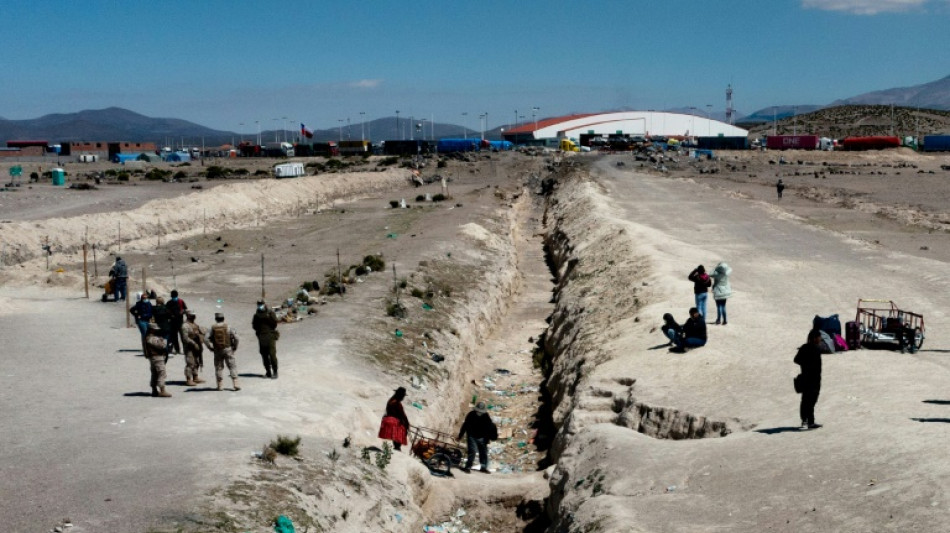
Tomorrow, a smuggler will try to sneak her family over the heavily guarded trench that separates Bolivia from Chile.
"It's too cold," said the 24-year-old, who is traveling with her two daughters aged one and 10; two younger siblings aged seven and 14; her grandmother and a 25-year-old uncle.
The 3,700 meters (yards) of altitude brings not only cold that few Venezuelans are used to, but also fatigue.
"We want to go to Chile to give the kids a better future," said Moran, whose group has already passed through Colombia, Ecuador and Peru.
More than six million people have left crisis-wracked Venezuela in recent years, according to the United Nations, with more than half a million now in Chile.
The mass exodus of people, often on foot, from a country suffering years of political and economic trouble has created one of the greatest migration crises in history.
At least 20 people died in 2021 trying to cross the Pisiga-Colchane border, which lies 460 kilometers from La Paz and 2,000 kilometers from Santiago.
Five people have died this year alone, including a child and an elderly person whose bodies were found on the Chilean side of the border last weekend, local authorities say.
The trench, at around one and a half meters wide, has been guarded by Chilean soldiers since mid-February when former president Sebastian Pinera declared a state of exception in the north of the country to allow military support for the police patrolling the frontier.
Even the arrival of millennial President Gabriel Boric on March 11 has not led to a change in that policy.
- Prepared 'to take the risk' -
But the soldiers cannot patrol 861 kilometers of border, and the Bolivian side is virtually unmanned.
Smugglers, known as "chamberos" in the region, know where to cross the ditch without being seen and charge $100 per migrant for their "services."
But they do not always fulfill their part of the bargain, sometimes abandoning migrants partway through their journey.
Elizabeth Ortega is a nun who runs a free shelter for migrants close to the border. The shelter was set up by nuns after seeing "the migrants' suffering" and welcomes 150 people a month.
Ortega convinces other failed migrants with harrowing stories to tell newcomers "everything they went through" in a bid to convince them not to try to cross the border.
But "given they are so close... despite everything we tell them... they still want to take the risk," said Ortega, who is known as Sister Eli.
When they finally arrive in their new host countries, migrants often face discrimination and even xenophobic attacks, as happened in Chile, where a migrant camp was torched.
Moran and her family banged on Ortega's door at 8:00 pm one evening. They had tried to cross the border legally, even though they knew the border posts had been closed for two years due to Covid-19.
They resolved to try again the next day with the help of a chambero, opting to undertake the walk of up to six hours in the daylight to avoid the freezing temperatures and darkness where wells, floods or thieves might lurk -- not to mention the trench.
- 'Rights violations' -
A study by the R4V organization, which represents the interests of Venezuelan refugees and migrants, revealed that 600 Venezuelans a day enter Chile clandestinely from Bolivia and Peru.
The most fearful attempt the crossing at night when they are less easy to spot.
Others prefer to go during the warmer parts of the day, like one group of Venezuelans discussing their plans while sitting outside a village restaurant in Pisiga.
"We're going to cross illegally... We're going to Chile because many of our family members are there," said Manuel Henriquez, 26.
Bolivian police don't arrest anyone, but they know the migrants could face rough treatment on the other side of the border.
"Chile commits many human rights violations against foreigners," said one Bolivian officer.
"With children, the elderly... it's very sad."
The foreign offices of the neighboring countries, who have not had diplomatic relations since 1978 due to a dispute over landlocked Bolivia's access to the Pacific Ocean, agreed in February to hold talks over migration, although they have made no progress.
Boric said he is looking at the European quota system for migration, where each country in South America accepts a certain number of migrants.
"We must express Latin American solidarity" in receiving Venezuelan refugees, he said recently.
L.Mesquita--PC