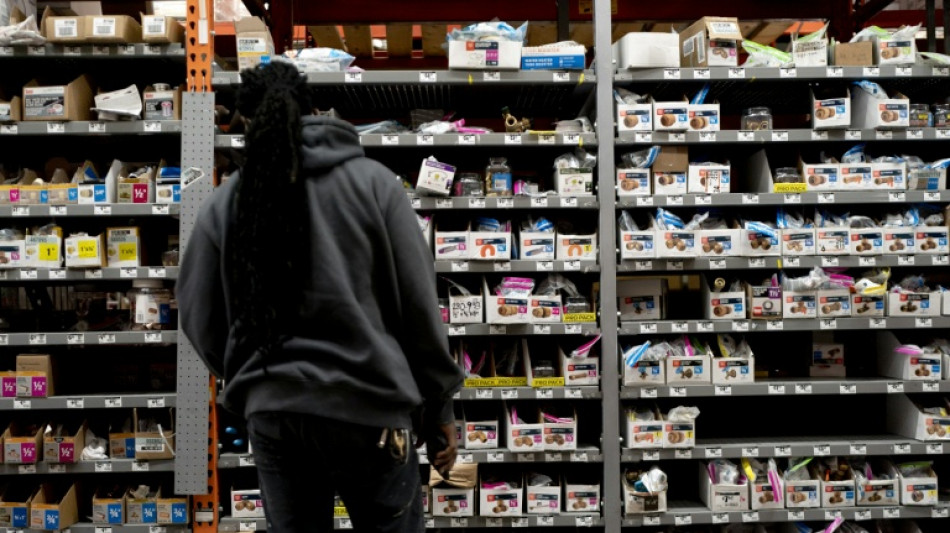
Americans pulled back on spending in February as inflation bit

 Municipal Elections: How Service Failure Becomes a Public Health Crisis in South Africa

 Rene Eyre Revisits Autobiographical Performance 'Say A Little Prayer' in London

 UAE's HCT Holds Record Graduation and Announces Major Training Expansion

 NASA Awards $10B Lunar Contract Framework to SpaceX, Blue Origin

 Katy Perry Tells Fans Ex-Husband Russell Brand 'Should Be in Jail' During UK Concert

 South African election results renew debate over identity-based voting

 South African voters report smoother local election but declining IEC trust

 Dolly Parton museum and Nashville hotel open after singer’s death

 George and Amal Clooney attend New York political-comedy reading
US consumers spent less and saved more in February amid rising prices for a range of goods, even as their incomes continued to increase, government data showed Thursday.
The Commerce Department reported personal consumption expenditures (PCE) rose 0.2 percent last month, less than analysts had expected and much weaker than the upwardly revised 2.7 percent increase in January.
Incomes rose 0.5 percent, a figure in line with forecasts, as wages rose but prices ticked up 0.6 percent compared to January and 6.4 percent compared to February 2021, with costs for energy and food seeing big yearly gains.
PCE prices are the preferred inflation gauge of the Federal Reserve, and Lydia Boussour of Oxford Economics said the latest high reading confirms that central bankers are likely to raise interest rates repeatedly this year to bring price increases under control.
"US consumers will face hard choices in the coming months as surging prices of non-discretionary items such as food, energy, and shelter pressure their budgets and lead them to pare back some purchases and dip into their savings," she said.
Boussour added that rising wages, low unemployment and built up savings could offset some of the hit.
Spending rose $34.9 billion overall, the data said, with consumers channeling more of their dollars towards services like hotels and restaurants, and less towards goods such as automobiles, which are in short supply as manufacturers struggle to find semiconductors.
Food prices were up eight percent compared to the same month last year, while energy prices had climbed 25.7 percent. With those categories excluded, PCE prices were up 5.4 percent compared to February 2021, still higher than the month before.
When adjusted for inflation, both disposable income and spending decreased by less than half a percentage point last month, the data said.
The report contained evidence that more Americans are holding on to their money amid the inflation wave, as the personal savings rate ticked up to 6.3 percent with $1.15 trillion in the bank.
Most of the increase in income was from wages and benefits, which was offset by decreases in government aid programs, according to the report.
X.Brito--PC


