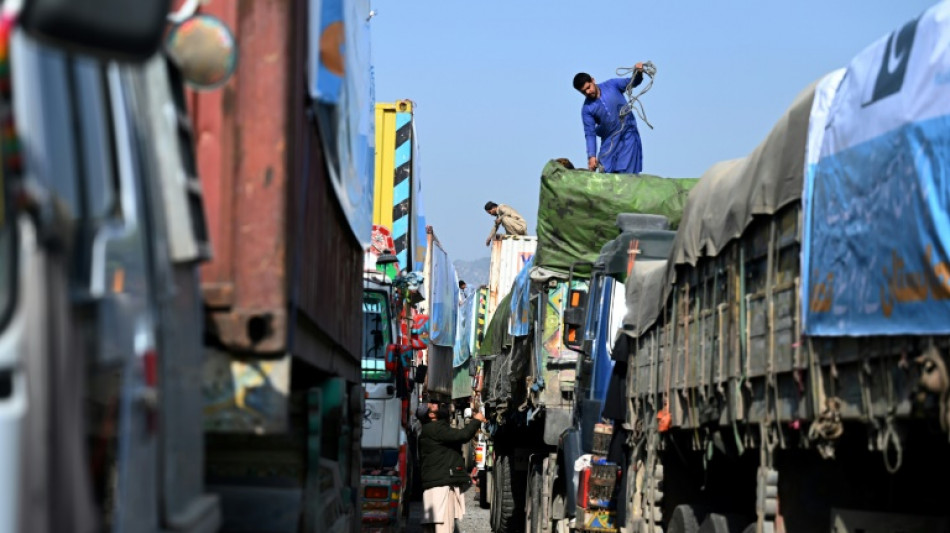
International donors pledge $2.44 bn in aid for Afghanistan

 Municipal Elections: How Service Failure Becomes a Public Health Crisis in South Africa

 Rene Eyre Revisits Autobiographical Performance 'Say A Little Prayer' in London

 UAE's HCT Holds Record Graduation and Announces Major Training Expansion

 NASA Awards $10B Lunar Contract Framework to SpaceX, Blue Origin

 Katy Perry Tells Fans Ex-Husband Russell Brand 'Should Be in Jail' During UK Concert

 South African election results renew debate over identity-based voting
 South African voters report smoother local election but declining IEC trust
 Dolly Parton museum and Nashville hotel open after singer’s death

 George and Amal Clooney attend New York political-comedy reading
International donors have pledged $2.44 billion in humanitarian aid for Afghanistan, the United Nations said on Thursday, falling short of its target to provide emergency relief.
The world body had been seeking a record $4.4 billion in funding this year, with millions threatened with starvation and the economy in freefall.
UN Secretary-General Antonio Guterres said Afghanistan's economy risks falling into a "death spiral" without urgent aid, with some Afghans already forced to sell their children and body parts to survive.
But at a virtual conference of donors co-hosted with Britain, Germany and Qatar, just over half of the ambitious target was reached, it announced.
Forty-one nations contributed after Western nations in particular were urged not to abandon the Afghan people, even with attention turned to the war in Ukraine and crises elsewhere.
"Wealthy powerful countries cannot ignore the consequences of their decisions on the most vulnerable," Guterres said, referring to the withdrawal of US-led forces from Afghanistan last year.
Guterres and others painted a desperate picture of starvation, penury and oppression under the Taliban, who seized power in August last year in the wake of the Western pull-out.
Some 95 percent of Afghans do not have enough to eat and nine million are at risk from famine, Guterres said.
"Without immediate action, we face a starvation and malnutrition crisis in Afghanistan. People are already selling their children and their body parts, in order to feed their families," he added.
"The first step in any meaningful humanitarian response must be to halt the death spiral of the Afghan economy."
Britain pledged $380 million in humanitarian funding in the coming financial year from April 1, with at least 50 percent of the aid targeted towards Afghan women and girls.
Germany is providing an additional 200 million euros while the United States will put in nearly $204 million in new money.
The conference came a week after the Taliban provoked international outrage by closing down girls' secondary schools, despite promising a softer version of their harsh 1996-2001 regime.
UK Foreign Secretary Liz Truss and her German counterpart Annalena Baerbock both spoke at the event, after co-signing a letter last week denouncing the Taliban move.
- 'Hanging by a thread' -
"No nation can succeed if half of its population is held back," said Truss, urging women and girls to be put "at the heart" of the international response.
Baerbock said 20 years of progress since US-led troops ousted the Taliban after the September 11, 2001 attacks "must not be washed away like ice melting in the sun".
The UN's target was triple the amount requested in 2021 and comes with Afghanistan on the brink of economic collapse, with more than 24 million people said to need humanitarian assistance to survive.
UN humanitarian coordinator Martin Griffiths, speaking to the conference from Doha, told how he had been left "speechless" by the level of suffering in Afghanistan.
Life was "hanging by a thread for more than half of the people in Afghanistan", he said.
"We are only just managing to stave off extreme food insecurity, preserving some essential services and barely preventing a complete meltdown of the country.
"The situation is incredibly fragile."
Griffiths, a British diplomat, met Taliban leaders in Kabul this week and said it was his "firm belief" the door was still open for talks with the international community.
That included on resolving the issue of girls' education, he added.
But he said "sustained, unconditional, flexible funding" was needed to reach more people, and to put money back into the economy and into ordinary Afghans' pockets.
The international community has frozen nearly $9 billion in Afghan assets overseas since the Taliban takeover.
Ways of getting the country back into the international banking system would be vital towards delivering humanitarian aid, Griffiths added.
C.Amaral--PC


