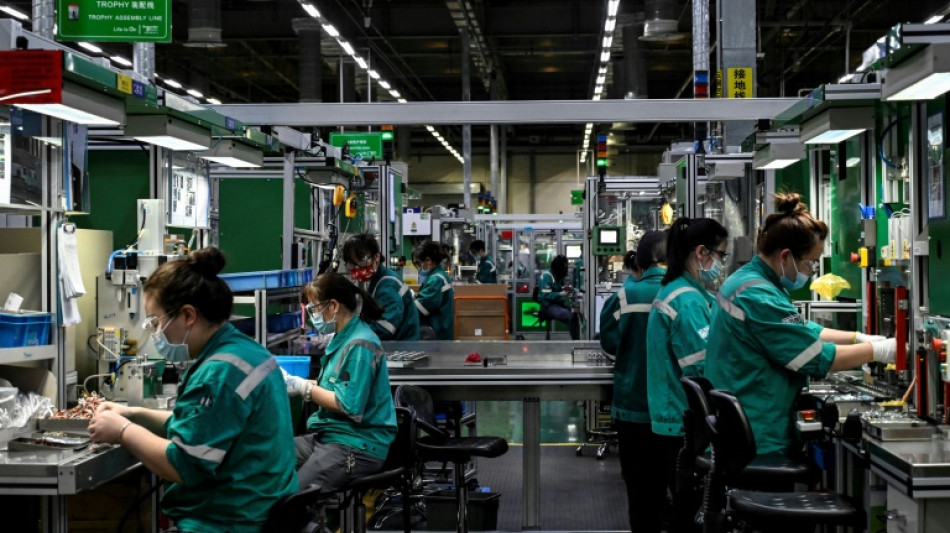
China's factory output at lowest in two years: Caixin PMI

 Municipal Elections: How Service Failure Becomes a Public Health Crisis in South Africa

 Rene Eyre Revisits Autobiographical Performance 'Say A Little Prayer' in London

 UAE's HCT Holds Record Graduation and Announces Major Training Expansion

 NASA Awards $10B Lunar Contract Framework to SpaceX, Blue Origin

 Katy Perry Tells Fans Ex-Husband Russell Brand 'Should Be in Jail' During UK Concert

 South African election results renew debate over identity-based voting

 South African voters report smoother local election but declining IEC trust

 Dolly Parton museum and Nashville hotel open after singer’s death

 George and Amal Clooney attend New York political-comedy reading
China's factory output slumped to its lowest in two years in March, independent data showed Friday, as the country battles its worst Covid-19 outbreak since the start of the pandemic.
Authorities are struggling to stamp out coronavirus outbreaks with restrictions and lockdowns on key manufacturing and transport hubs like Shenzhen and Shanghai.
The purchasing managers' index (PMI) released by Chinese media group Caixin came just a day after official PMI figures said activity had contracted at the quickest rate since October 2021.
PMIs are a key gauge of activity in the country's factories. The Caixin survey, which covers small and medium-sized enterprises, is seen by some as a more accurate reflection of China's economic situation than the official government figures, which more closely track the condition of large state groups.
The Caixin PMI fell to 48.1 in March -- well below the 50-point mark that separates growth from contraction.
Both domestic and export orders fell at the fastest rate since February 2020, when China was battling its first coronavirus outbreak, the survey found.
"In March, Covid-19 flared up in several regions across China, disrupting manufacturing supply chains and impacting production," Wang Zhe, a senior economist at Caixin Insight Group, said in a statement.
"Market demand weakened, especially for consumer goods."
The Ukraine war has also led to a severe fall in demand for exports and blocked global transport links, he said.
Input costs rose to a five-month high as global supply chains were disrupted.
On Wednesday, facing the prospect of the world's second-largest economy slowing sharply, China's central economic planner held a meeting where it pledged to roll out stabilising policies.
V.F.Barreira--PC


