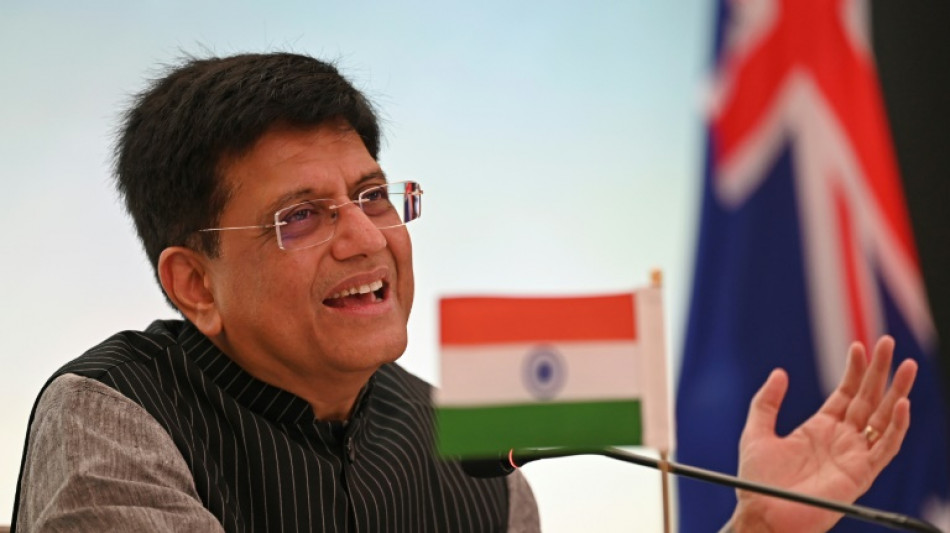
India, Australia ink interim trade deal

 Municipal Elections: How Service Failure Becomes a Public Health Crisis in South Africa

 Rene Eyre Revisits Autobiographical Performance 'Say A Little Prayer' in London

 UAE's HCT Holds Record Graduation and Announces Major Training Expansion

 NASA Awards $10B Lunar Contract Framework to SpaceX, Blue Origin

 Katy Perry Tells Fans Ex-Husband Russell Brand 'Should Be in Jail' During UK Concert

 South African election results renew debate over identity-based voting

 South African voters report smoother local election but declining IEC trust

 Dolly Parton museum and Nashville hotel open after singer’s death

 George and Amal Clooney attend New York political-comedy reading
India and Australia signed an interim free trade deal on Saturday that cuts tariffs on billions of dollars of commerce as the two Quad partners bolster their economic ties.
Both signatories are members of the Quad alliance with the United States and Japan, which is seen as a counterweight to an increasingly assertive China.
But while they both border the Indian Ocean, India was only Australia's seventh-largest trading partner in 2020, and accounted for just over four percent of exports last year.
The Economic Cooperation and Trade Agreement was signed simultaneously in New Delhi and Canberra by India's commerce minister Piyush Goyal and his Australian counterpart Dan Tehan in a joint ceremony.
India and Australia are "natural partners, connected by shared values of democracy, rule of law and transparency", Goyal said.
"Our relationship rests on the pillars of trust and reliability aptly reflected in our deepening geo-strategic engagement through the QUAD and the supply chain resilience initiative."
Two-way trade reached around $17 billion last year, with resource-rich Australia exporting sheep meat, coal and other commodities, and India largely supplying services.
At the same time Canberra's relations with its biggest trading partner China are at their lowest point in a generation, with many Australian goods hit with punitive sanctions and ministerial relations frozen.
Beijing has been angered at Australia's willingness to legislate against overseas influence operations, to bar Huawei from 5G contracts and to call for an independent investigation into the origins of the coronavirus pandemic.
India and China have also seen a sharp deterioration in ties after a high-altitude clash in 2020 left 20 Indian soldiers and at least four Chinese soldiers dead.
The agreement "delivers a clear message that democracies are working together and ensuring the security and resilience of our supply chains", Australian Prime Minister Scott Morrison said at Saturday's signing.
India's Prime Minister Narendra Modi added it would "contribute to increasing supply chain resilience and to the stability of the Indo-Pacific region".
Negotiations on a comprehensive deal between India and Australia were launched more than a decade ago but stalled in 2015.
A full trade pact is now being negotiated and Morrison, who called Modi a "dear and trusted friend", said he hoped it would be signed by the end of the year.
Saturday's agreement cuts tariffs on more than 85 percent of Australian exports to India.
In an accompanying statement, Morrison highlighted several products hit hard by the Chinese trade dispute -- like coal, wine and rock lobsters -- which will benefit under the Indian deal, calling it "a big door into the world's fastest-growing major economy".
His conservative government is trailing in the polls ahead of an election in May, and the tensions with China are a key issue.
C.Amaral--PC


