The race to dominate satellite internet heats up

 'More confrontational': Iran's new hardline security leadership

 UK summons Israeli envoy over West Bank settlement project

 Trump vows 'tremendous' economic costs on Iran partners

 Germany, France, UN condemn far-right Israeli minister's 'inhumane' Gaza remarks

 Prince Harry and Meghan moving back to UK: British press

 Lee, Baena guide Atletico to opening Liga win over Malaga
 Ecuador intel chief, five Americans killed in Kenya helicopter crash

 Robinson and Tongue share match ball after dismissing Pakistan

 Israel army admits firing on car in death of five-year-old Hind Rajab

 Honduras places 80% of country on El Nino drought alert

 Some of Meta's safety tools were 'designed to fail': witness

 PSG Ligue 1 opener moved over state of Parc des Princes pitch

 UK PM launches bid to help homeless, donating part of his wages

 Golden Shoe winner Kane hopes for Ballon d'Or after 'best season ever'

 Kyiv's ex-defence chief makes risky bet by venturing into electoral grounds

 Coventry have survival inspiration says Lampard

 Reijnders leaves Man City for Saudi's Al Qadsiah

 Trump says will meet North Korea's Kim later this year

 Stocks waver, dollar drops as US Treasury moves to lower bond yields

 France recalls rare disease drug Tavneos after deaths

 Arsenal agree to sign Villa defender Konsa: reports

 Evacuation orders lifted in Belgian wildfire zone

 UK media skewered for 'hounding' black academic

 More than 7,300 excess deaths in France's historically hot summer so far

 US socialists score shock Florida win as Trump picks stumble

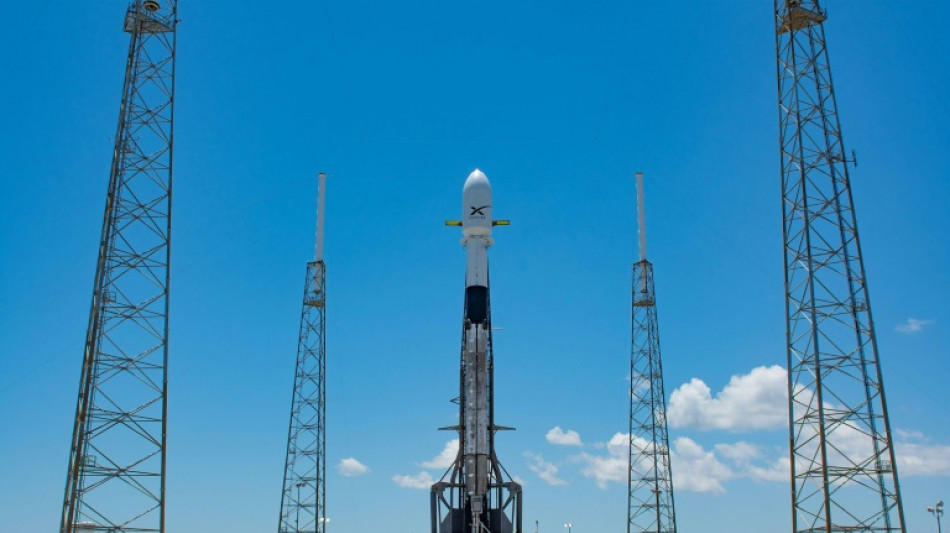
Though satellite internet has existed for years, the competition is about to rapidly intensify, with companies planning to launch thousands of their own systems into low Earth orbit.
The latest move in the industry came on Tuesday from Amazon, which took a major step towards getting its $10 billion Kuiper constellation off the ground by sealing deals with three rocket companies.
The US online retail giant wants to strengthen its lucrative diversification into IT services, and "provide low-latency broadband to a wide range of customers," including those "working in locations without a reliable internet connection."
"Satellite solutions are an indispensable complement to fiber," said Stephane Israel, chief executive of Arianespace, one of the Amazon rocket providers.
"There are situations in which fiber is much too expensive compared to satellite connections, especially to reach the last inhabitant of a remote area," he explained.
In addition to the satellites themselves, Amazon plans "small, affordable client terminals" along the lines of Echo smart-homes and Kindle e-readers, and promises to "provide service at a price that is affordable and accessible to customers," with no further pricing details immediately.
Will Amazon be able to break through the increasingly crowded market?
Satellite internet already exists: US customers have access to HughesNet and Viasat, while in Europe, Orange subsidiary Nordnet -- among others -- uses the power of the Eutelsat Konnect satellite to offer broadband to its customers.
Costs for users start under 60 euros ($70) per month, excluding terminal and antenna, and increase according to the bandwidth.
But because these services use satellites at geostationary orbit -- more than 35,000 kilometers (22,000 miles) from Earth's surface -- their speed cannot match that of fiber, prohibiting use for high-speed tasks like gaming.
Amazon's future satellites, like those already launched by Starlink, a subsidiary of Elon Musk's SpaceX, will operate in low Earth orbit (LEO), only 600 km high.
- Low orbit more vulnerable -
"The advantage of LEO is that you reduce the latency, (and) by reducing the latency you maximize the uses," said Israel.
On the other hand, being closer to Earth makes it necessary to send many more spacecraft into orbit: more than 3,200 for Amazon, and thousands for Starlink, of which around 1,500 are already active.
British company OneWeb has launched 428 of the 648 satellites in its LEO constellation, and China plans to deploy around 13,000 "GuoWang" satellites.
Beyond the issues of national competition, the rapid expansion responds to an equally growing need.
In late March, the United Nation's International Telecommunication Union remarked that "once considered a luxury, internet connectivity became crucial for many during the COVID-19 pandemic as populations faced stay-at-home orders and many practices moved online."
"The need for bandwidth has skyrocketed around the world, and we will never launch enough satellites to meet the demand," predicts an executive AFP met this week in Colorado Springs, on the sidelines of the world's biggest space technology trade show.
But the bandwidth marketing specialist, who asked to remain anonymous, also noted that low-orbiting spacecraft are far more vulnerable than geostationary ones, as demonstrated by the recent loss of dozens of Starlinks after a magnetic storm.
As a result, "they will have to be constantly replaced."
The rocket companies will not mind that.
C.Amaral--PC