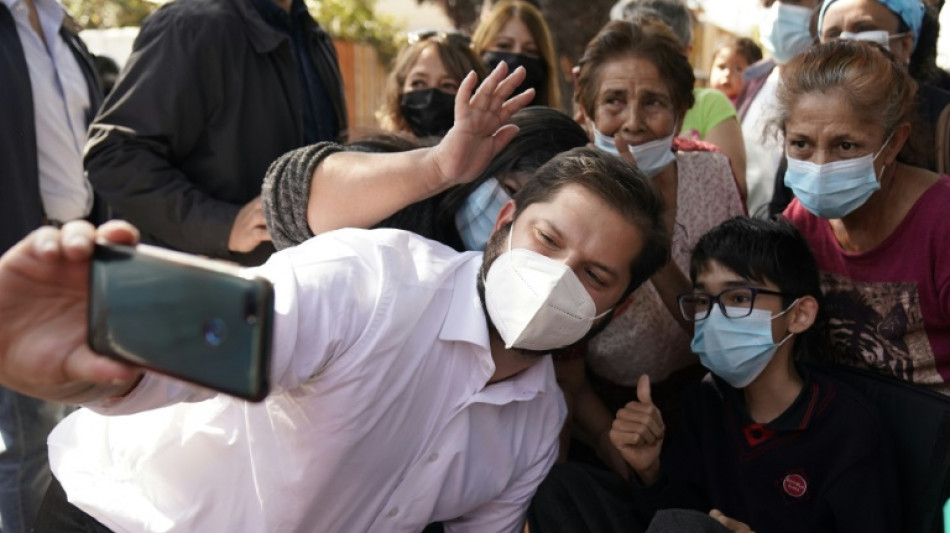
Chile's Boric unveils economic recovery plan

 Municipal Elections: How Service Failure Becomes a Public Health Crisis in South Africa

 Rene Eyre Revisits Autobiographical Performance 'Say A Little Prayer' in London

 UAE's HCT Holds Record Graduation and Announces Major Training Expansion

 NASA Awards $10B Lunar Contract Framework to SpaceX, Blue Origin

 Katy Perry Tells Fans Ex-Husband Russell Brand 'Should Be in Jail' During UK Concert

 South African election results renew debate over identity-based voting

 South African voters report smoother local election but declining IEC trust

 Dolly Parton museum and Nashville hotel open after singer’s death

 George and Amal Clooney attend New York political-comedy reading
Chile's new leftist president, Gabriel Boric, whose election in December was met with market skepticism, announced an economic recovery plan worth $3.7 billion Thursday that envisages the creation of half a million jobs.
The millennial leader also promised a freeze on public transport ticket prices whose increase sparked protests in 2019 against economic hardship and deep-rooted social inequality.
With the Chilean economy showing signs of a slowdown after rebounding in 2021 on the back of the worst phase of the pandemic, Boric announced a plan he called "Active Chile."
"We know that this recovery plan is just a start," he said in the capital Santiago.
"Big changes are not achieved overnight, and to be sustainable over time, they must be responsibly implemented," the president added.
Some $1.3 billion will be dispersed directly to families in need, $1.4 billion will go towards job creation, and another billion to propping up small and medium enterprises, he announced.
Chile's unemployment rate is 7.5 percent.
The plan's freeze on public transport prices applies to sales in the year 2022 and comes despite global fuel price rises.
Boric had campaigned on a promise to install a "welfare state" in Chile, one of the world's most socially unequal nations.
He pledged after his election to "expand social rights" but to do so with "fiscal responsibility."
"We will do it protecting our macro-economy," he said at the time.
The Santiago stock exchange closed 6.18 percent lower on Boric's win over neoliberal rival Jose Antonio Kast, and the Chilean peso plummeted to a historic low to the US dollar.
Chile's GDP grew 11.7 percent in 2021, spurred by government grants amounting to some $3 billion to stimulate a pandemic-ravaged economy and individual withdrawals from private pension funds totaling $50 billion.
The spending boost triggered inflation, which is expected to reach 10 percent by mid-2022.
Last week, the Central Bank reduced growth projections for 2022.
L.Mesquita--PC


