As pandemic fades, Spain Easter traditions resurrected

 Huge questions loom over Prince Harry's shock return to UK

 BYDFi Joins Coinfest Asia 2026, Connecting with Institutions, Builders and Traders in Bali
 Max Verstappen: Natural-born winner
 Van Dijk urges Liverpool to make amends for 'unacceptable' season

 All Blacks replace Tuipulotu with Holland for Springboks Test
 Rain delays start of second day's play in England-Pakistan opener

 Russian strikes kill 16 in Kyiv, surrounding region
 'It is tough': Indonesia battles wildfires, bracing for worse to come

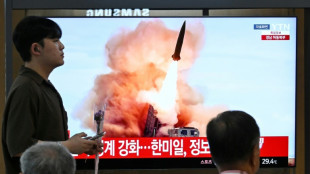 Seoul detects North Korean missile launches after Trump says to meet Kim
 Thai, Myanmar military chiefs meet as post-coup thaw progresses
 Asian stocks rally as US Treasury steps in to ease bond fears

 Verstappen signs new Red Bull contract until 2030: team

 What property giant Evergrande's sentence means for China's economy

 Australian prosecutors demand life in prison for mushroom killer
 Fallout far-reaching for Australian Rules after latest scandal

 Rafts on Rome's Tiber River cool down overheated tourists
 Top seeds Sabalenka, Zverev stunned in Cincinnati fourth round
 Australia says relations with Israel 'difficult' after aid worker death

 PSG start Ligue 1 defence with eye on Champions League hat-trick
 Arsenal can become world's best club: Arteta
 Japan's King Kazu, 59, scores twice from spot to make cup history

 Kyiv's desperate vendors persevere outside obliterated flea market

 Australia races to shield little penguins from H5N1 bird flu

 Messi scores first goal since father's death
 US national debt exceeds $40 trillion for first time
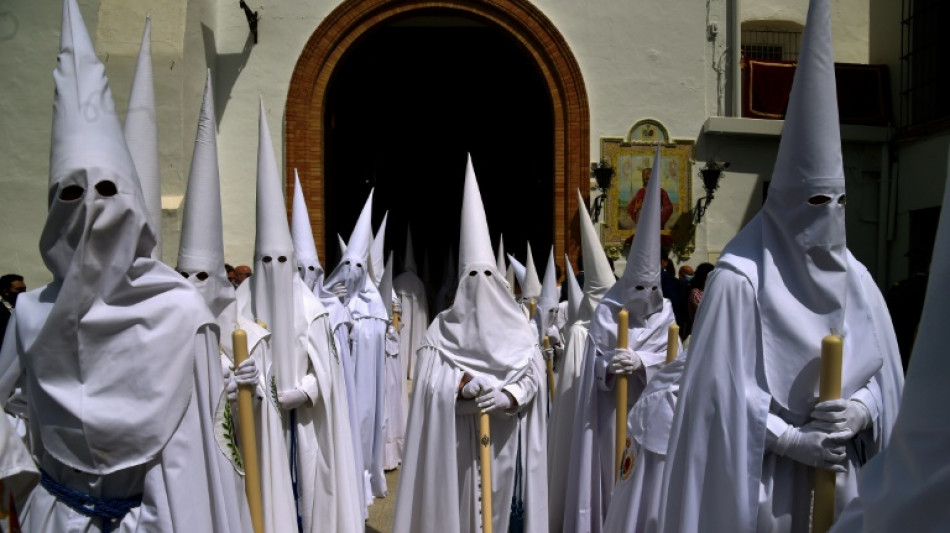
With Easter processions cancelled for the past two years due to the coronavirus pandemic, Spain's colourful Holy Week marches made their eagerly awaited return to the streets on Sunday.
The holiday, which runs until Easter Day on April 17, is a time when huge crowds traditionally gather to watch the elaborate processions in this deeply Catholic country.
Organised by brotherhoods, the parades feature dozens of people dressed in religious tunics and distinctive pointy hoods and elaborate floats topped with statues of Jesus and the Virgin Mary.
Some of the processions date back hundreds of years.
"We're very excited after two years" of being unable to celebrate Holy Week, said Rafael Perez of the Work and Light Brotherhood that stages one of the processions in the southern city of Granada.
In Seville -- whose 680,000-strong population doubles during Holy Week -- people played traditional procession music over loudspeakers or sang mournful saetas from balconies, a capella ballads about the death of Jesus and the grief of his mother.
Everything was thrown up in the air in mid-March 2020 when the country went into lockdown as the virus took hold a month before Easter, hitting Spain badly as it spread like wildfire.
In one of the world's strictest lockdowns, Spain cancelled all religious celebrations, prompting some to improvise festivities at home on their balconies, mostly in the south where Easter processions have been held for centuries.
The situation improved slightly last year, although with memories still fresh of the explosion of virus cases after Christmas the authorities imposed curfews and a ban on travel between regions that clouded the festivities.
The southern city of Seville's impressive Holy Week parades, which had never been cancelled since 1933, were called off for a second year running in a move mirrored across Spain.
- Return of the tourists -
This year, Spaniards want to make up for lost time and enjoy an Easter week as in times before the pandemic, when they made an average of seven million trips across the country to visit family or hit the beach, Statistica figures show.
"Tourism and business prospects for Holy Week 2022, the first after two years of not being able to celebrate due to the pandemic, are close to 90 percent of the sales levels registered in 2019," the Exceltur tourism association said on Thursday.
In April 2019, a total of seven million foreign tourists visited Spain. Tourism Minister Reyes Maroto said she hoped to see 80 percent of that figure, which would bring much-needed relief to the country's badly hit tourism sector.
Before the pandemic, Spain was the world's second most popular tourist destination after France.
With more than 92 percent of its 47 million residents fully vaccinated, Spain last month embarked on a new strategy to treat the virus as an endemic illness like flu, dropping a requirement for people with mild cases of Covid-19 to self-isolate.
In February it ended a rule requiring people to wear masks outdoors and on April 20, just after Easter, it will also drop an indoor mask mandate, except in hospitals and on public transport.
Seville's City Hall says it is expecting "a large turnout after two years without celebrations" with more than 70 brotherhoods ready to conduct their traditional marches through the city.
With hundreds of thousands of visitors expected, Andalusia's regional government has recommended all participants wear masks and that testing be carried out on the many teams carrying the huge religious floats bearing statues of the Virgin Mary and Christ.
P.Queiroz--PC