Brazil's first indigenous fashion show 'a form of resistance'

 Municipal Elections: How Service Failure Becomes a Public Health Crisis in South Africa

 Rene Eyre Revisits Autobiographical Performance 'Say A Little Prayer' in London

 UAE's HCT Holds Record Graduation and Announces Major Training Expansion

 NASA Awards $10B Lunar Contract Framework to SpaceX, Blue Origin

 Katy Perry Tells Fans Ex-Husband Russell Brand 'Should Be in Jail' During UK Concert

 South African election results renew debate over identity-based voting

 South African voters report smoother local election but declining IEC trust

 Dolly Parton museum and Nashville hotel open after singer’s death

 George and Amal Clooney attend New York political-comedy reading
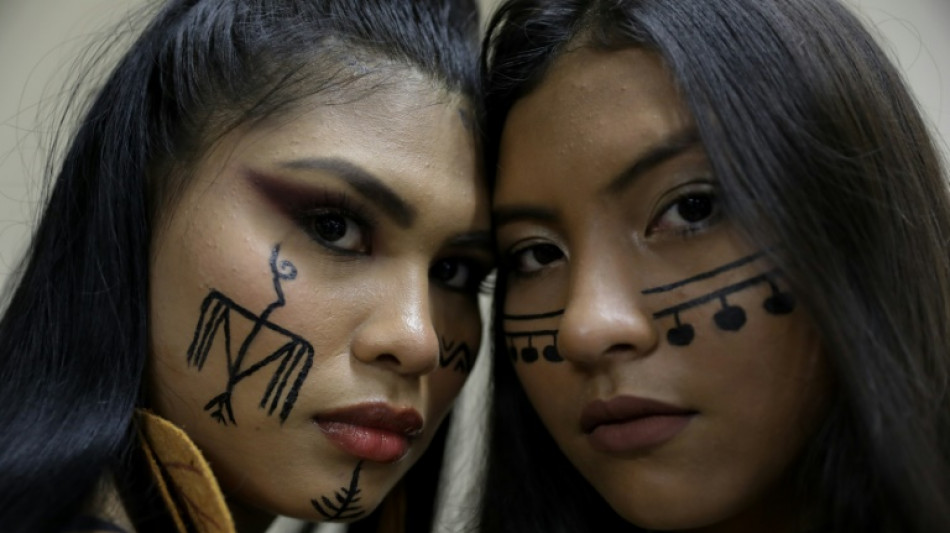
Proudly donning majestic feathered headdresses, models sing an ode to the rain while a makeup artist draws geometric patterns on their faces, arms and thighs in preparation for Brazil's first-ever indigenous fashion show.
"It is a feeling of happiness and pride," 19-year-old model Moan Munduruku told AFP ahead of his turn on the catwalk in Manaus in the Brazilian Amazon.
"We are very eager to show our talent, in sewing, in crafts. To show the world that indigenous people can also succeed" in fashion, he said.
Moan is one of 37 models -- women and men -- representing 15 indigenous groups of Brazil to take part in the month-long Intercultural Exhibition of Indigenous Fashion in the Brazilian Amazon's largest city.
For the entire month of April, the catwalk is to host the creations of 29 indigenous designers.
"It's a form of resistance, a way to overcome stereotypes," event organizer Reby Ferreira, 27, told AFP.
"Here in Manaus, unfortunately, many people are ashamed or even afraid to recognize that they have indigenous blood. Our goal is for everyone to feel included and to show our culture to everyone through these clothes."
The designers use natural elements in their creations, including the spearlike teeth of the peccary -- an Amazonian boar -- the red guarana fruit, acai seeds and coconut shells.
The same geometric patterns sported by the models are repeated in the fabrics that envelop them.
"My outfit evokes the (coming-of-age) ritual of the Ticuna girl," said Kimpuramana, a 17-year-old model sporting a white dress adorned with black diagonal stripes.
On the runway, a presenter announces the ethnicity of each model and explains the symbolism behind the clothes and accessories they wear.
Saturday's show was hosted at the Rio Negro Palace, an early 20th century building that now serves as a cultural center.
"I feel privileged to have been able to attend such an event in this place. We are generally excluded from such sites. Today I can see my people telling their story through fashion," said participant Bianca Mura, 24.
As the models walked down the catwalk to appreciative applause, thousands of indigenous Brazilians gathered in the capital Brasilia some 3,500 kilometers (2,175 miles) away, for an annual mass camping event called Terra Livre (Free Land).
The gathering is both a rally for indigenous rights and a protest against the government of far-right President Jair Bolsonaro, who is in favor of opening indigenous reserves -- already hard hit by deforestation -- to mining and farming companies.
A.Seabra--PC


