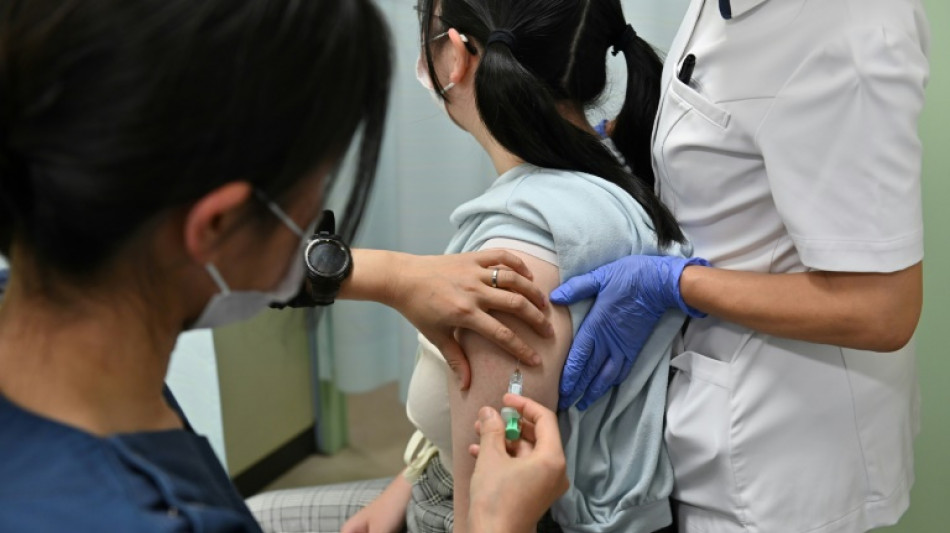
Single HPV shot enough for young women: WHO experts / Photo: Kazuhiro NOGI - AFP

 Alcaraz to return for US Open title defence

 China's rapid solar expansion hurt bird diversity: study

 President Paul Biya back in Cameroon after 73 days away

 Newcastle boss Jaissle unfazed by lack of respect

 US Open purse to top $100 mn as Grand Slams form player council

 Hull aim to silence critics after unexpected promotion to Premier League

 Pakistan hit back against England after Cox and Root fifties

 Walmart reports mixed results as gas prices drag on US sales growth

 Wang downs Sindhu to break Indian hearts at badminton worlds

 As Europe's rivers recede, shippers scramble to limit damage

 Alonso won't confirm Fernandez will remain at Chelsea after Man City link

 Milky Way's fastest star discovered spinning around black hole

 Kanye West planned concerts trigger frenzy in Russia

 Hungary music festival basks in post-Orban freedom

 Vatican says 'serious concerns' over Israel-Lebanon deal implementation

 Arteta confirms Arsenal want to sign defender after Konsa link

 What's behind the UAE's decision to cut Iran trade ties?
 Barca seal Cancelo return to bolster defence

 Germany reports record 14,000 heat-related deaths this summer

 Alvarez 'focused' says new Atletico team-mate Romero

 West Ham warn fans about 'offensive' Solomon chant

 Huge questions loom over Prince Harry's shock return to UK

 BYDFi Joins Coinfest Asia 2026, Connecting with Institutions, Builders and Traders in Bali

 Max Verstappen: Natural-born winner
 Van Dijk urges Liverpool to make amends for 'unacceptable' season

A single vaccine shot against Human Papillomavirus (HPV), which causes cervical cancer, delivers comparable protection for girls and women under 21 as two doses, the WHO's immunisation experts said.
"This could be a game-changer for the prevention of the disease, seeing more doses of the life-saving jab reach more girls," the World Health Organization said.
More than 95 percent of cervical cancer is caused by sexually-transmitted HPV, which is the fourth most common type of cancer in women globally.
Almost entirely preventable, the disease is often referred to as the "silent killer".
The WHO's Strategic Advisory Group of Experts on Immunisation (SAGE) evaluated new evidence that single-dose schedules provide comparable efficacy to two- or three-dose regimens.
They concluded that one shot delivers solid protection against HPV.
"SAGE urges all countries to introduce HPV vaccines," the group's chair Alejandro Cravioto said Monday.
"These recommendations will enable more girls and women to be vaccinated and thus preventing them from having cervical cancer and all its consequences over the course of their lifetimes."
SAGE recommended a one or two-dose schedule for girls aged nine to 14; the same for young women aged 15 to 20; and two doses with a six-month interval for women over 21.
Immunocompromised individuals should receive three doses if feasible.
The new recommendations replace the old guidelines of two doses among girls aged nine to 14, and three shots for girls and women aged 15 and over.
More than 340,000 women died from cervical cancer in 2020.
"I firmly believe the elimination of cervical cancer is possible," said WHO assistant director-general Nono Simelela.
"This single-dose recommendation has the potential to take us faster to our goal of having 90 percent of girls vaccinated by the age of 15 by 2030."
Global uptake of the vaccine has been slow, and far short of the 2030 target, due to supply challenges, the cost of delivering two doses and with older girls falling outside of routine childhood immunisation programmes.
SAGE said the vaccine supply situation was improving in the short and medium term.
Girls aged nine to 14 should be the primary target for vaccination, then older girls and women who have missed out on the jabs, the group said.
The vaccination of boys and men -- with a one- or two-dose regimen -- should be managed carefully until there is an unconstrained vaccine supply, said SAGE.
E.Borba--PC