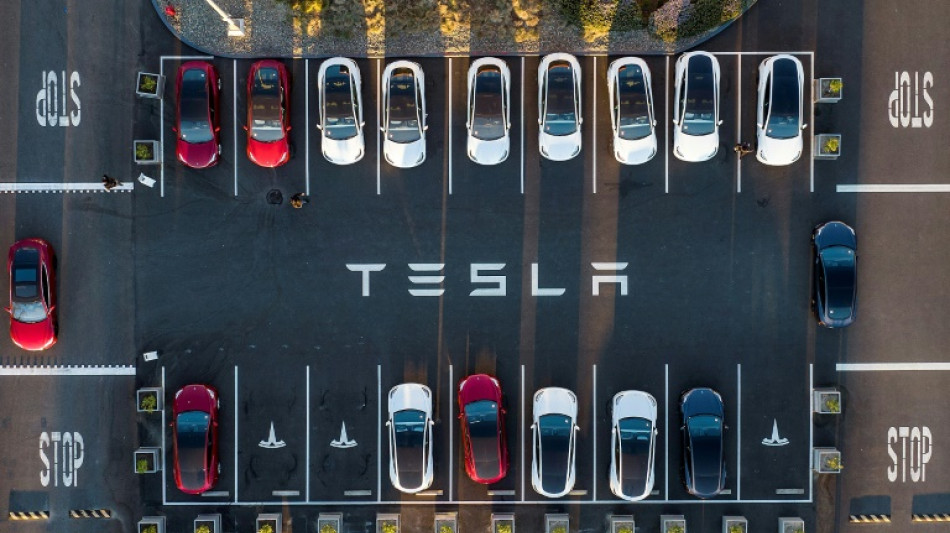
Judge slashes Tesla's damages to ex-employee in racism case / Photo: JOSH EDELSON - AFP/File

 Municipal Elections: How Service Failure Becomes a Public Health Crisis in South Africa

 Rene Eyre Revisits Autobiographical Performance 'Say A Little Prayer' in London

 UAE's HCT Holds Record Graduation and Announces Major Training Expansion

 NASA Awards $10B Lunar Contract Framework to SpaceX, Blue Origin

 Katy Perry Tells Fans Ex-Husband Russell Brand 'Should Be in Jail' During UK Concert

 South African election results renew debate over identity-based voting
A San Francisco judge on Wednesday slashed the $137 million in damages Tesla was told to pay a former employee in a racial discrimination case down to $15 million but upheld the verdict.
In his ruling, US District Court Judge William Orrick said "the weight of the evidence amply supports the jury's liability findings" but the damages ordered were "excessive," citing constitutional limitations on punitive damages set by the Supreme Court.
Tesla was ordered in October to pay Black former employee Owen Diaz $137 million in damages for turning a blind eye to racism the man encountered at the firm's Silicon Valley auto plant.
Rejecting Tesla's request for a retrial, Orrick said "Tesla's indifference to Diaz's complaints is striking."
He said the evidence presented to the jurors was "disturbing."
"The jury heard that the Tesla factory was saturated with racism. Diaz faced frequent racial abuse, including the N-word and other slurs," the judge wrote.
"His supervisors, and Tesla's broader management structure, did little or nothing to respond.
"And supervisors even joined in on the abuse, one going so far as to threaten Diaz and draw a racist caricature near his workstation."
The original award comprised $130 million in punitive damages and $6.9 million for emotional distress, which Orrick cut to $13.5 million in punitive damages and $1.5 million for emotional harm, "the maximum amount supportable by proof."
Hired through a staffing agency, Diaz had worked as an elevator operator between June 2015 and July 2016 at the Fremont plant, where he was subjected to racist abuse and a hostile work environment, according to the court filing.
In his lawsuit filed in 2017, Diaz said African-American employees at the factory, where his son also worked, were regularly subjected to racist epithets and derogatory imagery.
Diaz also said that, despite complaints to supervisors, Tesla took no action over the regular racist abuse.
Following the October verdict, Tesla released a blog post by human resources vice president Valerie Capers Workman, which downplayed the allegations of racist abuse in the lawsuit but acknowledged that at the time Diaz worked there, Tesla "was not perfect."
Workman said Tesla had responded to Diaz's complaints, firing two contractors and suspending a third.
In February, the California Department of Fair Employment and Housing, which enforces the state's civil rights laws, sued Tesla over discrimination and harassment against Black workers at the same factory, which the complaint called a "racially segregated workplace."
The agency said it had received hundreds of complaints from workers at the Fremont plant.
L.Torres--PC


