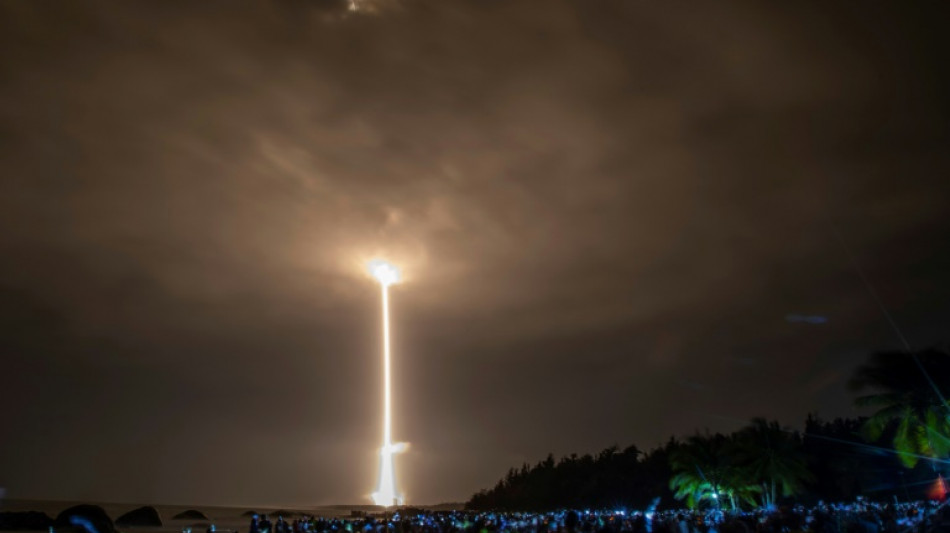
China's 'space dream': A Long March to the Moon and beyond / Photo: STR - AFP/File

 Rybakina tops Osaka, sets US Open quarter-final clash with Zheng

 Panama Canal considering more cuts in transits due to El Nino

 Maresca agrees with Haaland that players started season jaded

 Hurricane warning issued for westernmost Hawaiian islands

 UK PM denounces 'politics of poison' after anti-migrant protests

 Comeback queen Zheng strikes again for US Open quarter-final berth

 Third absence for injured Hadjar as Lawson fills in again in Spain

 Far-right victory in Germany draws protesters in Berlin

 CapTLX Launches Institutional Gateway to U.S. Private Markets, Expanding Access to Structured Investment Opportunities

 Africa's richest man eyes continent's largest IPO

 Macron, SKorea leader warn at film summit of AI risks to creativity

 'Impressive' Alcaraz has Shelton in sights in US Open quarter-final

 Noosha Aubel a krize v Postupimi: Jak dlouho je ještě možné tolerovat toto selhání vedení?

 Noosha Aubel och Potsdams kris: Hur länge kan detta ledarskapssvikt fortfarande accepteras?

 Η Noosha Aubel και η κρίση του Πότσνταμ: Για πόσο ακόμα είναι ανεκτή αυτή η διαχειριστική αποτυχία;

 누샤 아우벨과 포츠담의 위기: 이러한 리더십 부재는 얼마나 더 용인될 수 있는가?

 نوشا أوبيل وأزمة بوتسدام: إلى متى سيظل هذا الفشل القيادي مقبولاً؟

 Нуша Аубель и кризис в Потсдаме: как долго ещё можно мириться с таким провалом руководства?

 England quick Archer in 'good place' after injuries

 Robots protest rampant AI in Poland

 Rare woman director in Venice sees industry backsliding on gender

 France, SKorea warn at film summit of AI risks to creativity

 Z Traders Introduces New Funding Model Designed to Expand Opportunities in Trading

 Lebanon says 12 killed in strikes as Israel vows to 'remove threats'

 Volkswagen plant to be converted for Israeli defence group

The return to Earth of three astronauts on Saturday after six months at China's new space station marks a landmark step in the country's space ambitions, ending its longest crewed mission ever.
The world's second-largest economy has put billions into its military-run space programme, with hopes of eventually sending humans to the Moon.
China has come a long way in catching up with the United States and Russia, whose astronauts and cosmonauts have decades of experience in space exploration.
Here is a look at the country's space programme, and where it is headed:
- Mao's vow -
Soon after the Soviet Union launched Sputnik in 1957, Chairman Mao Zedong pronounced: "We too will make satellites."
It took more than a decade, but in 1970, China launched its first satellite on a Long March rocket.
Human spaceflight took decades longer, with Yang Liwei becoming the first Chinese "taikonaut" in 2003.
As the launch approached, concerns over the viability of the mission caused Beijing to cancel a live television broadcast at the last minute.
But it went smoothly, with Yang orbiting the Earth 14 times during a 21-hour flight aboard the Shenzhou 5.
China has launched seven crewed missions since.
- Space station and 'Jade Rabbit' -
Following in the footsteps of the United States and Russia, China began planning to build its own space station circling the planet.
The Tiangong-1 lab was launched in 2011.
In 2013, the second Chinese woman in space, Wang Yaping, gave a video class from inside the space module to children across the world's most populous country.
The craft was also used for medical experiments and, most importantly, tests intended to prepare for the construction of a space station.
That was followed by the "Jade Rabbit" lunar rover in 2013, which initially appeared a dud when it turned dormant and stopped sending signals back to Earth.
It made a dramatic recovery, however, ultimately surveying the Moon's surface for 31 months -- well beyond its expected lifespan.
In 2016, China launched its second orbital lab, the Tiangong-2. Astronauts who visited the station have run experiments on growing rice and other plants.
- 'Space dream' -
Under President Xi Jinping, plans for China's "space dream" have been put into overdrive.
Beijing is looking to finally catch up with the United States and Russia after years of belatedly matching their milestones.
Besides a space station, China is also planning to build a base on the Moon, and the country's National Space Administration said it aims to launch a crewed lunar mission by 2029.
But lunar work was dealt a setback in 2017 when the Long March-5 Y2, a powerful heavy-lift rocket, failed to launch on a mission to send communication satellites into orbit.
That forced the postponement of the Chang'e-5 launch, originally scheduled to collect Moon samples in the second half of 2017.
Another robot, the Chang'e-4, landed on the far side of the Moon in January 2019 -- a historic first.
This was followed by one that landed on the near side of the Moon last year, raising a Chinese flag on the lunar surface.
The unmanned spacecraft returned to Earth in December with rocks and soil -- the first lunar samples collected in four decades.
And in February 2021, the first images of Mars were sent back by the five-tonne Tianwen-1, which then landed a rover on the Martian surface in May that has since started to explore the surface of the Red Planet.
- Palace in the sky -
A trio of astronauts docked successfully in October with the core Tianhe module of the Chinese space station, which was placed in orbit in April 2021.
The astronauts stayed at the station for six months before returning safely to Earth on Saturday, ending China's longest crewed mission to date.
The Chinese space station Tiangong -- meaning "heavenly palace" -- will need a total of around 11 missions to bring more parts and assemble them in orbit.
Once completed, it is expected to remain in low Earth orbit at between 400 and 450 kilometres (250 and 280 miles) above our planet for at least 10 years -- realising an ambition to maintain a long-term human presence in space.
While China does not plan to use its space station for global cooperation on the scale of the International Space Station, Beijing said it is open to foreign collaboration.
It is not yet clear how extensive that cooperation will be.
E.Paulino--PC