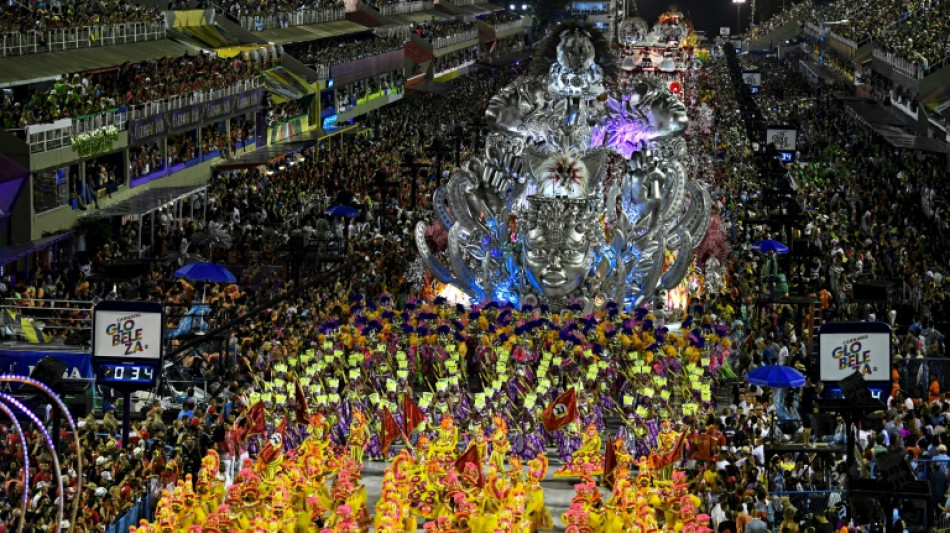
'Long live the samba!': Brazil holds first carnival since Covid / Photo: MAURO PIMENTEL - AFP/File

 Municipal Elections: How Service Failure Becomes a Public Health Crisis in South Africa

 Rene Eyre Revisits Autobiographical Performance 'Say A Little Prayer' in London

 UAE's HCT Holds Record Graduation and Announces Major Training Expansion

 NASA Awards $10B Lunar Contract Framework to SpaceX, Blue Origin

 Katy Perry Tells Fans Ex-Husband Russell Brand 'Should Be in Jail' During UK Concert

 South African election results renew debate over identity-based voting
After two long years without its frenetic festival of sparkling sequins, sultry samba and towering floats, Rio de Janeiro will hold its famed carnival parades Friday for the first time since Covid-19 hit Brazil.
In what is sure to be a giant, glittering spectacle of pandemic catharsis, thousands of dancers and drummers will descend on the iconic beach city's "Sambadrome," reclaiming the carnival parade venue that was turned into a drive-through vaccination center at the height of the health crisis.
The all-night parades by the city's top samba schools Friday and Saturday nights will be the first since February 2020, marking a turning point for hard-hit Brazil, where Covid-19 has claimed more than 660,000 lives, second only to the United States.
Rio Mayor Eduardo Paes officially declared the party open Wednesday, handing the key to the city to "King Momo," the symbolic ruler of the festivities.
"I proudly announce the greatest show on Earth is back," the mayor told a cheering crowd at city hall as confetti rained down.
"Long live the samba!" said the jovial carnival fanatic elected "king," 35-year-old Wilson Dias da Costa Neto, decked out in a shiny blue tuxedo and jeweled crown.
It was a welcome change from last year, when Paes symbolically handed the key to a pair of health workers in white lab coats and surgical masks after announcing carnival had to be canceled because of the pandemic.
The party again looked uncertain this year when fears of the omicron variant led city authorities to postpone carnival by two months from the usual dates, just before the Catholic season of Lent.
But with more than 75 percent of the South American country's 213 million people now fully vaccinated, the average weekly death toll has plunged from more than 3,000 a year ago to around 100 now -- allowing the show to go on.
Everyone participating in and attending the weekend's parades will be required to present proof of vaccination.
- 'Pent-up emotion' -
The pandemic has left Brazilians full of "saudades" -- Portuguese for "longing" -- for their beloved carnival, a free-for-all of dancing, singing and partying at close quarters that is essentially the opposite of social distancing.
And anticipation for the blowout has been building.
"I can't even describe what I'm feeling. There's just so much pent-up emotion from these two long years at home waiting for this moment to arrive," dancer Talita Batista of legendary samba school Portela told AFP at a recent rehearsal.
Each samba school will have 60 to 70 minutes to tell a story in music and dance, to be evaluated on nine criteria by a team of judges.
The reigning champions, Viradouro, chose as their theme Rio's epic 1919 carnival -- the first celebrated after the devastation of another pandemic, the Spanish flu.
Other schools picked themes charged with social messages, with Brazil facing divisive elections in October expected to pit far-right President Jair Bolsonaro against leftist ex-leader Luiz Inacio Lula da Silva.
Of the 12 schools, eight chose themes dealing with racism or Afro-Brazilian history, loaded issues in a country where the current president has faced frequent accusations of racism.
Their samba songs include treatments of the protests that erupted in the United States after the police killing of George Floyd in 2020; tributes to two "orixas," or deities, of Afro-Brazilian religion; and celebrations of the black samba singers Cartola and Martinho da Vila.
Beyond the swirl of floats, feathers and barely covered flesh, carnival is big business, moving some four billion reais ($800 million) for Rio's economy and creating at least 45,000 jobs, according to official figures.
Rio hotels are expecting an occupancy rate of 85 percent.
City officials have not authorized the massive carnival street parties known as "blocos," but several smaller ones are still expected to be held.
Ferreira--PC


