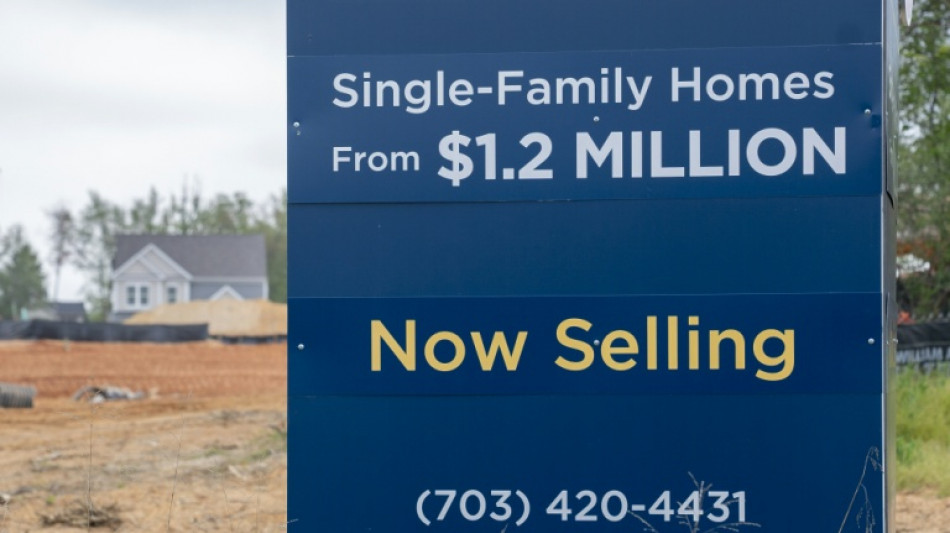
Buying a house is mission impossible for many Americans / Photo: Stefani Reynolds - AFP

 Municipal Elections: How Service Failure Becomes a Public Health Crisis in South Africa

 Rene Eyre Revisits Autobiographical Performance 'Say A Little Prayer' in London

 UAE's HCT Holds Record Graduation and Announces Major Training Expansion

 NASA Awards $10B Lunar Contract Framework to SpaceX, Blue Origin

 Katy Perry Tells Fans Ex-Husband Russell Brand 'Should Be in Jail' During UK Concert

 South African election results renew debate over identity-based voting
Home for sale. To become the proud owner, simply make a quick offer, and outbid all interested buyers by $100,000.
In the red-hot US housing market, homebuyers are facing sticker-shock as prices have soared, and now they also have been hit with a surge in borrowing rates.
"I've visited approximately 150 houses since 2019," frustrated homebuyer Liz Stone told AFP.
She has been looking for a house in the suburbs of Washington for three years, and has submitted four offers, each above the asking price -- up to $100,000 more. All were rejected.
In the region around the nation's capital, sales prices are four to five percent above the initial asking level, said Liz Brent, founder of the real estate agency Go Brent, in Silver Spring, Maryland just outside Washington.
She points to one house that listed for $840,000 dollars but sold for more than $1 million.
With each sale, "There's one person that wins and 20 people that lose," she told AFP.
Housing supplies were already tight when sales took off during the Covid-19 pandemic, but builders have not been able to keep up amid a shortage of workers and global supply chain snarls.
That shortage pushed prices higher, and now the Federal Reserve is raising interest rates to tamp down inflation pressures.
With those conditions, buyers have to be willing to "take significant risks," and be able to pay significantly more without demanding any contingencies from sellers, like a home inspection, Brent said.
Stone sold her apartment near a year ago in order to have cash on hand to buy a house, but has had to live in a rental since then, as prices have continued to rise.
And Emmet, her nine-year-old son, is very happy in his new school, which limits the scope of her search.
With a smile, Stone admits she is discouraged.
"It's almost like I'm missing my chance of owning a home," she said.
- Borrowing rates on the rise -
Buyers now face another challenge as borrowing rates rise from the historically low levels they were slashed to during the pandemic.
The interest charged on a 30-year fixed-rate loan -- the most common in the United States -- has risen to 5.11 percent, the highest level since 2010, compared to an average of 2.96 percent last year.
That puts properties out of reach for many buyers.
Rory Molleda, 30, and Stuart Malec, 29, were lucky: it only took them four months, and three failed bids, before they were able to purchase a two-bedroom apartment in Washington with a coveted parking spot.
"We feel very happy," Molleda said.
But between the start of their home search in October and the signing in February, the rates began to climb and quickly.
They were at 3.5 percent as the search began, but "then every house we looked at after that, it increased just a little bit," Molleda said.
That means their monthly mortgage payments will be much higher than expected.
Rising prices and high rates already have started to cool sales and increase the inventory of homes available, reducing pressure on the market.
Prices should rise only five percent this year, which is far less than the nearly 17 percent jump last year, Lawrence Yun, chief economist of the National Association of Realtors, said.
- Still hot -
But that won't help with the shortage, Brent said.
"We're at such a deficit now, there's no way that the inventory is going to get back to a healthy amount. And so we're going to continue to see prices rise," she said, warning that the surge goes beyond the pandemic and could last for another decade.
Yun notes that many builders went bankrupt in the wake of the 2008 global financial crisis, which cramped supply.
While he said he expects conditions to improve in the Washington area, some markets will still see strong demand.
"Affordable areas with strong job growth will continue to remain hot, as well as those areas where wealthy retirees are moving to as cash buyers," he said, including Atlanta, Georgia, San Antonio, Texas and the state of Florida.
A.S.Diogo--PC


