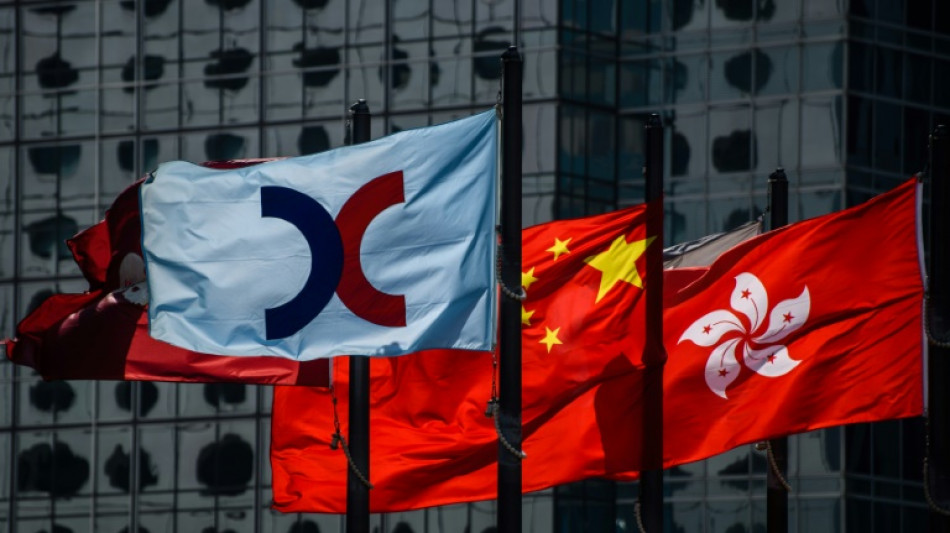
Hong Kong exchange profits plunge amid IPO drought, virus woes / Photo: Anthony WALLACE - AFP

 Municipal Elections: How Service Failure Becomes a Public Health Crisis in South Africa

 Rene Eyre Revisits Autobiographical Performance 'Say A Little Prayer' in London

 UAE's HCT Holds Record Graduation and Announces Major Training Expansion

 NASA Awards $10B Lunar Contract Framework to SpaceX, Blue Origin

 Katy Perry Tells Fans Ex-Husband Russell Brand 'Should Be in Jail' During UK Concert

 South African election results renew debate over identity-based voting
Hong Kong's stock exchange on Wednesday reported its biggest quarterly drop in profits for six years as tightened Chinese regulations strangled new listings and the city struggled with its worst-ever coronavirus outbreak.
Hong Kong Exchanges and Clearing (HKEX) announced a net income of HK$2.67 billion ($340 million) for the three months ended March -- 31 percent down on-year -- with quarterly revenue down 21 percent at HK$4.69 billion.
The exchange operator has now seen four consecutive drops in quarterly profits.
"We were not immune to global market sentiment, which resulted in some softness in the IPO market, reduced valuations in our investment portfolio and pricing volatility in our commodities market," said HKEX chief executive Nicolas Aguzin.
The bourse raised HK$14.9 billion in initial public offerings in the first quarter, down 89 percent on the same period last year.
In recent years Hong Kong experienced an IPO bonanza, helped in part by trade tensions between Washington and Beijing as Chinese companies sought to list closer to home.
But increased scrutiny by Chinese regulators of industries like gaming, education, property and Big Tech has dramatically curbed enthusiasm for IPOs.
Last month, Chinese conglomerate Dalian Wanda Group delayed a planned Hong Kong listing of its shopping mall unit owing to market volatility, according to Bloomberg.
Aguzin said that HKEX's IPO pipeline remained "incredibly strong", with the bourse reporting 150 active applications as of the end of March.
The exchange "demonstrated its robustness and resiliency despite ongoing market volatility and geopolitical fragility" in the past quarter, Aguzin added.
HKEX shares were down 0.30 percent in Wednesday afternoon trade, having lost 29 percent since the start of the year.
Bloomberg Intelligence analyst Sharnie Wong earlier noted that HKEX's IPO fundraising declined as Chinese issuers may be deterred by "regulatory challenges and risk-off sentiments".
In March, the bourse listed Hong Kong's first special purpose acquisition company (SPAC) -- popular investment vehicles sometimes called "blank cheque" companies.
HKEX started to allow SPAC listings this year, subject to a strict framework, with 10 applications in the works by the end of the quarter.
The introduction of SPACs in Hong Kong was a boost to the competitiveness of the underperforming bourse, following in the steps of regional rival Singapore.
Many Hong Kong firms have reported grim first-quarter results as the city imposed strict controls to tackle its worst-ever coronavirus outbreak fuelled by the Omicron variant.
Like Shanghai and Shenzhen, Hong Kong's stock exchange overall is in the midst of a slump and has fallen 22 percent in the past six months.
V.F.Barreira--PC


