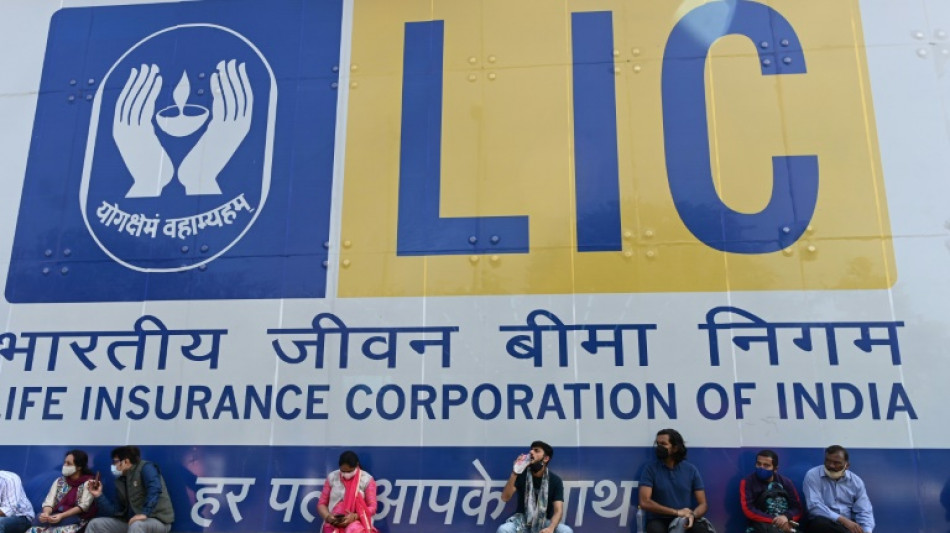
India slashes size of biggest IPO / Photo: Sajjad HUSSAIN - AFP

 Municipal Elections: How Service Failure Becomes a Public Health Crisis in South Africa

 Rene Eyre Revisits Autobiographical Performance 'Say A Little Prayer' in London

 UAE's HCT Holds Record Graduation and Announces Major Training Expansion

 NASA Awards $10B Lunar Contract Framework to SpaceX, Blue Origin

 Katy Perry Tells Fans Ex-Husband Russell Brand 'Should Be in Jail' During UK Concert

 South African election results renew debate over identity-based voting
India has slashed the size of an initial public offering by insurance giant LIC but the share issue will still be the country's largest to date, with a targeted windfall of $2.7 billion, regulatory filings showed Wednesday.
Prime Minister Narendra Modi's government is desperate for proceeds from the IPO by Life Insurance Corporation of India and the sale of other state assets to help fix tattered public finances.
The long-awaited IPO -- originally slated for March -- will open next week, after the government chose to wait out recent market volatility triggered by the Russian invasion of Ukraine, the filing seen by AFP showed.
But the adverse market conditions did force the government to substantially cut its stake sale from an earlier five percent to 3.5 percent.
The government will sell 221 million shares within a price band of 902 to 949 rupees, the prospectus showed.
This implies an IPO size of between 200 and 210 billion rupees ($2.61 billion to $2.74 billion), overtaking that of payments firm Paytm, which raised $2.5 billion in November in India's largest public share sale to date.
The offer values LIC at six trillion rupees ($78 billion), and follows a years-long exercise by bankers and bureaucrats to appraise the mammoth insurer and ready it for listing.
Founded in 1956 by nationalising and combining 245 insurers, LIC was for decades synonymous with life insurance in post-independence India, until the entry of private companies in 2000.
It continues to lead the pack with a 61 percent share of the life insurance market in a country of 1.4 billion people, with its army of 1.3 million "LIC agents" giving it huge reach, especially in rural India.
LIC's market share has, however, declined steadily in the face of competition from net-savvy private insurers offering specialised products.
The firm warned in its regulatory filing that "there can be no assurance that our corporation will not lose further market share" to private companies.
The insurer is also India's largest asset manager, with 39.55 trillion rupees under management as of September 30, including significant stakes in Indian blue chips like Reliance and Infosys.
The government hopes LIC's IPO will attract legions of first-time investors to the stock market, in a country where less than five percent of people have trading accounts.
It will be a crucial step in Modi's policy to "monetise and modernise" state-run companies and plug an estimated 16.6 trillion rupee fiscal deficit this financial year.
In the last financial year, ending March 31, the government missed its privatisation goal for the third straight year, raising 135.61 billion rupees -- only eight percent of its original divestment target.
J.Oliveira--PC


