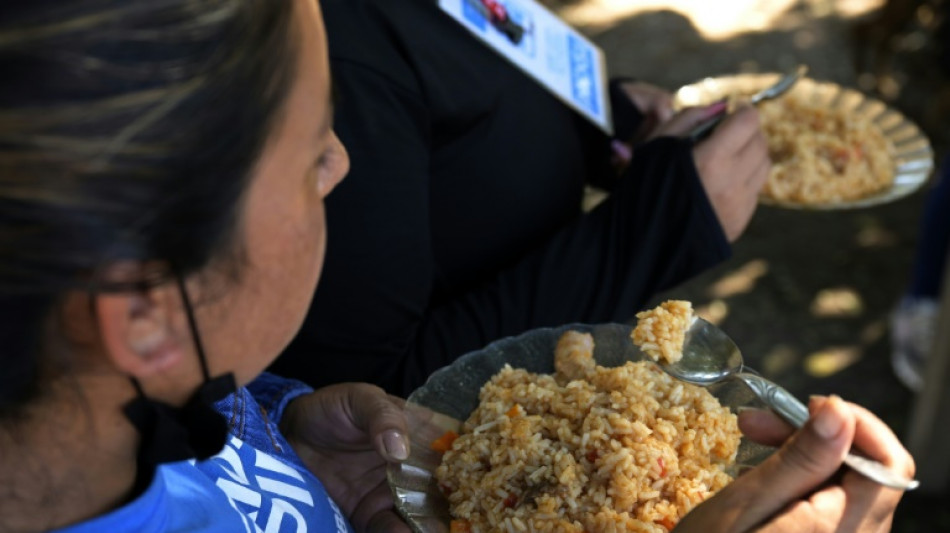
With inflation rising, millions in Argentina rely on food aid / Photo: JUAN MABROMATA - AFP

 Pegula dethrones Swiatek to reach Cincinnati final

 IndyCars zip among iconic Washington landmarks ahead of Freedom 250

 Real Madrid snatch late win at Espanyol on Mourinho's return

 Real Madrid beat Espanyol in Mourinho's first game on return
 Olise helps Bayern past Dortmund in German Supercup

 Coach Rennie hails clinical All Blacks after Springboks Test win

 Charlton deliver blow to 'under pressure' Hammers boss Nuno

 Carrick keeps calm despite Man Utd misery, big-spending Spurs crushed

 Canada's Carney stands up to Trump, despite risks

 Lens hammer Auxerre thanks to Thauvin penalty double

 No singles for Serena, but she joins Alcaraz for US Open
 Joao Pedro extends Chelsea stay with new long-term deal

 Yamaguchi to face An in hunt for fourth badminton world crown

 Norris clinches pole for Dutch GP

 Norris clinches pole for Dutch Grand Prix

 Pope Leo calls for courage in Rimini visit after stop in tiny San Marino
 Man Utd must learn from 'frustrating' defeat at Hull: Carrick

 Yamaguchi on course for fourth badminton world crown

 Man Utd humiliated by Hull in dismal start to Premier League season

 Anthropic market debut could break SpaceX IPO record: media

 Pope's 'couturier of the sacred' fueled by faith
 Duplantis locked in on 'grinding' for big bars

 Stokes says decision to leave Headingley off Ashes roster 'shambolic'

 New arrival Rodri to miss Elche opener: Barca's Flick

 Atletico's Alvarez to return against Villarreal: Simeone

Elena Gonzalez's backyard soup kitchen is a hive of activity, with busy hands chopping and stirring as a cauldron with a bit of chicken and much rice boils over a wood fire in a poor Argentina neighborhood.
Gonzalez's soup kitchen in Belen de Escobar, some 55 kilometers (34 miles) from Buenos Aires, is one of more than 1,500 in the country of 45 million.
Argentina has a long history of high inflation but is going through a particularly rough patch, worsened by the global repercussions of the war in Ukraine.
With food prices in the country rising 20 percent in just three months, a complex network of public and private organizations is required to feed millions of increasingly hungry mouths.
"The situation is getting more and more complicated," said Gonzalez, whose soup kitchen is eight years old.
From a combination of state aid, private donations, contributions from local residents, a communal vegetable garden and a few chickens, she manages to put food on the table.
Gonzalez says she cannot afford to miss a day of cooking. "The local children would come to my door to demand their plate," she told AFP.
Her soup kitchen receives help from the network Barrios de Pie (Neighborhoods on their Feet), a social movement born from the economic crisis 20 years ago, and for which the need has never abated.
It is an essential cog in the wheel of citizen mobilization topping up the public aid on which more than four million people depend, according to official figures.
Recently, the government has had to increase by 50 percent -- to between $78 and $156 per month -- the food stamps that some 2.4 million households rely on.
Another 300,000 mouths are fed at school canteens, while yet more get their daily meal from religious organizations and NGOs.
Local shops fill in some of the remaining gap, delivering unsold food to soup kitchens or sometimes directly to households in need.
- 'Hanging in there' -
"Argentina has a much larger social assistance network than other Latin American countries," sociologist Ricardo Rouvier of the University of San Andres told AFP.
But the country is facing a dilemma: It has to limit public spending because of commitments to the International Monetary Fund under a recent deal to refinance a multi-billion dollar debt.
And things are likely to get worse with the Ukraine war fueling global price inflation hot on the heels of the coronavirus pandemic's economic ravages.
A UN report on Wednesday projected GDP growth of 3.0 percent for Argentina for 2022, and warned of "sustained high inflation" and likely higher unemployment rates.
This is what makes private initiatives so critical.
But they, too, are struggling, with "inconsistent" public aid, said Silvia Saravia, coordinator of Barrios de Pie.
"We are hanging in there. We have to, because there is a need," she told AFP.
"We never know exactly what we are going to have. So, how do we survive, how do we have so many soup kitchens and social community kitchens? Partly... because the families in the neighborhood understand that by cooking together they will be able to eat better than cooking separately."
NGOs and private soup kitchens "are the real heroes of this story," said Virginia Ronco of the Munro Food Bank -- the country’s largest -- which feeds about 340,000 people a day.
"Even in situations of great vulnerability, they put a lot of heart and ingenuity into their work."
X.Matos--PC