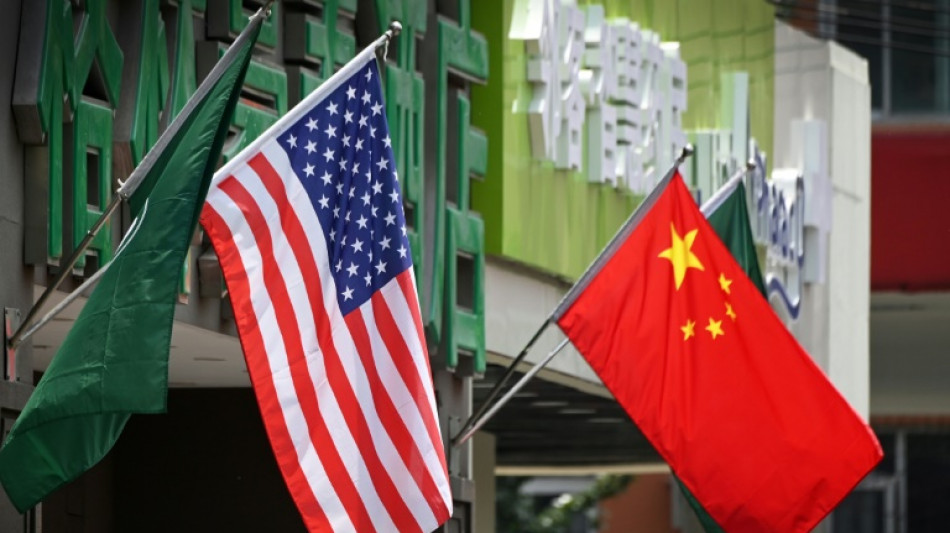
US reviewing tariffs on Chinese goods set to end in July / Photo: Greg Baker - AFP/File

 $1.8 Billion Pledged for Biodiversity at COP17 as Monaco Reaffirms Commitment

 Phoenix Symphony Resumes Performances Amid Financial Uncertainty

 Turkish Energy Minister Highlights Qatar as Key Partner for Regional and Global Energy Security

 London Museum Granted 24/7 License Ahead of November Opening

 Dana White Confirms Flight to Washington for Trump Meeting on Press Secretary Role

 Dengue Fever Expands Into High Himalayas as Climate Change Warms Nepal

 IoT Refrigerator Hacks Disrupt Blood Labs and Supermarkets Across Europe and US
American tariffs on hundreds of billions of dollars of Chinese imports are due to expire in July, but could be extended if enough industries ask for it, US officials said Tuesday.
With Americans facing the highest inflation in more than four decades and companies struggling to find key supplies, President Joe Biden has faced increasing calls to get rid of the punitive duties imposed during the trade war launched by his predecessor Donald Trump.
The tariffs were first imposed in 2018, eventually ramping up to cover about $350 billion in annual imports from China in retaliation for Beijing's theft of American intellectual property and forced transfer of technology.
The measures will lapse July 6 unless there is a request to continue them, at which point they would be subject to review.
US trade officials said Tuesday they are officially reaching out to the public to seek comment on whether to extend the tariffs, including sending letters to 600 firms that expressed support for the measures.
"Under the statute, the tariffs would expire at the four-year anniversary unless we go through this process and get a request for the continuation of action," a senior official with the office of the US Trade Representative (USTR) told reporters.
The official declined to say whether high prices would be a consideration, but said any review will look at "the effects of such actions on the United States economy, including consumers."
Foreign companies have long complained about Beijing's failure to protect know-how and patents, and in some cases forcing firms to share information with domestic partners as the price for doing business in the massive Chinese market.
Prior to Trump, US administrations had sought to resolve the issues through dialogue and gentle pressure, but Trump pulled out all the stops, sparking retaliation from Beijing on US goods.
And despite a "phase one" trade pact that took effect in February 2020, USTR Katherine Tai said the hardline measures have not "incentivized" Beijing to alter its practices.
USTR will look at input from "all stakeholders on how they view the tariffs whether they want to be increased, decreased (or) modified," another official said.
P.L.Madureira--PC

