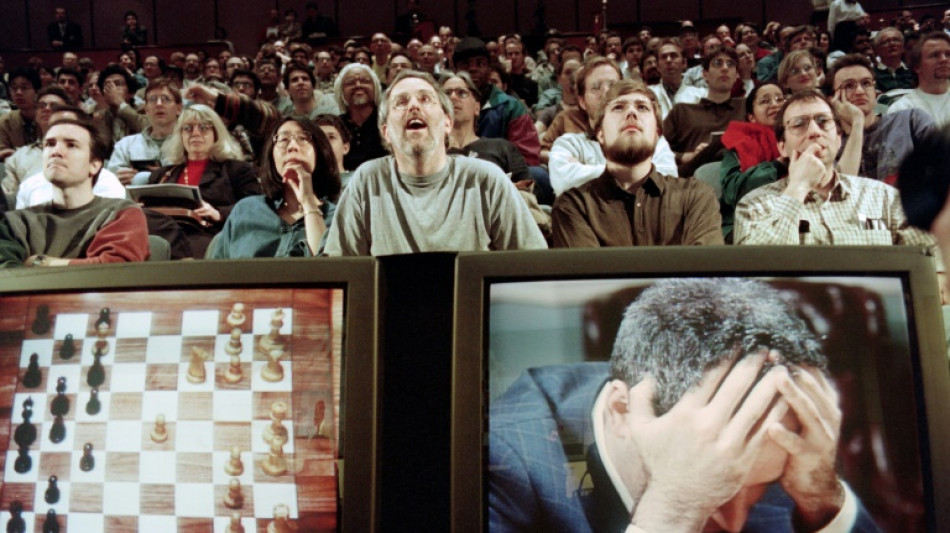
The 1997 chess game that thrust AI into the spotlight / Photo: STAN HONDA - AFP/File

 Kenyan farmers turn to bugs as organic demand grows
 'His feet are his pillars': Nepal para swimmer gives all for Asian glory

 New Zealand moves to ban social media for under-16s
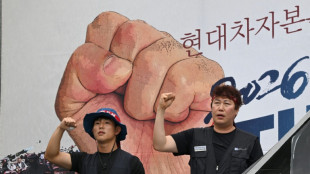 Hyundai union back in wage talks after rare full-day strike

 Shein grapples with EU backlash, but clients keep coming

 Key facts about Chinese-founded fast-fashion giant Shein

 Shein to make market debut in Hong Kong in September
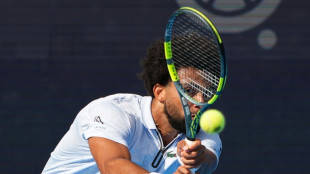 Fils tops Tiafoe to claim first ATP Masters title in Cincinnati

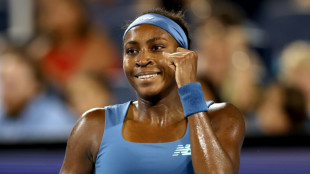 Gauff powers past Pegula to win Cincinnati WTA 1000 crown
 Ukraine backers gather as war escalates, air defence runs low

 Syria says Israel talks addressed de-escalation, staying out of Israel-Turkey tensions
 Tourism boom pushes limits of Athens air traffic control

 Liga holders Barcelona crush Elche, Atletico salvage Villarreal draw

 Spain's World Cup hero Torres saves PSG's blushes at Rennes

 Swiss forward Embolo joins Atlanta United

 Former cricket captains appeal to Pakistan over Khan health care
 Latest 'Spider-Man' tops American box office for 4th weekend

 Szoboszlai's last-gasp leveller rescues Liverpool in Newcastle draw
 Landfill collapse kills 30 in Guinea

 'Unbelievable' Cherki proves his point to Man City boss Maresca

 10-man Atletico snatch Villarreal draw as Alvarez returns
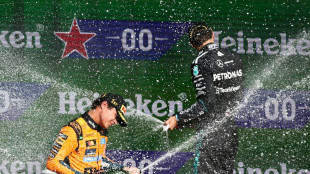
 Seville, Jefferson-Wooden roar to 100m wins at Silesia Diamond League

 VW chief warns carmaker's situation 'more than critical'

 England cricketer Carse under investigation after 'nightclub incident'
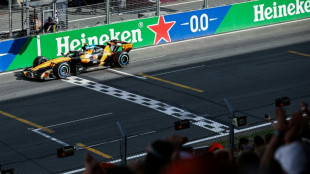 McLaren's Norris wins Dutch GP after Verstappen crash

With his hand pushed firmly into his cheek and his eyes fixed on the table, Garry Kasparov shot a final dark glance at the chessboard before storming out of the room: the king of chess had just been beaten by a computer.
May 11, 1997 was a watershed for the relationship between man and machine, when the artificial intelligence (AI) supercomputer Deep Blue finally achieved what developers had been promising for decades.
It was an "incredible" moment, AI expert Philippe Rolet told AFP, even if the enduring technological impact was not so huge.
"Deep Blue's victory made people realise that machines could be as strong as humans, even on their territory," he said.
Developers at IBM, the US firm that made Deep Blue, were ecstatic with the victory but quickly refocused on the wider significance.
"This is not about man versus machine. This is really about how we, humans, use technology to solve difficult problems," said Deep Blue team chief Chung-Jen Tan after the match, listing possible benefits from financial analysis to weather forecasting.
Even Chung would have struggled to comprehend how central AI has now become -- finding applications in almost every field of human existence.
"AI has exploded over the last 10 years or so," UCLA computer science professor Richard Korf told AFP.
"We're now doing things that used to be impossible."
- 'One man cracked' -
After his defeat, Kasparov, who is still widely regarded as the greatest chess player of all time, was furious.
He hinted there had been unfair practices, denied he had really lost and concluded that nothing at all had been proved about the power of computers.
He explained that the match could be seen as "one man, the best player in the world, (who) has cracked under pressure".
The computer was beatable, he argued, because it had too many weak points.
Nowadays, the best computers will always beat even the strongest human chess players.
AI-powered machines have mastered every game going and now have much bigger worlds to conquer.
Korf cites notable advances in facial recognition that have helped make self-driving cars a reality.
Yann LeCun, head of AI research at Meta/Facebook, told AFP there had been "absolutely incredible progress" in recent years.
LeCun, one of the founding fathers of modern AI, lists among the achievements of today's computers an ability "to translate any language into any language in a set of 200 languages" or "to have a single neural network that understands 100 languages".
It is a far cry from 1997, when Facebook didn't even exist.
- Machines 'not the danger' -
Experts agree that the Kasparov match was important as a symbol but left little in the way of a technical legacy.
"There was nothing revolutionary in the design of Deep Blue," said Korf, describing it as an evolution of methods that had been around since the 1950s.
"It was also a piece of dedicated hardware designed just to play chess."
Facebook, Google and other tech firms have pushed AI in all sorts of other directions.
They have fuelled increasingly powerful AI machines with unimaginable amounts of data from their users, serving up remorselessly targeted content and advertising and forging trillion-dollar companies in the process.
AI technology now helps to decide anything from the temperature of a room to the price of vehicle insurance.
Devices from vacuum cleaners to doorbells come with arrays of sensors to furnish AI systems with data to better target consumers.
While critics bemoan a loss of privacy, enthusiasts believe AI products just make everyone's lives easier.
Despite his painful history with machines, Kasparov is largely unfazed by AI's increasingly dominant position.
"There is simply no evidence that machines are threatening us," he told AFP last year.
"The real danger comes not from killer robots but from people -- because people still have a monopoly on evil."
V.Fontes--PC