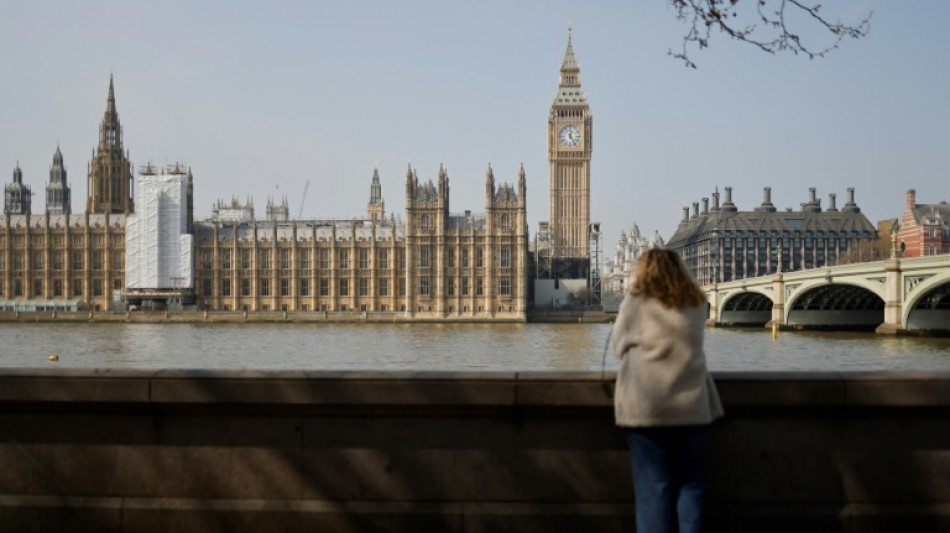
UK recession risk gathers pace as economy shrinks in March / Photo: Tolga Akmen - AFP/File

 UK PM dismisses Russian threats as Ukraine allies gather in Kyiv

 Attacks on Red Cross in DR Congo making Ebola fight 'harder'
 Oil falls ahead of US plan for economic war on Iran
 Millions of Teslas recalled in China over door handle safety

 IUX Launches New Education Webinar Series to Support Traders’ Financial Literacy

 Dutch say won't participate in 'no longer' neutral Eurovision

 Kenyan farmers turn to bugs as organic demand grows

 'His feet are his pillars': Nepal para swimmer gives all for Asian glory

 New Zealand moves to ban social media for under-16s
 Hyundai union back in wage talks after rare full-day strike

 Shein grapples with EU backlash, but clients keep coming

 Key facts about Chinese-founded fast-fashion giant Shein

 Shein to make market debut in Hong Kong in September

 Fils tops Tiafoe to claim first ATP Masters title in Cincinnati

 Gauff powers past Pegula to win Cincinnati WTA 1000 crown

 Ukraine backers gather as war escalates, air defence runs low

 Syria says Israel talks addressed de-escalation, staying out of Israel-Turkey tensions

 Tourism boom pushes limits of Athens air traffic control

 Liga holders Barcelona crush Elche, Atletico salvage Villarreal draw

 Spain's World Cup hero Torres saves PSG's blushes at Rennes

 Swiss forward Embolo joins Atlanta United
 Former cricket captains appeal to Pakistan over Khan health care
 Latest 'Spider-Man' tops American box office for 4th weekend

 Szoboszlai's last-gasp leveller rescues Liverpool in Newcastle draw

 Landfill collapse kills 30 in Guinea

Britain's economy shrank in March on fallout from soaring inflation, increasing the prospect of the country falling into recession.
Official first-quarter data on Thursday showed that following solid output in January, the UK economy posted zero growth the following month and contracted by 0.1 percent in March.
It comes after the Bank of England (BoE) last week warned that Britain risks falling into recession with UK inflation expected to top 10 percent, a four-decade high, by the end of the year.
Consumer prices are surging worldwide on supply strains as economies reopen from pandemic lockdowns -- and in the wake of the Ukraine war that is aggravating already high energy costs.
Britain's economy grew 0.8 percent overall in the January-March period, the slowest quarterly growth for a year, the Office for National Statistics (ONS) said in a statement.
It compared with gross domestic product expansion of 1.3 percent in the fourth quarter of last year.
- 'Russia disruption' -
Responding to Thursday's data, finance minister Rishi Sunak said Britain's economic recovery from the pandemic was "being disrupted by (Russian President Vladimir) Putin's barbaric invasion of Ukraine and other global challenges".
Sunak, however, added in a statement that UK "growth in the first few months of the year was strong, faster than the US, Germany and Italy".
The UK economy grew for a fourth quarter in a row, and is above pre-pandemic levels.
Prime Minister Boris Johnson said he expected British growth to "return very strongly in the next couple of years".
In an interview with LBC radio, he also refused to rule out a windfall tax on energy companies as surging oil and gas prices hit households hard.
"We'll have to look at it," said Johnson despite repeating his displeasure at such a levy.
"I don't like them... I don't think they're the right way forward," he said, adding that a windfall tax on the likes of BP and Shell would deter them from investing in greener energy.
Johnson's comments came one week after his Conservative party lost control of key councils in local elections -- an outcome blamed in part on the cost-of-living crisis.
Darren Morgan, director of economic statistics at the ONS, said declining output in the services and production sectors resulted in overall growth contracting in March.
- 'Recession risk' -
"The risk of recession has just risen," said Paul Dales, chief UK economist at Capital Economics.
He noted that the GDP figures "suggest the economy had less momentum than we thought even before the full hit from the cost-of-living crisis has been felt".
Dales said "strong price pressures will probably mean the BoE will raise interest rates further".
The central bank last week raised its main interest rate by a quarter point to one percent to tackle runaway UK inflation.
It was the fourth straight increase by the BoE, while its key rate now stands at the highest level since the global financial crisis in 2009.
Raised rates have lifted borrowing costs for consumers and businesses, further impacting spending.
R.Veloso--PC