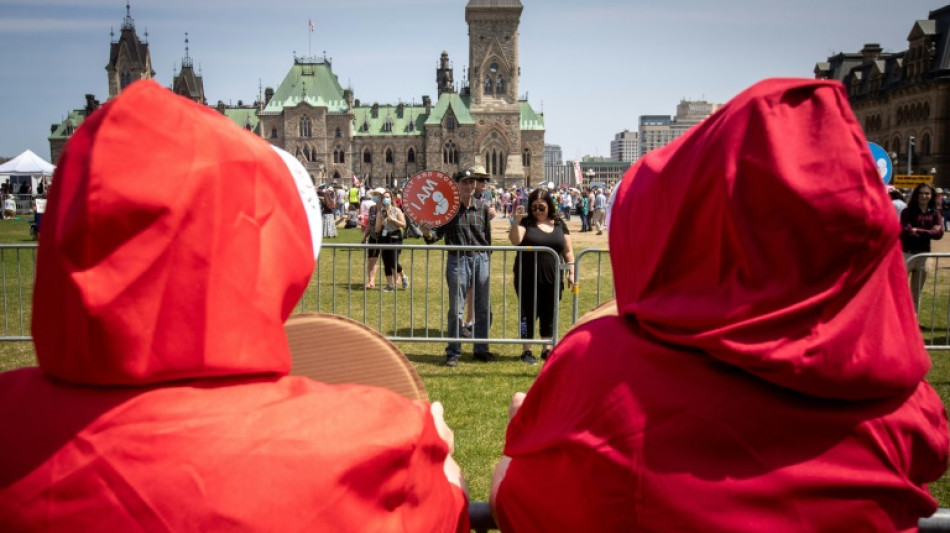
US abortion debate spills over into Canada / Photo: Lars Hagberg - AFP

 $1.8 Billion Pledged for Biodiversity at COP17 as Monaco Reaffirms Commitment

 Phoenix Symphony Resumes Performances Amid Financial Uncertainty

 Turkish Energy Minister Highlights Qatar as Key Partner for Regional and Global Energy Security

 London Museum Granted 24/7 License Ahead of November Opening

 Dana White Confirms Flight to Washington for Trump Meeting on Press Secretary Role

 Dengue Fever Expands Into High Himalayas as Climate Change Warms Nepal

 IoT Refrigerator Hacks Disrupt Blood Labs and Supermarkets Across Europe and US
Anti-abortion activists galvanized, supporters of the right to the procedure aghast and worried: a debate in the United States has spilled over the border into Canada.
Explosive revelations that the US Supreme Court's conservative majority is preparing to overturn Roe v. Wade -- the landmark ruling legalizing abortion -- has given new impetus to Canadian opponents.
A few thousand marched in Ottawa on Thursday. "I sure hope it is a turning point" in the debate, said Emily Helferty, 23, who took part in the rally with her parents.
"A lot of people have been praying for this for a really long time."
As in the United States, abortion rights in Canada are not protected by legislation, but rather by case law. In 1988, the Supreme Court of Canada struck down restrictions on abortions in the case of a doctor, Henry Morgentaler, prosecuted for providing illegal miscarriages.
In upholding his acquittal by a jury, the top court agreed with defense arguments that the law was unconstitutional on the grounds that it infringed on a woman's right to life, liberty and security of the person.
"Clearly we do not have the same legal framework as the United States because the political polarization is not as strong," said Isabelle Duplessis, a law professor and women's rights expert in Montreal.
She therefore does not expect a reversal of the Supreme Court of Canada decision, but is worried about the consequences of the debate on civil society.
"This debate will have an impact on us," she said. "It is obvious that there can be a backlash against women's rights and abortion rights in Canada."
Prime Minister Justin Trudeau's government has sought to reassure Canadians that it will protect access to abortions and raised the possibility of codifying the right.
"This is a moment where the potential of an overturning of Roe v. Wade in the US has women in Canada and around the world very worried that there is going to be a rolling back of significant gains they have made, that we have all made, in women’s right," he told a news conference Thursday.
- Obstacles in rural Canada -
In Canada, abortion is theoretically permitted throughout a pregnancy, but it is the provinces and territories that must then guarantee its availability. This is the real issue in a vast country where nearly 80 percent of the inhabitants say they are in favour of abortion rights.
"At the heart of the problem is access to hospitals practicing abortion in certain regions," said Joyce Arthur, executive director of the Abortion Rights Coalition of Canada.
On average, only one in six hospitals perform abortions. Of the hundred hospitals and clinics offering them in Canada, half are in Quebec.
And in many provinces -- Manitoba, Nova Scotia, New Brunswick, Alberta -- it is impossible to obtain an abortion in rural areas.
In New Brunswick, repeatedly singled out by the Canadian government for its relative lack of access, abortion is not reimbursed if performed outside one of its three hospitals.
Some provinces also do not reimburse the cost of the abortion pill, which was authorized for use only in 2015 after a lengthy review.
On Wednesday, the federal government announced Can$3.5 million (US$2.7 million) to increase access to abortion services.
In making the announcement, Health Minister Jean-Yves Duclos said: "The legal debate over the right to abortion is closed in this country, but that doesn't mean that the fight is over."
P.Serra--PC

