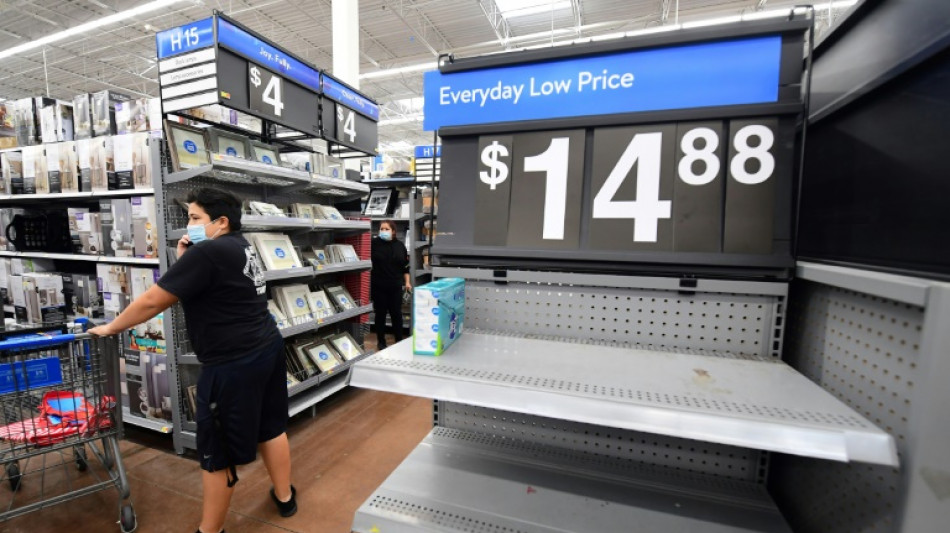
Walmart profits hit by costs as some consumers shift behavior / Photo: Frederic J. BROWN - AFP/File

 $1.8 Billion Pledged for Biodiversity at COP17 as Monaco Reaffirms Commitment

 Phoenix Symphony Resumes Performances Amid Financial Uncertainty

 Turkish Energy Minister Highlights Qatar as Key Partner for Regional and Global Energy Security

 London Museum Granted 24/7 License Ahead of November Opening

 Dana White Confirms Flight to Washington for Trump Meeting on Press Secretary Role

 Dengue Fever Expands Into High Himalayas as Climate Change Warms Nepal

 IoT Refrigerator Hacks Disrupt Blood Labs and Supermarkets Across Europe and US
Walmart reported a drop in profits Tuesday due to higher costs for labor, food and fuel as it pointed to some consumers shifting away from discretionary items amid high inflation.
Shares tumbled following the report, with profits lagging expectations as Walmart executives described a series of cost hits that converged during the period.
The company was overstaffed for part of the quarter due to the unexpectedly speedy return of workers who were afflicted by the Omicron variant of Covid-19, resulting in higher labor costs.
Walmart was also affected by a spike in energy costs when the Russian invasion of Ukraine sent oil prices soaring.
Another obstacle was a March fire that destroyed a warehouse in Indianapolis, Indiana that employed more than 1,000 people. Nobody was injured in the episode, but Walmart had to replace goods and route items through neighboring infrastructure, adding cost.
Walmart reported a 25 percent drop in profits to $2.1 billion for the quarter ending April 30. That translated into $1.30 per share, below the $1.48 expected by analysts.
Revenues rose 2.4 percent to $141.6 billion.
Walmart raised its full-year sales forecast slightly but lowered its profit forecast. It now expects earnings per share to fall one percent after previously projecting an increase in the mid-single digits.
Chief Executive Doug McMillon acknowledged on a conference call with analysts that the results were "a disappointment to us," but said, "We're looking forward to putting it behind us and having a strong year."
Walmart's revenue at its massive US namesake stores rose on average just three percent, versus a 5.6 percent jump in the quarter that ended in January, a benchmark known as comparable sales. E-commerce sales growth has also leveled off compared with earlier in the pandemic.
Executives said strong demand for pricey items such as game consoles suggest that some consumers are not cutting back due to inflation.
But other shoppers have shifted behavior as rising prices for gasoline and other necessities pressure consumers, resulting in some people steering more money to staples such as groceries and away from discretionary items such as apparel.
As a result, Walmart has been adding more promotions in general merchandise, where inventories have risen significantly from a year ago.
Another shift is in the move away from brands for lunch meats, dairy and other goods in favor of Walmart's own branded goods, which are lower-priced.
Walmart US President John Furner said the company planned to redouble efforts with food suppliers to limit future price increases.
"We need to do more to control costs, to make sure we can provide good value for our customers," Furner said on the call.
Walmart shares fell 8.0 percent to $136.32 in early trading.
Ferreira--PC

