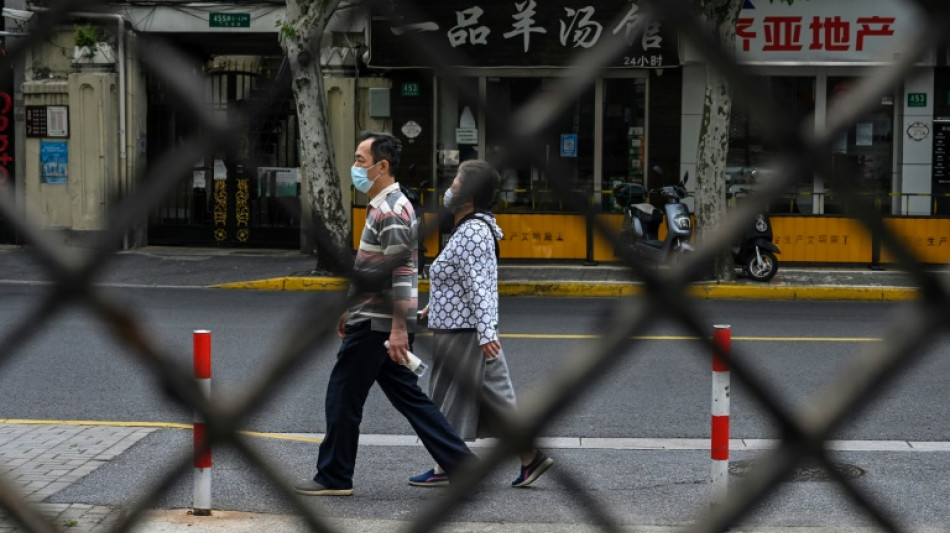
China cuts key mortgage reference rate as Covid bites / Photo: Hector RETAMAL - AFP

 $1.8 Billion Pledged for Biodiversity at COP17 as Monaco Reaffirms Commitment

 Phoenix Symphony Resumes Performances Amid Financial Uncertainty

 Turkish Energy Minister Highlights Qatar as Key Partner for Regional and Global Energy Security

 London Museum Granted 24/7 License Ahead of November Opening

 Dana White Confirms Flight to Washington for Trump Meeting on Press Secretary Role

 Dengue Fever Expands Into High Himalayas as Climate Change Warms Nepal

 IoT Refrigerator Hacks Disrupt Blood Labs and Supermarkets Across Europe and US
China on Friday announced it would cut a key interest rate in a boost to home buyers and debt-mired developers as the country's economy is slowed by Covid-19 restrictions ripping across major cities.
Prolonged virus lockdowns have constricted supply chains, quelled demand and stalled manufacturing in the last major economy welded to a zero-Covid approach to the pandemic.
The five-year loan prime rate (LPR) -- which many lenders base their mortgage rates -- was trimmed to 4.45 percent from 4.6 percent, China's central bank said on Friday.
Since the rate is "the benchmark for pricing most mortgages, we think the move is aimed at supporting housing demand," Julian Evans-Pritchard, an analyst at Capital Economics, said.
The cut "should help drive a revival in housing sales."
The one-year loan prime rate, which guides how much interest commercial banks charge to corporate borrowers, remained unchanged at 3.7 percent.
The reduction in the mortgage reference rate comes as a wave of defaults ripples through the country's real estate sector, with developers sagging under massive debts and struggling with a slump in demand.
Sunac, one of China's largest developers to default on payments in recent months, said last week that sales in major cities had fallen dramatically in March and April due to the coronavirus wave.
Economic data this week highlighted the stark impact of Covid-19 restrictions and lockdowns in many major Chinese cities.
Figures on Monday showed retail sales and factory output last month slumped the most since the start of the pandemic, while unemployment edged back toward its February 2020 peak.
The haircut to the LPR was greater than the market expected, analysts said, as China's planners try to inject life into a slowing economy.
"Monthly economic indicators published recently suggest severe growth pressure," according to Chaoping Zhu, global market strategist at JP Morgan Asset Management.
"Aside from weakness in consumption, industrial production and investment activities, the sharp decline in bank loans reveals a more fundamental challenge –- a lack of confidence among both corporate and household sectors."
Beijing's unrelenting approach to Covid-19 outbreaks has snarled supply chains and locked down tens of millions of people, hitting major financial, industrial and tourist hubs.
Borders remain closed to most foreigners and a slew of international sports events have been scrapped over pandemic concerns.
China's premier Li Keqiang on Wednesday called for government departments to "step up their sense of urgency" and said "new measures that can be used should be used" to prop up the world's second-largest economy.
China has targeted full-year growth of around 5.5 percent, but data published in April showed that first-quarter growth slowed to 4.8 percent after its economy lost steam in the latter half of last year.
G.M.Castelo--PC