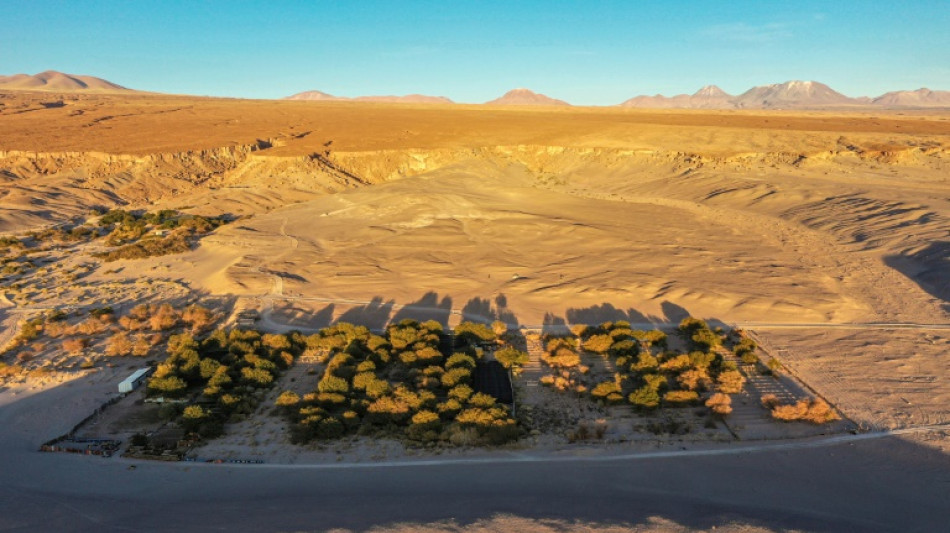
'Kind of complicated': Growing grapes in the world's driest desert / Photo: MARTIN BERNETTI - AFP/File

 What scientists know so far about Nepal's deadly floods

 US general visits Colombia to discuss war on drugs

 Meta settlement puts social media industry on notice: 'There will be more'

 NFL owners approve record Seahawks sale

 Nigerian armed groups net nearly $6 mn in ransoms: study

 Savio scores on debut as Spurs advance in League Cup

 Mbappe hits treble as Real Madrid thrash Real Sociedad

 At Dollywood, superfans honor the late singer and local hero

 Stocks mixed as oil drops, US inflation stays high

 Bolivia's Paz appoints new economy minister amid bailout talks

 US designates UK-based Palestine Action as foreign 'terrorist group'
 'Rocky Horror Picture Show' star Tim Curry dead at 80
 American Moll wins women's pole vault at Zurich city event

 As Canada takes on US tariffs, what's behind the David and Goliath fight?

 UEFA 'likely' to drop threat to boycott FIFA tournaments: source

 US disrupts platforms allegedly used by Chinese hackers

 The foreign tourists missing in Nepal's flash floods

 Hundreds missing after Nepal-Tibet flood kills 98

 CIA director was on 'semi-routine' mission in Moscow: Trump
 Aldeguer switches to Rossi's VR46 for next season

 Rent TRON Energy and Reduce USDT Fees : TronBid Expands Marketplace

 Pakistan captain Babar Azam returns against England '90 percent fit'

 Stocks mixed as oil drops, inflation stays high

 Improving standards transform pole vault as spectacle, says Duplantis

 India close in on win despite Sri Lanka fightback in second Test
In the middle of Chile's Atacama desert, the driest in the world, Hector Espindola has an unexpected job: he runs a vineyard.
Nearly 2,500 meters (8,000 feet) above sea level, his small Bosque Viejo farm produces muscat grapes -- and another of a unique "criollo," or local, variety -- in the shadow of quince, pear and fig trees irrigated by a stream fed by melting Andean snow.
Espindola, 71, farms in an oasis in the Toconao region in Chile's extreme north -- some 1,500 kilometers (932 miles) from the vineyards at the center of the world's longest country that have made it one of the world's top 10 wine exporters.
But growing grapes in the desert is no easy task.
Espindola contends with extreme day-night temperature fluctuations and extreme solar radiation on top of wind and frost.
"You have to be dedicated. I water here at night... at three in the morning, eleven at night," he told AFP while caressing his vines, dry and brown two months after the harvest.
"You have to be careful because here the heat, the climate is no joke," he said.
"Sometimes it is windy and production is lost, sometimes the frost comes early. It is kind of complicated."
- For her sons -
Espindola sends his crop to the Ayllu cooperative which since 2017 has received grapes from 18 small vineyards around Toconao.
In 2021, the cooperative received 16 tons of grapes for a yield of 12,000 bottles.
The harvest was better in 2022 with more than 20 tons of grapes -- enough for 15,000 bottles but still just a drop, at about one percent, of Chile's annual production.
Most contributors to the cooperative are members of indigenous communities who were previously individual, small-scale producers.
One of them, 67-year-old Cecilia Cruz, grows syrah and pinot noir grapes at an altitude of about 3,600 meters outside the village of Socaire -- Chile's highest vineyard.
"I feel special... to have this vineyard here and to produce wine at this altitude," she said amid the vines that still sport a few bunches of wrinkled, dried grapes.
But she has a bigger goal: "a future" for her three sons.
- 'Taste the Atacama' -
For Ayllu oenologist Fabian Munoz, 24, the mission is to create a unique wine that captures the characteristics of the volcanic rock in which the grapes grow.
"When the consumer tastes an Ayllu wine (they should) think: 'Wow! I'm tasting the Atacama desert'," he said.
Carolina Vicencio, an expert in wine chemistry, said the altitude, low atmospheric pressure and extreme temperature fluctuations make for a thicker-skinned grape.
"This generates more tannin molecules in the skin of the grape which gives a certain bitterness in the wine," she said.
"There is also higher salinity of the soil... which makes for a touch of mineralization in the mouth" that makes the Atacama desert wine one of a kind.
V.Dantas--PC