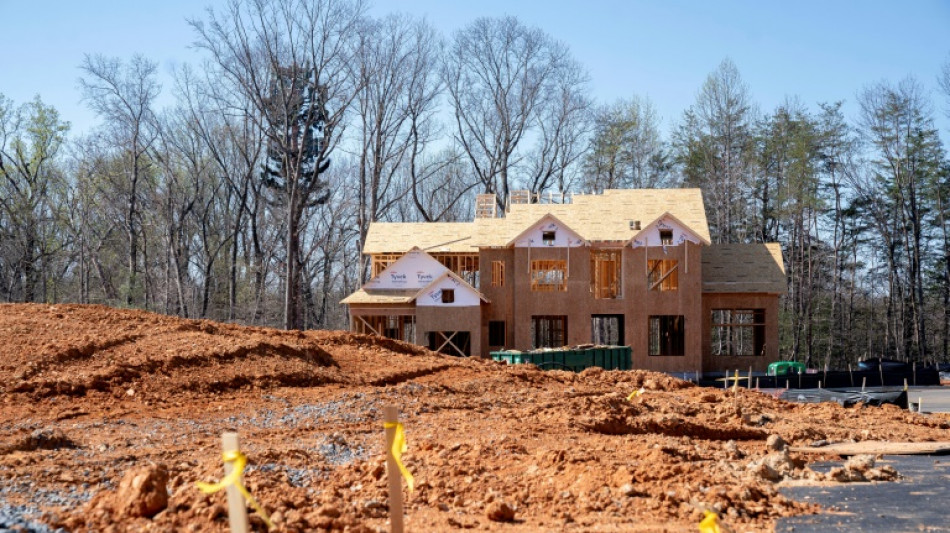
US new home sales fall sharply in April amid rising prices / Photo: Stefani Reynolds - AFP/File

 $1.8 Billion Pledged for Biodiversity at COP17 as Monaco Reaffirms Commitment

 Phoenix Symphony Resumes Performances Amid Financial Uncertainty

 Turkish Energy Minister Highlights Qatar as Key Partner for Regional and Global Energy Security

 London Museum Granted 24/7 License Ahead of November Opening

 Dana White Confirms Flight to Washington for Trump Meeting on Press Secretary Role

 Dengue Fever Expands Into High Himalayas as Climate Change Warms Nepal

 IoT Refrigerator Hacks Disrupt Blood Labs and Supermarkets Across Europe and US
US new home sales plunged in April to their lowest in two years, even as prices continued to climb, according to government data released Tuesday, as would-be buyers felt the heat of soaring inflation and rising interest rates.
Home sales have been booming throughout the Covid-19, but with inflation at its highest since the early 1980s, the Federal Reserve has begun raising interest rates aggressively to cool the economy, which is pushing borrowing costs higher.
Sales of new single-family homes fell 16.6 percent in April to an annual rate of 591,000, seasonally adjusted, the Commerce Department reported, the lowest rate since April 2020.
The decline was far worse than analysts had projected, and compounded by the downward revision to the sales figures for March.
"It's pretty scary," said Gregory Daco, chief economist at Ernst & Young.
"I was expecting a decline, but not this steep a drop," he told AFP, noting that new home sales had slowed for the fourth consecutive month.
All regions saw sales fall sharply, though the South saw the steepest decline.
Last month's sales pace was a 26.9 percent drop compared to April 2021, the report said.
However, even amid higher borrowing costs that are cooling demand from homebuyers, prices continued to rise in April, reaching a median of $450,600 from $435,000 in the prior month.
The popularity of remote work as well as increased household savings during the pandemic prompted many families to move out of congested urban areas and purchase larger houses or vacation homes.
The surge in demand sent prices soaring as potential homebuyers competed to snap up properties -- even paying cash -- in an increasingly tight market hindered by global supply chain snarls that held back new construction.
- 'Recession warning' -
Home sales are a key driver of activity, spurring sales of many categories of goods, including furniture and appliances, so a slowdown could have broader effects on the economy, economists say.
"The April drop for new home sales is a clear recession warning," said Robert Dietz, chief economist at the National Association of Home Builders (NAHB).
"While the nation needs additional housing, home sales are slackening as tightening monetary policy continues to put upward pressure on mortgage rates and supply chain disruptions raise construction costs."
As the sales pace dropped sharply, the supply of new homes on the market rose last month, jumping to a nine months' supply from 6.9 months in April, the report said.
Existing home sales have also slowed over the past several months, falling 2.4 percent in April, the National Association of Realtors (NAR) reported last week.
The average rate on a 30-year, fixed-rate mortgage was 4.98 percent in April, up from 4.17 percent in March, and far above the 2021 average of 2.96 percent, according to Freddie Mac.
"Higher mortgage rates and lofty prices are making housing more expensive, particularly for first-time buyers," said Oren Klachkin, the lead US economist at Oxford Economics. "Looking ahead, income gains won't keep up with rising borrowing costs and elevated home prices, pushing down affordability and pressuring home sales."
"Builders will add to the housing stock, but not sufficiently enough to meaningfully tilt housing market dynamics in favor of buyers."
A.Santos--PC

