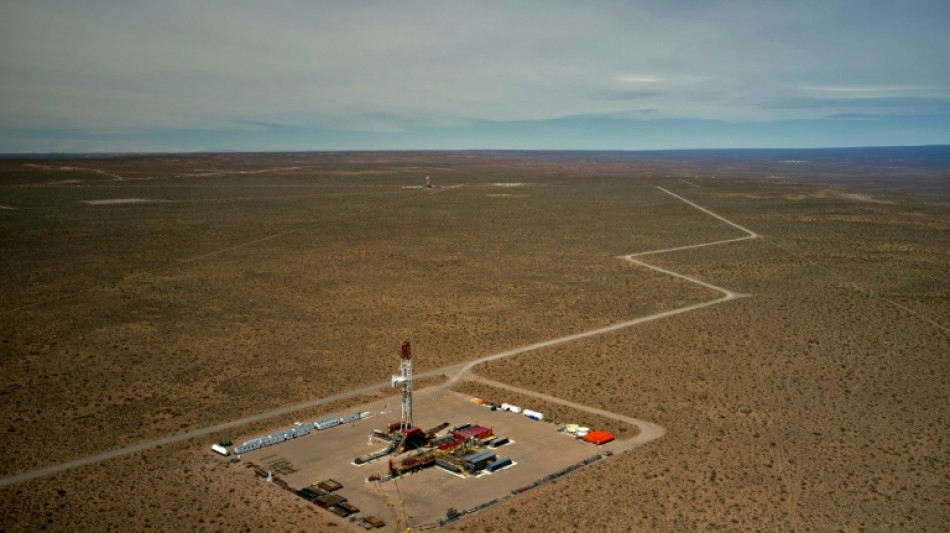
Argentina to ease exchange control for oil and gas companies / Photo: Emiliano Lasalvia - AFP

 $1.8 Billion Pledged for Biodiversity at COP17 as Monaco Reaffirms Commitment

 Phoenix Symphony Resumes Performances Amid Financial Uncertainty

 Turkish Energy Minister Highlights Qatar as Key Partner for Regional and Global Energy Security

 London Museum Granted 24/7 License Ahead of November Opening

 Dana White Confirms Flight to Washington for Trump Meeting on Press Secretary Role

 Dengue Fever Expands Into High Himalayas as Climate Change Warms Nepal

 IoT Refrigerator Hacks Disrupt Blood Labs and Supermarkets Across Europe and US
Argentina on Tuesday announced an easing of foreign exchange controls for the shale oil and gas industry in a bid to promote investment and boost production.
In an area known as Vaca Muerta in Patagonia, Argentina has what is considered the second-largest shale gas reserve in the world and the fourth largest of shale oil.
Extraction has been hampered by a lack of much-needed but costly investment, especially for hydraulic fracking.
On Tuesday, Economy Minister Martin Guzman said "a special regime for currency access" would be put in place for the hydrocarbon industry "to guarantee the special equipment they require," especially for fracking.
About 20 oil companies have been operating in Vaca Muerta since 2013, including Chevron, Shell, Total and Statoil in partnership with the Argentine oil company YPF.
Since September 2019, Argentina has had exchange controls in place with a limited official rate of about 120 pesos for one dollar.
At the same time, currency can be exchanged at a rate of some 200 pesos to the dollar through debt bonds or on the informal market.
"We have a great opportunity in energy in Argentina. The next 15 years have great potential for development," said President Alberto Fernandez, on a working trip with Guzman.
The government says oil production can increase by 70 percent and gas production by 30 percent over the next five years.
In recent months, Argentina has increased its production of hydrocarbons to reach a record 578,000 barrels per day in April -- an increase of 13 percent in 12 months, according to the government.
Gas production in the same month was 127 million cubic meters, an increase of 12 percent year-on-year.
That has allowed the country to reverse five years of decline in oil production, said Guzman.
Last month, the government launched a construction tender phase for a gas pipeline from Vaca Muerta to the north of the country, to increase domestic supply and exports at a time when worldwide energy costs have shot up due to the war in Ukraine.
E.Paulino--PC

