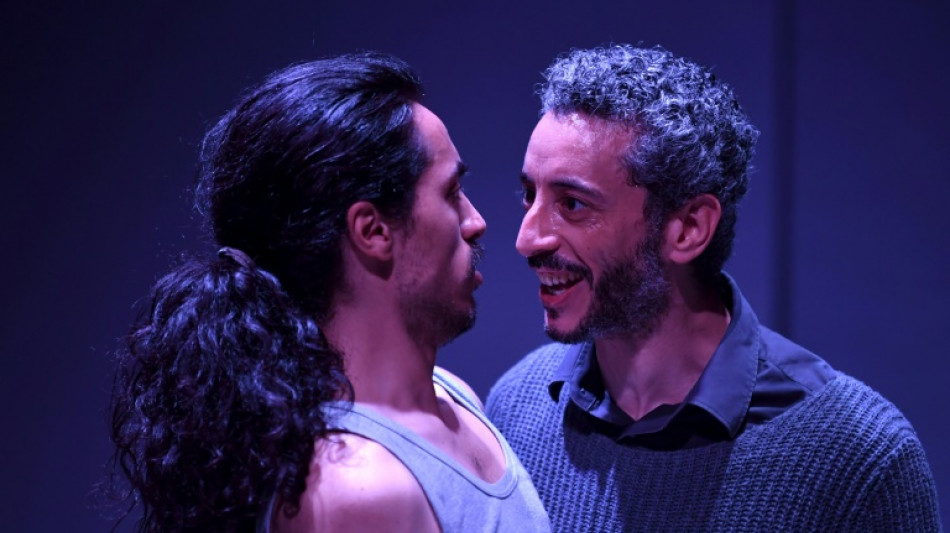
Tunisia's first LGBTQ play lifts curtain on hidden violence / Photo: FETHI BELAID - AFP

 $1.8 Billion Pledged for Biodiversity at COP17 as Monaco Reaffirms Commitment

 Phoenix Symphony Resumes Performances Amid Financial Uncertainty

 Turkish Energy Minister Highlights Qatar as Key Partner for Regional and Global Energy Security

 London Museum Granted 24/7 License Ahead of November Opening

 Dana White Confirms Flight to Washington for Trump Meeting on Press Secretary Role

 Dengue Fever Expands Into High Himalayas as Climate Change Warms Nepal

 IoT Refrigerator Hacks Disrupt Blood Labs and Supermarkets Across Europe and US
It's the first queer play to be staged in Tunisia -- director Essia Jaibi's latest work aims to challenge conservative attitudes in a country where same-sex acts are punishable by prison terms.
"Flagranti" (or "In the Act"), which premiered at a city-centre theatre in the capital at the weekend, deals with "a reality that we pretend not to see", Jaibi told AFP.
The work, co-produced by LGBTQ rights group Mawjoudin (translating to "we exist"), is played by six mostly amateur actors aged between 23 and 71, reflecting a decades-long struggle for gay rights in the North African country.
Infused with black humour, it tells the stories of people who have suffered violence at home, in the workplace and in public.
Tunisia is seen as relatively liberal on social issues compared with other Arab countries, but nevertheless imposes sentences of up to three years in prison for "sodomy" for both men and women.
The country saw a rise in public LGBTQ rights activism in the years following its 2011 revolution that kicked off the Arab Spring uprisings.
But despite years of efforts, rights groups say the community is still vulnerable, with as little as a photo on a telephone potentially leading to arrest, physical violence and anal examinations.
The notorious Article 230 of the penal code saw 59 people jailed between early 2020 and last October, according to Mawjoudin.
The play, inspired by real events, "talks about a taboo subject, a reality that in Tunisia we keep pretending not to see, which this show is trying to bring to the public's attention," Jaibi said.
Mawjoudin member Karam Aouini said the play aims to challenge "discriminatory" mentalities and campaign for an end to a "backward law", as well as promote queer art.
The NGO also organised Tunisia's first queer cinema festival in 2018.
- 'Historic moment' -
The two-hour play deals not only with LGBTQ issues, but also other problems facing all Tunisians: police and judicial corruption, impunity and the brain drain as people leave to seek better economic prospects in Europe and elsewhere.
When the play ended, the audience erupted into a storm of applause.
For audience member Alay Aridhi, 27, the event was "a historic moment" for Tunisia.
"Holding an event like this in an Arab, Muslim country isn't easy," he said. "It seems we can now tell these stories."
Salim, a 24-year-old member of the LGBTQ community, said the play had touched him deeply.
"I saw my life on the stage. It was overwhelming, I had a lump in my throat," he said.
Rights groups are continuing to campaign for an end to Article 230, first introduced by French colonial administrators in 1913.
But with parliament dissolved and the country in political turmoil after President Kais Saied's power grab last year, no such move is on the radar for now.
The United Nations Committee Against Torture has condemned Tunisia's use of anal tests.
The country in 2017 committed to ending the practice, but it has continued nonetheless.
In December, two men were found guilty of same-sex acts after they refused to undergo such examinations -- seen by judges as proof of their guilt.
The Tunisian president, whose July power grab allowed him to issue laws and seize control of the judiciary, has said he is opposed to jail terms based on sexual orientation -- but also to the full decriminalisation of homosexuality.
Actor Hamadi Bejaoui, who portrayed a doctor named Adam in the production, described it as a "harsh experience that shows a human being crushed".
But despite this, he remains determined.
"We will not back down. The fight continues!" he said.
F.Moura--PC

