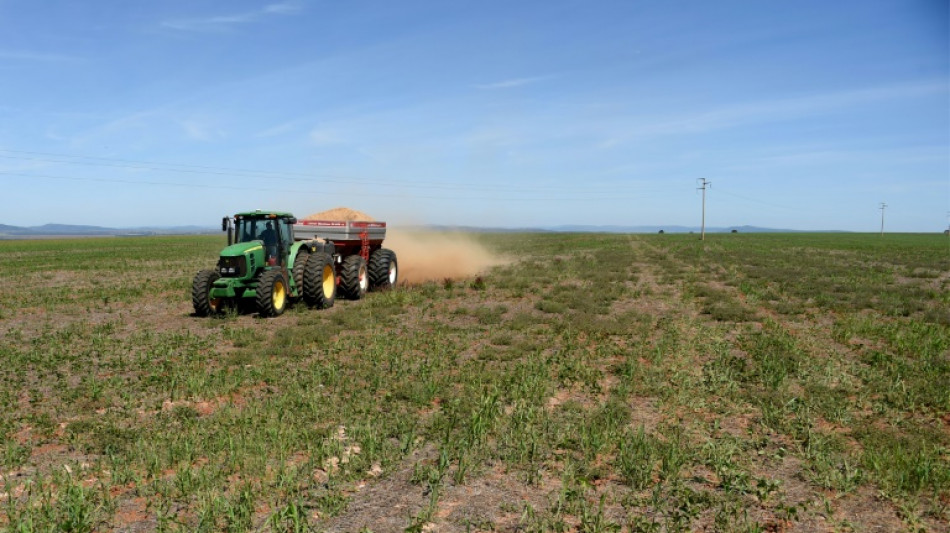
Ukraine war pushes Brazil toward natural fertilizers / Photo: EVARISTO SA - AFP

 Fed's Cook rejects Trump mortgage fraud claims

 Police probe 'assault allegations' after Carse's nightclub incident

 How we might hear new Dolly Parton music in the future

 Nvidia doubles revenue, forecasts even more AI spending

 Canada renews push to boycott US products

 Savio scores on debut as Spurs set-up League Cup tie with Liverpool

 Brazil sues Discord over child safety measures, demands $100 mln in damages

 Alberta NDP Urges Smith to Postpone Separation Vote Amid Trade War

 Fenerbahce stun Lyon in Champions League as AEK crush Levski

 Why Global Finance Still Relies on Wall Street Despite Diversification Trends

 Bethlehem Father Seeks Aid for Special Needs Children Amid Health Crisis

 LIV Golf to lay off majority of staff

 How narwhal 'scientists' track Arctic warming

 Iran says US sanctions will achieve nothing

 Essential Dolly: five key Parton songs

 Veteran promoter Warren says it's Joshua's job to agree Fury fight

 Ex-champ Wawrinka gets last-minute wildcard to US Open

 Brennan blasts to Vuelta stage five victory, Pogacar holds lead
 What could change for US teens on Instagram and Facebook
 Meta, US states agree $16.7 bn settlement in landmark teen safety case

 'Point of no return' if Israel-Hamas truce fails: US envoy to Gaza board

 Barcelona holding out hope for Alvarez as Atletico resist sale

 Werro basks in new status, shelves world record talk

 Bill Gates warns world unprepared for AI upheaval

 Prince Harry and family arrive back in Britain: UK media

Fearing Russia's invasion of Ukraine will disrupt its crucial supply of fertilizer imports, agricultural powerhouse Brazil is increasingly turning to natural alternatives.
Brazil, a top producer of soy, corn, cotton, sugarcane and coffee, is the world's fourth-biggest consumer of so-called "NPK" chemical fertilizers -- nitrogen-, phosphorus- and potassium-based.
It imports around 80 percent of its total supply -- and 25 percent of that from Russia, whose exports have now been targeted by Western sanctions over the Ukraine invasion.
That is causing farmers in the South American giant to turn to alternatives, including remineralizers, or "agrominerals" -- pulverized, nutrient-rich rocks that are spread on fields before planting.
Brazil, which authorized remineralizers for agricultural use in 2013, is the world leader in the technique, which is also used in the United States, Canada, India and France, among others.
"Brazil is a tropical country, and the rains tend to wash away soil nutrients. Rock powder rebuilds the soil and renews it," says Marcio Remedio, mineral resources director at the Brazilian Geological Service.
The technique also "allows plants' roots to develop better and capture the nutrients they need to grow," says Suzi Huff Theodoro, a geologist at the University of Brasilia.
"We have rocks with the right profile in various parts of the country, and the cost is significantly cheaper" than chemical fertilizers, she told AFP.
- Beyond chemicals -
A study last year found around five percent of farmland in Brazil used remineralizers.
That figure looks set to jump this year: the country's 30 suppliers report they are seeing unprecedented demand, says Theodoro.
"Most of them have already sold their entire output for the year, to all kinds of farms -- from industrial to mid-sized to small and mostly ecologically minded," she says.
Farmer Rogerio Vian has almost stopped using chemical fertilizers altogether.
Vian, who runs a 1,000-hectare (nearly 2,500-acre) soy and corn farm in the central-western state of Goias, was an early adopter of alternative technologies.
He started out nine years ago making his own products from microorganisms found in native forests.
He pulverized them and applied them while planting to protect against parasites and help his crops absorb nutrients.
Now Vian, who founded the 700-member Association for Sustainable Agriculture (GAAS), is using remineralizers, too.
"I've cut my fertilizer and seed treatment costs by 50 percent, with no loss of productivity," he says.
"Brazil is a mega-biodiverse country, and that holds enormous potential in terms of tools and techniques for our work, which we're only just starting to discover."
- 'Unstoppable change' -
Brazil will still be using NPK fertilizers for the foreseeable future, but it could dramatically reduce its dependence on foreign suppliers, says researcher Jose Carlos Polidoro of the state-owned Brazilian Agricultural Research Corporation (Embrapa).
"Organic and organomineral fertilizers -- made with mining residue, organic agro-industrial residue and sewage sludge -- account for five percent of the Brazilian fertilizer market today," he says.
"But they have the potential to reduce our imports by 20 percent."
Another fast-growing technique: treating crops with rhizobacteria, which draw nitrogen from the air and deliver it directly to plants, helping them grow -- and reducing the consumption of industrial nitrogen-based fertilizers.
Not that the farmers rapidly adopting these products have an easy row to hoe.
"Farmers are running into difficulty finding financing to invest more, and there's a shortage of technical assistance available," says Carlos Pitol, an agricultural consultant in the central-western state of Mato Grosso do Sul and a member of GAAS.
"But the change in the production system is growing, and it's unstoppable."
A.Silveira--PC