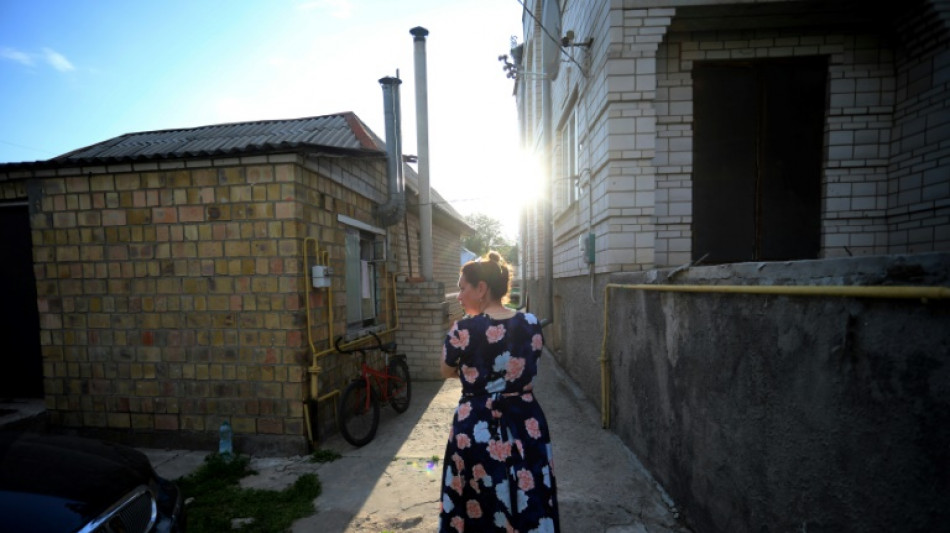
For Ukraine's Roma, discrimination adds to agonies of war / Photo: Aleksey Filippov - AFP

 Once a top export, prized Kashmir carpet fades

 Search for 1,000 missing after deadly Nepal-Tibet floods
 Park So-yeon first woman to play for eSports powerhouse South Korea
 Yayoi Kusama: Japan's kaleidoscopic, troubled 'polka dot queen'
 Euro champ Hunt 'on her toes' against world's best in Zurich 100m
 Asian chip firms lifted by Nvidia forecast but broader markets struggle

 Search for missing after Nepal-Tibet floods kill 165
 Qantas says profits slump as fuel costs surge
 Lofty bond yields, Bessent's intervention pose challenge to Fed's Warsh

 The foreigners missing in Nepal's flash floods

 Bond yields are surging: Here's why that could spell trouble
 Fed's Cook rejects Trump mortgage fraud claims
 Police probe 'assault allegations' after Carse's nightclub incident
 How we might hear new Dolly Parton music in the future

 Nvidia doubles revenue, forecasts even more AI spending

 Canada renews push to boycott US products

 Savio scores on debut as Spurs set-up League Cup tie with Liverpool
 Brazil sues Discord over child safety measures, demands $100 mln in damages

 Alberta NDP Urges Smith to Postpone Separation Vote Amid Trade War

 Fenerbahce stun Lyon in Champions League as AEK crush Levski

 Why Global Finance Still Relies on Wall Street Despite Diversification Trends
 Bethlehem Father Seeks Aid for Special Needs Children Amid Health Crisis
 LIV Golf to lay off majority of staff
 How narwhal 'scientists' track Arctic warming
 Iran says US sanctions will achieve nothing
Forced to flee fighting, Lyudmyla was assured the authorities would rehouse her in a town in western Ukraine. But when she arrived, they took one look at her and turned her away.
"On the phone, it was OK. We agreed on the room. But when I arrived, they saw my dark skin and refused to give me shelter," she said.
A member of the Roma minority, this 59-year-old -- who prefers not to give her family name -- is by her own admission "a success story", being one of the few members of her community to have had an education.
And the same is true of her daughter, Ilona, who is a lawyer.
Together, they refused to be turned away, threatening to file a complaint, and only after a full day of haggling obtained the keys to the room where they spent one month along with Ilona's mother-in-law and three children.
"If I hadn't been educated, we would have had to sleep on the street or in the railway station," explained Lyudmyla, who has now returned to her home in Trebukhiv just to the west of Kyiv after Russian troops pulled back from the area to focus on southern and eastern Ukraine.
Like her, many of Ukraine's Roma population say they have struggled to access shelter and the aid that has poured in to the country since the Russians invaded on February 24.
- Rare complaints -
Census figures suggest there are some 50,000 Roma people in Ukraine, but rights groups say the figure is closer to 400,000.
"The biggest problem is housing: People don't want to host Roma families," says Julian Kondur of Chiricli, an international Ukraine-based charity that supports Roma women.
Like in many countries, long-held prejudices about the Roma people have fuelled a fear of them, he says.
On Wednesday, Human Rights Watch accused neighbouring Moldova of "deliberately housing most Roma refugees separately from others fleeing the war in Ukraine", denouncing the move as "unequal and discriminatory treatment".
Through its hotline, Chiricli has collected many testimonies about what happened during evacuations.
"A bus was about to leave (the northeastern city of) Kharkiv and the driver said 'no' to a Roma family," says Kondur, citing just one example.
"Sometimes, Roma themselves are so used to discrimination that they accept it as normal" and rarely complain, he says.
Lyudmyla initially told AFP she did not experience any discrimination, before then relating her experience.
Though she struggled to find shelter in western Ukraine, during the first two weeks of the war, Lyudmyla had offered refuge to around 50 other Roma in her basement.
Dressed in a long flowery dress, she recalled the fear and winter chill of those early days.
"Ten kilometres from here, there were Russian tanks and very heavy explosions. It was really scary," she said.
And it was so cold that one of her grandchildren became seriously ill.
- 'We're suffering too' -
Aside from the lack of solidarity shown towards their community, the Roma have also struggled to access certain types of aid because they do not have the right papers.
To avoid repression under the Soviet regime, the Roma did not register with the local authorities, and many do not have identity documents, birth certificates or passports to prove citizenship.
"At the time, there was a saying: If you don't have a passport, you don't have problems," Kondur says.
Since Ukraine became independent in 1991, many Roma people have moved to register, but around 30,000 still have not, putting them at a further disadvantage in wartime.
"Inevitably, you need to have identity documents to get food packages, to get financial support both from the government and the UN," he explains.
For all these reasons, Roma tend "to find help within their own community", says Valentina Zolotarenko, who works as a mediator to help her people access public services.
"On television, you see only Ukrainians, but we're suffering too," says the 59-year-old, who was born in Russia.
But "despite the bombs, I prefer being a Ukrainian Roma than a Russian one," she adds.
"It's far worse there for my community."
E.Borba--PC