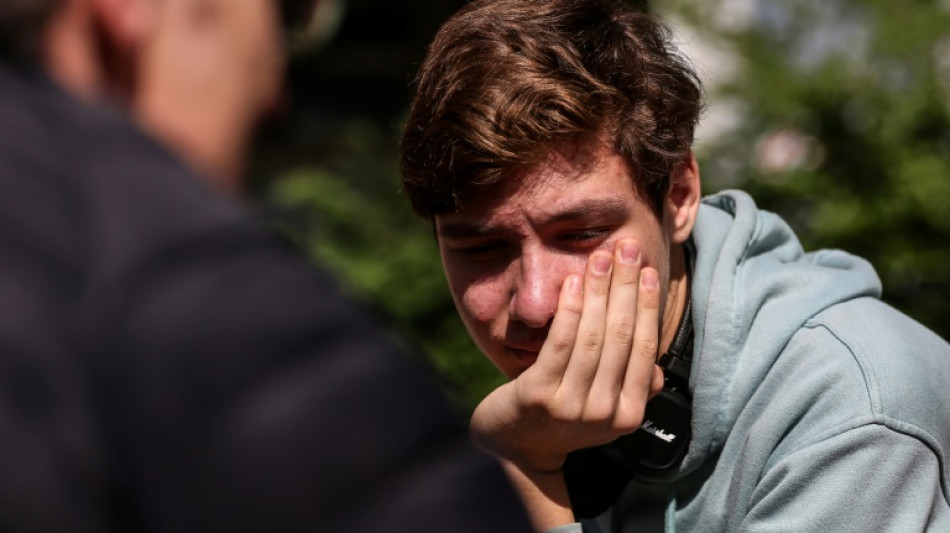
War pushes Ukrainian teen towards Belgian future / Photo: Valeria Mongelli - AFP

 $1.8 Billion Pledged for Biodiversity at COP17 as Monaco Reaffirms Commitment

 Phoenix Symphony Resumes Performances Amid Financial Uncertainty

 Turkish Energy Minister Highlights Qatar as Key Partner for Regional and Global Energy Security

 London Museum Granted 24/7 License Ahead of November Opening

 Dana White Confirms Flight to Washington for Trump Meeting on Press Secretary Role

 Dengue Fever Expands Into High Himalayas as Climate Change Warms Nepal

 IoT Refrigerator Hacks Disrupt Blood Labs and Supermarkets Across Europe and US
Three months ago, Mykyta never would have thought he'd be hoping to study for an engineering degree at a Belgian university.
But, like so many other Ukrainians who have left their homeland as it endures Russia's military assault, his dreams had to change.
Now, the 17-year-old is one of 22 Ukrainians attending a class for new arrivals at the Technov technical college in Vilvoorde, a Dutch-speaking suburb of Brussels.
While some of his schoolmates are pinning their hopes on returning to Ukraine soon, once the situation permits, Mykyta is intent on seeing through university in Belgium.
"I want to go to university at the end of this year, I want to go to an engineering programme, maybe in the electricity direction," he told AFP.
The degree would be in English, and to get there Mykyta is already taking classes to boost his fluency, preparing for an English language certificate required for the intake.
"I think I can improve my English and can get good work," he said.
Mykyta was on vacation in Egypt with his parents and his sister when Russia invaded Ukraine on February 24.
Unable to return to their home city of Kyiv, their father took the family to stay with relatives in Belgium, then went back to Ukraine alone in March, Mykyta said.
His mother and sister hope to return in the coming months, but Mykyta plans to find a part-time job to pay for rent and stay in Belgium.
"Most of the Ukrainians are here with their mothers (because) generally their fathers and brothers stayed," said Marc Deldime, the head of the Technov college.
For the past two decades, his Catholic high school has operated transition classes for foreigners newly arrived in Belgium who need intensive teaching in Dutch to join the education system.
Currently, out of its 430 students, 60 are foreign.
Before the Ukrainians arrived, the school corridors echoed with languages from other war-torn countries, including Syria and Afghanistan.
The teachers are trained to detect signs of trauma among the children, and can call on psychologists if needed, Deldime explained.
But, so far, he said the Ukrainian children are doing well, and "the school lets them forget a bit about the war".
Alongside Mykyta, 14-year-old Ukrainian Lisa said she too was on vacation when the war started and found it impossible to return to Ukraine. Her father called on friends in Belgium to help them.
While she is still too young to chart a course for higher education, Lisa said she also plans to find casual work in Belgium.
"I think maybe as a waitress in a cafe, doing waffles or ice creams," she said.
H.Silva--PC

