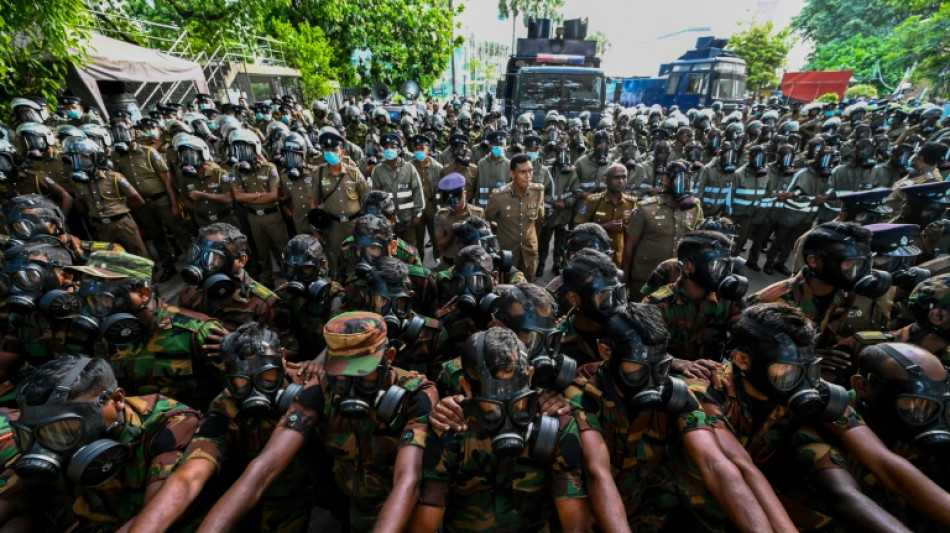
Sri Lanka police tear-gas students in fresh clashes / Photo: ISHARA S. KODIKARA - AFP

 $1.8 Billion Pledged for Biodiversity at COP17 as Monaco Reaffirms Commitment

 Phoenix Symphony Resumes Performances Amid Financial Uncertainty

 Turkish Energy Minister Highlights Qatar as Key Partner for Regional and Global Energy Security

 London Museum Granted 24/7 License Ahead of November Opening

 Dana White Confirms Flight to Washington for Trump Meeting on Press Secretary Role

 Dengue Fever Expands Into High Himalayas as Climate Change Warms Nepal

 IoT Refrigerator Hacks Disrupt Blood Labs and Supermarkets Across Europe and US
Police fired tear gas to disperse thousands of students trying to storm the Sri Lankan president's home Sunday as the government offered an olive branch to demonstrators demanding his resignation.
Anti-riot squads used water cannon followed by tear gas, as protesters pulled down yellow iron barricades across a road leading to President Gotabaya Rajapaksa's official residence in Colombo.
Nearby, thousands of men and women demonstrated for the 51st straight day outside Rajapaksa's seafront office on Sunday, demanding that he step down over the country's worst economic crisis since independence.
Prime Minister Ranil Wickremesinghe went on national television on Sunday evening offering young protesters a greater say in how the country is administered.
"The youth are calling for a change in the existing system," Wickremesinghe said, laying out plans for 15 committees that would work with parliament to decide national policies.
"I propose to appoint four youth representatives to each of the 15 committees," he said, adding that they could be drawn from the current protestors.
Wickremesinghe is not from Rajapaksa's party, but was given the job after the president's elder brother Mahinda resigned as prime minister on May 9 after weeks of protests, when no other legislator agreed to step in.
Wickremesinghe is the sole parliamentary representative of the United National Party, a once-powerful political force that was nearly wiped out in Sri Lanka's last elections.
Rajapaksa's party, which has a majority in the legislature, has offered to provide him with the necessary support to run a government.
Sunday's student action came a day after a similar clash when protesters tried to storm Rajapaksa's heavily guarded colonial-era official residence, where he has bunkered down since thousands surrounded his private home on March 31.
An unprecedented shortage of foreign exchange to import even the most essential supplies, including food, fuel and medicines, has led to severe hardships for the country's 22-million population.
The government last month asked the IMF for urgent financial assistance and talks are still underway.
The country has also defaulted on its $51-billion foreign debt.
Its currency has depreciated by 44.2 percent against the US dollar this year, while inflation hit a record 33.8 percent last month.
P.Cavaco--PC

