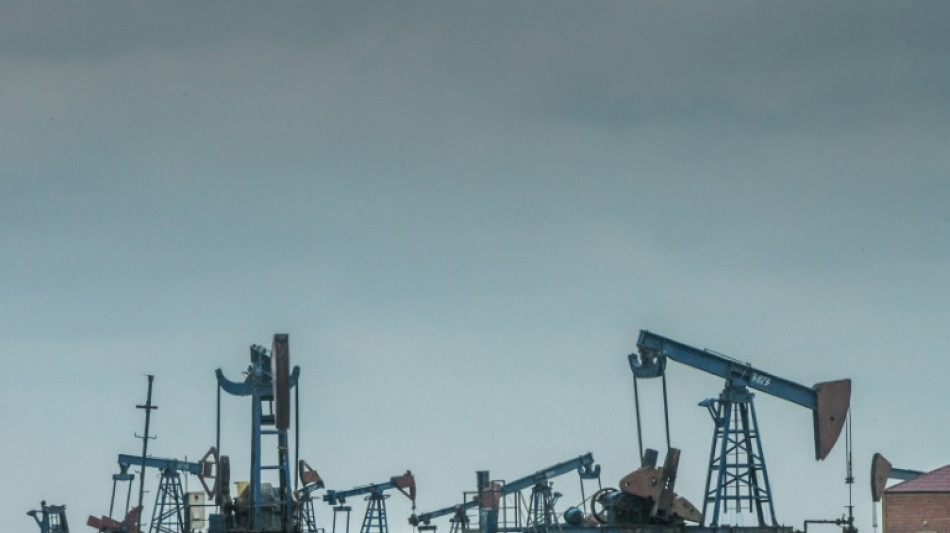
EU seeks to break deadlock on Russian oil ban before summit / Photo: Mladen ANTONOV - AFP/File

 $1.8 Billion Pledged for Biodiversity at COP17 as Monaco Reaffirms Commitment

 Phoenix Symphony Resumes Performances Amid Financial Uncertainty

 Turkish Energy Minister Highlights Qatar as Key Partner for Regional and Global Energy Security

 London Museum Granted 24/7 License Ahead of November Opening

 Dana White Confirms Flight to Washington for Trump Meeting on Press Secretary Role

 Dengue Fever Expands Into High Himalayas as Climate Change Warms Nepal

 IoT Refrigerator Hacks Disrupt Blood Labs and Supermarkets Across Europe and US
Ambassadors from the 27 European Union member states on Sunday examined a compromise that could enable them to break the deadlock on a Russian oil embargo ahead of an emergency summit in Brussels this week.
The bloc's officials fear the absence of an agreement will cast a shadow over the two-day meeting starting Monday between European leaders.
Ukrainian President Volodymyr Zelensky will address the gathering by video link to press the bloc to "kill Russian exports" three months after the invasion of Ukraine.
The latest round of proposed sanctions by the EU has been blocked by landlocked Hungary, which has no access to seafaring oil cargo ships.
Hungary is dependent for 65 percent of its oil needs on Russian crude supplied via the Druzhba pipeline, which runs from Russia to various points in eastern and central Europe.
Budapest has rejected as inadequate a proposal to allow it two years longer than other EU states to wean itself off Russian oil.
It wants at least four years and at least 800 million euros ($860 million) in EU funds to adapt its refineries to process non-Russian crude and boost pipeline capacity to neighbouring Croatia.
Slovakia and the Czech Republic, also supplied by the Druzhba pipeline, accepted exemptions of two and half years, diplomatic sources said.
The compromise solution put to national negotiators on Sunday consists of excluding the Druzhba pipeline from a future oil embargo and only imposing sanctions on oil shipped to the EU by tanker vessel, European sources said.
The Druzhba pipeline accounts for a third of all EU oil supplies from Russia. Maritime cargos account for the remaining two thirds.
- 'Much less painful' -
The compromise was tabled by France, which currently holds the rotating EU presidency, and by the European Council, which represents the governments of the EU nations.
Its aim is to break a stalemate that has, since early May, prevented the EU from imposing a sixth round of sanctions on Moscow over its war in Ukraine.
This embargo on sea deliveries would involve stopping purchases of oil within six months and of petroleum products by the end of the year.
It would also impose additional sanctions on Russian banks and expand the list of Russian individuals blacklisted by the bloc.
Another option under consideration would be to postpone the entire package of new sanctions until a solution can be found to provide Hungary with alternative oil supplies, the sources said.
"A limited embargo that excludes pipelines will be much less painful for Putin's Russia, because finding new clients for oil supply by tankers is much less difficult," said Thomas Pellerin-Carlin of the Jacques Delors Institute think tank.
The EU wants to cut funding for the Kremlin's war effort. Last year's bill for Russian oil imports was 80 billion euros ($86 billion), four times greater than that for natural gas.
If the EU ambassadors succeed on Sunday in reaching a compromise on an oil embargo, it will still need to be approved by their governments before it can be put to the summit.
H.Silva--PC

