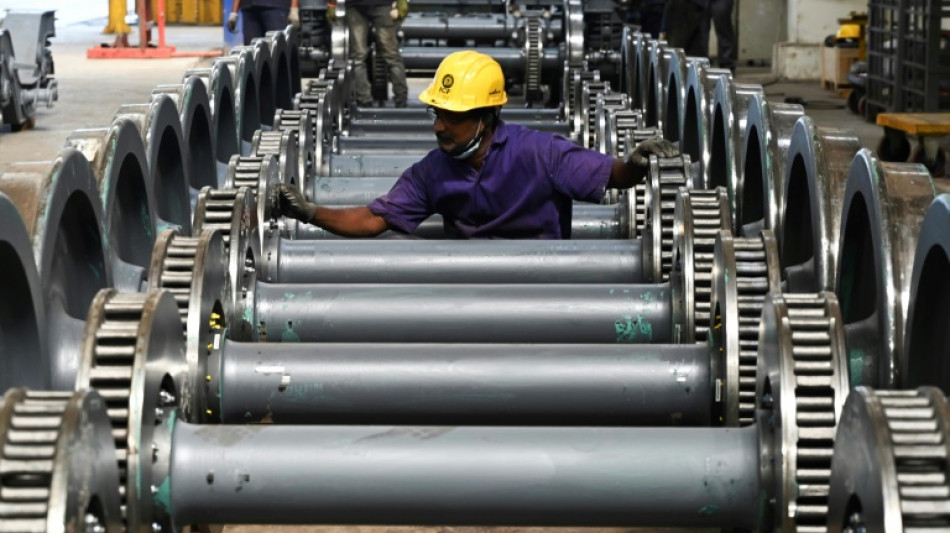
India growth slows on inflation, higher oil prices / Photo: Arun SANKAR - AFP/File

 $1.8 Billion Pledged for Biodiversity at COP17 as Monaco Reaffirms Commitment

 Phoenix Symphony Resumes Performances Amid Financial Uncertainty

 Turkish Energy Minister Highlights Qatar as Key Partner for Regional and Global Energy Security

 London Museum Granted 24/7 License Ahead of November Opening

 Dana White Confirms Flight to Washington for Trump Meeting on Press Secretary Role

 Dengue Fever Expands Into High Himalayas as Climate Change Warms Nepal

 IoT Refrigerator Hacks Disrupt Blood Labs and Supermarkets Across Europe and US
India's growth slowed further in the first three months of 2022, the National Statistics Office said Tuesday, with inflation and higher oil prices denting a post-pandemic recovery.
Asia's third-largest economy grew 4.1 percent, year-on-year, in the last quarter, NSO data showed.
Annual growth for the 12 months to the end of March stood at 8.7 percent.
Rising global commodity prices have sparked concern among policymakers, with India's central bank announcing its first interest rate hike in nearly four years this month.
The country of 1.4 billion people imports more than 80 percent of its crude oil and the cost of meeting domestic fuel demand has soared since Russia invaded Ukraine in February.
India is also the world's largest importer of edible oils, prices of which are at record highs since the conflict began.
"The pandemic may be receding, but growth has not returned," economist Mihir Swarup Sharma of the New Delhi-based Observer Research Foundation told AFP.
"Instead, imports as a proportion of GDP -- driven by higher prices for food, fuel, and other commodities -- are rising."
Prime Minister Narendra Modi's government this month announced tax breaks to offset higher food and petrol costs.
Higher-than-expected revenues could give New Delhi some "headroom" to cushion consumers from inflation, Sharma said.
But the $26 billion cost of the scheme will likely blow out the government's budget deficit beyond its target for 2022-23, which it put at 6.4 percent of GDP.
Consumer inflation hit 6.95 percent in March, according to the Reserve Bank of India, which slashed its own growth forecast to 7.2 percent for the year ending March 2022.
"Alarmingly, persistent and spreading inflationary pressures are becoming more acute with every passing day," Reserve Bank of India governor Shaktikanta Das said this month.
- Further headwinds -
India saw a dramatic uptick in economic activity in the second half of 2021 after the coronavirus pandemic sparked its worst recession since independence from Britain 75 years ago.
Extended lockdowns hit consumer spending and brought factories to a standstill during the Covid-19 outbreak, which at its peak saw thousands of people dying across the country each day, overwhelming hospitals and crematoriums.
Several Indian states briefly imposed mild restrictions on public gatherings and commercial activity after an outbreak of the highly infectious Omicron variant of the virus.
Further headwinds are likely to hit growth in the June quarter, with India this month announcing a sudden ban on wheat exports and a cap on the overseas sale of sugar.
India is the world's second-largest producer of both crops but scorching temperatures and the country's hottest March on record -- blamed on climate change -- have dented yields.
G.Teles--PC

