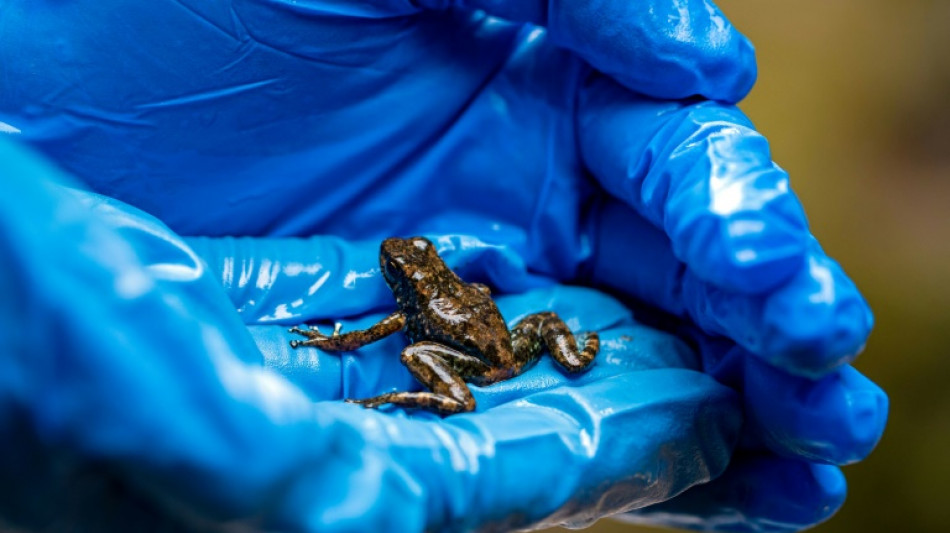
Ecuadoran frogs Rocket and Harlequin taking on mining industry
/ Photo: Cristina Vega RHOR - AFP

 US mother's child murder trial puts spotlight on postpartum psychosis

 'End of an era': Players lament decline of the disc at Gamescom

 Air traffic controllers left early before deadly NY crash: report

 Golf media firm loses Callaway, PGA Tour deals over violent ad

 US to push economic pressure on Iran at G20 finance talks

 Kiss rotates Wallabies forwards for Argentina Test

 Guns, drugs and car chases: GTA 6 preview lands on Netflix after leaks

 Arteta braced for 'tough' Martinelli, Jesus exits from Arsenal

 Welbeck scores first Chelsea goal in League Cup win over Luton

 Arsenal face depleted Aston Villa, Spurs seek return on £300m spend

 Werro edges ever closer to elusive women's 800m world record

 Callaway cuts ties with golf media firm over violent ad

 Trump says Putin won't attack NATO territory

 Labor Day 2026: Complete Starter Tool Kit Under $375

 Tamil Nadu Govt Assigns Ministers to Oversee Chennai Monsoon Preparedness

 Alfred gets revenge on Jefferson-Wooden in Zurich 100m

 US Open men's singles: Three talking points

 Michael Strahan Welcomes Fifth Child with Girlfriend Kayla Quick

 Kuminga’s Timberwolves Deal Saves Millions in Taxes Despite Lower Pay Than Lakers Offer
 Trump says Russia is 'not going to attack' NATO territory

 OpenAI Tests 'Persistent Mode' for Codex AI Agent

 PSG to face Barcelona, Man City and Villa in Champions League as draw is made

 Two killed, one arrested, at school near Berlin: police

 Cox defies Pakistan after Abbas's treble strike rocks England

 Bosnian Serb war criminal Ratko Mladic dead

On the banks of a crystalline waterfall, biologist Andrea Teran lets out a yelp.
She holds in the palm of her hand one of two frog species at the center of a legal battle against Ecuador's mining industry.
Teran, 37, is a specialist in the fragile existence of a creature called the Resistance Rocket Frog, which does not yet have a scientific name, and the Longnose Harlequin (Atelopus longirostris), which was believed extinct for 30 years.
The discovery several years ago of these two tiny frogs measuring no more than four centimeters has become the central argument in opposition to a proposed nearly 5,000 hectare mining project in a native forest in Junin, Imbabura province, around three and a half hours north of Quito.
The Longnose Harlequin reappeared in 2016.
"It was a frog that came back from the dead," said an emotional Teran, whom AFP accompanied on an expedition in this forest area following a two-hour walk.
"If the water is polluted (by mining) the last populations of this frog will be lost," said the biologist from the Jambatu Center dedicated to the study and conservation of amphibians.
The Longnose Harlequin is extinct according to the International Union for the Conservation of Nature's (IUCN) red list.
But scientists rediscovered traces of life in this forest where the mineral exploitation license was granted to Ecuador's Enami and Chile's Codelco. They are due to begin in 2024 to extract 210,000 tons of copper a year.
In Ecuador, which launched a massive mining exploitation operation in 2019, there are at least 12 projects at advanced stages to mine reserves of 43.7 million ounces of gold, 46 billion pounds of copper and 183 million ounces of silver, according to the Spurrier Group consultancy.
But the 2019 discovery of a new species of rock frog has only intensified the desire to protect its forest habitat.
- Last hope -
In 2020, Teran launched a legal battle to prevent the mining project from going ahead.
Although she succeeded in the first instance, she then lost on appeal.
But the mining concession has also been challenged by a collective of Junin residents pointing to errors in the environmental impact studies, such as the lack of a protection plan for the two frog species.
"There are so many mistakes. They are violating the rights of nature, and on top of that the documents were never correctly communicated to the community and there was no environmental consultation," the file's lawyer Mario Moncayo told AFP.
But a judge rejected the claim of oversights.
Defenders of these two frogs can still appeal, which is perhaps their last hope of halting the mining project.
Contacted by AFP, both the government and the mining companies refused to comment.
- No solutions -
When the Jambatu Center scientists came across the new rocket frog species they initially mistook it for one called the Confusing Rocket Frog (Ectopoglossus confusus).
However, an anatomical difference in its tongue was found, and genetic studies allowed experts to identify it as a completely new Ectopoglossus species that they named "resistance."
"It lives in unique conditions, with the sound of the waterfall we don't know how it communicates, we don't know anything about its reproductive biology," said Teran.
Their skin contains great medicinal potential, and renders them extremely sensitive to environmental changes.
They are thus considered bioindicators, meaning that if the ecosystem is affected, they could disappear.
Protection of nature is enshrined in the constitution of Ecuador, which has 650 known species of frogs, 60 percent of which are in danger of extinction.
But the South American country derives six percent of its GDP from its oil and mining industries, according to the Central Bank.
"We are in a mega-diverse region and the decisions taken have to be mega-responsible," said Teran.
It's an issue that divides opinion in Junin.
"If authorities value the species that live here then they need to halt" the mining project, said farmer Hugo Ramirez, 40.
But for carpenter Pedro Vallejos, 63, environmentalists are offering no solutions to end poverty.
"There's no employment in the countryside, there are no alternatives," he said.
F.Carias--PC