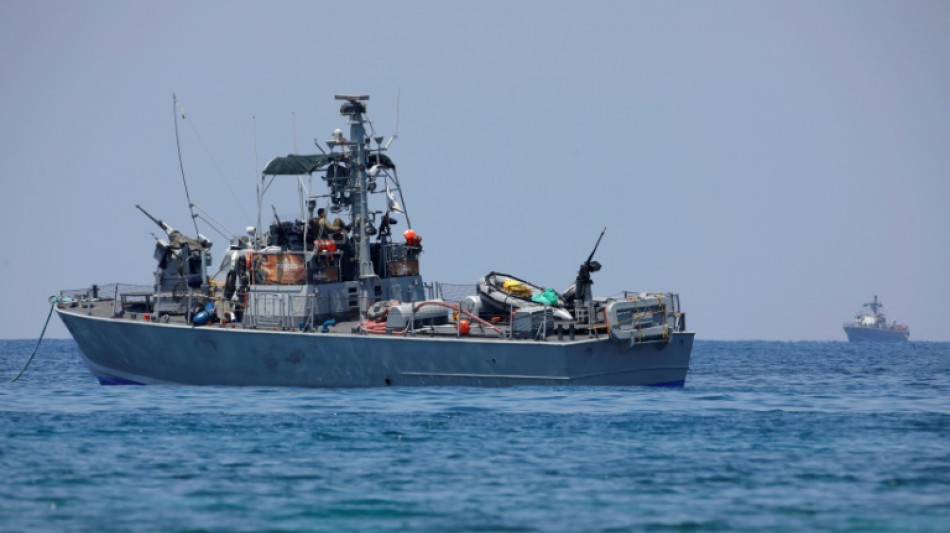
Lebanon asks for US mediation after Israel gas ship move / Photo: Jalaa MAREY - AFP

 $1.8 Billion Pledged for Biodiversity at COP17 as Monaco Reaffirms Commitment

 Phoenix Symphony Resumes Performances Amid Financial Uncertainty

 Turkish Energy Minister Highlights Qatar as Key Partner for Regional and Global Energy Security

 London Museum Granted 24/7 License Ahead of November Opening

 Dana White Confirms Flight to Washington for Trump Meeting on Press Secretary Role

 Dengue Fever Expands Into High Himalayas as Climate Change Warms Nepal

 IoT Refrigerator Hacks Disrupt Blood Labs and Supermarkets Across Europe and US
Lebanon on Monday called for US mediation after Israel moved a gas production vessel into an offshore field, a part of which is claimed by Beirut.
The ship operated by London-listed Energean Plc arrived in the Karish gas field on Sunday and will immediately commence operations, Energean said in a statement.
The move immediately drew condemnation from Lebanon's president and prime minister who held talks on Monday to discuss next steps.
The two agreed to "invite US envoy Amos Hochstein to Beirut to look into restarting negotiations to demarcate Lebanon's southern maritime border" which stalled last May, said a statement by Prime Minister Najib Mikati.
"Any exploration, drilling or extraction carried out by Israel in the disputed areas constitutes a provocation and an act of aggression," the statement said.
Lebanon and Israel last fought a war in 2006, have no diplomatic relations and are separated by a UN-patrolled border.
They had resumed negotiations over their maritime border in 2020 but the process was stalled by Beirut's claim that the map used by the United Nations in the talks needed modifying.
Lebanon initially demanded 860 square kilometres (330 square miles) of territory in the disputed maritime area but then asked for an additional 1,430 square kilometres (552 square miles), including part of Karish.
- Disputed territory -
Lebanese officials said Sunday that any Israeli activity in disputed waters would constitute a "hostile act" and an "attack" on Lebanon's natural resources.
But for Israel, Karish lies "within Israel's UN-recognised exclusive economic zone," and not in disputed territory, a senior Israeli official told AFP on condition of anonymity.
An Israeli energy ministry spokeswoman told AFP that drilling was completed months ago and "the flow of gas from Karish should start in September".
The production vessel that arrived Sunday will be connected to Karish via pipelines, she said.
"Other pipelines will take the gas from the platform to the Israeli shores," she said, referring to the ship.
Lebanon's powerful Iran-backed Hezbollah militant movement has warned Israel that it could seek to disrupt attempts to extract oil and gas from Karish and other disputed areas.
Lebanese energy expert Laury Haytayan said Lebanese authorities should sign a decree amending demarcation lines of the maritime border instead of turning to Washington for mediation.
"If Lebanese officials believe that an invitation for Hochstein to visit Beirut will stop work in Karish, this is a waste of time," she told AFP.
P.Queiroz--PC

