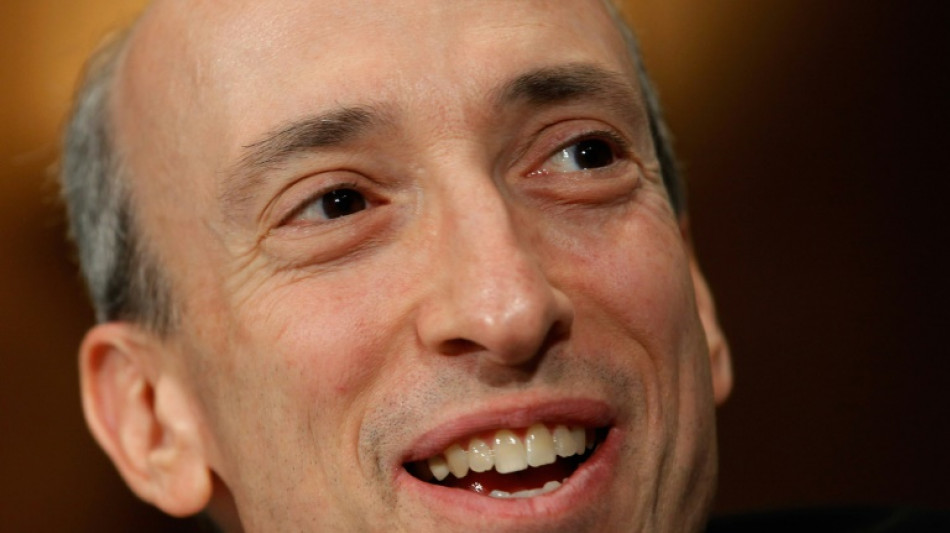
US regulator favors revamp of stock market trading system / Photo: CHIP SOMODEVILLA - GETTY IMAGES NORTH AMERICA/AFP/File

 $1.8 Billion Pledged for Biodiversity at COP17 as Monaco Reaffirms Commitment

 Phoenix Symphony Resumes Performances Amid Financial Uncertainty

 Turkish Energy Minister Highlights Qatar as Key Partner for Regional and Global Energy Security

 London Museum Granted 24/7 License Ahead of November Opening

 Dana White Confirms Flight to Washington for Trump Meeting on Press Secretary Role

 Dengue Fever Expands Into High Himalayas as Climate Change Warms Nepal

 IoT Refrigerator Hacks Disrupt Blood Labs and Supermarkets Across Europe and US
Citing equity market trading defects revealed in last year's GameStop saga, a top US securities regulator on Wednesday endorsed a broad revamp of the stock market trading system.
In a speech billed as a first step towards a possible update in the rules likely to rile financial firms, Gary Gensler, chair of the Securities and Exchange Commission, said he favored restructuring the system in order to better protect retail investors.
"It's not clear... that our current national market system is as fair and competitive as possible for investors," Gensler said in a virtual address at a conference hosted by Piper Sandler.
The speech marks the SEC's latest action in response to frenzied trading in early 2021 during which extreme volatility in GameStop, AMC Entertainment and a handful of other equities rocked the market and led brokerages to implement sudden trading restrictions that angered investors and spurred congressional probes.
Gensler said the current system routes "the vast majority" of stock trades orders to electronic trading wholesalers such as Citadel Securities and Virtu Financial.
In some cases, these firms pay the brokerages, an arrangement known as "payment for order flow" that can allow brokerages such as Robinhood Markets to offer commission-free trades to individual investors.
But Gensler is skeptical that this arrangement protects retail investors and believes the payment for order flow system creates conflicts of interests and encourages "gamification" on online platforms to increase trading volumes.
Gensler has asked SEC staff to consider steps to "enhance order-by-order competition," potentially through auctions. He has also asked staff for recommendations to mitigate the risks with payment for order flow and to provide more transparency.
The SEC head described the speech as a starting point towards possible regulation that will include extensive public comment and discussion with other SEC commissioners.
Doug Cifu, chief executive of Virtu, disputed Gensler's characterizations, telling CNBC that most of the broker dealers with which his firm trades do not accept payment for order flow.
"The chair with all due respect is conflating the issue of payment for order flow with the ecosystem that has evolved in this country for retail trading, which has really enabled retail investors to have instantaneous execution and essentially zero commission on 8000 listed names," Cifu said.
"You know, the cliche that markets have never been better is actually factually correct."
X.Matos--PC

