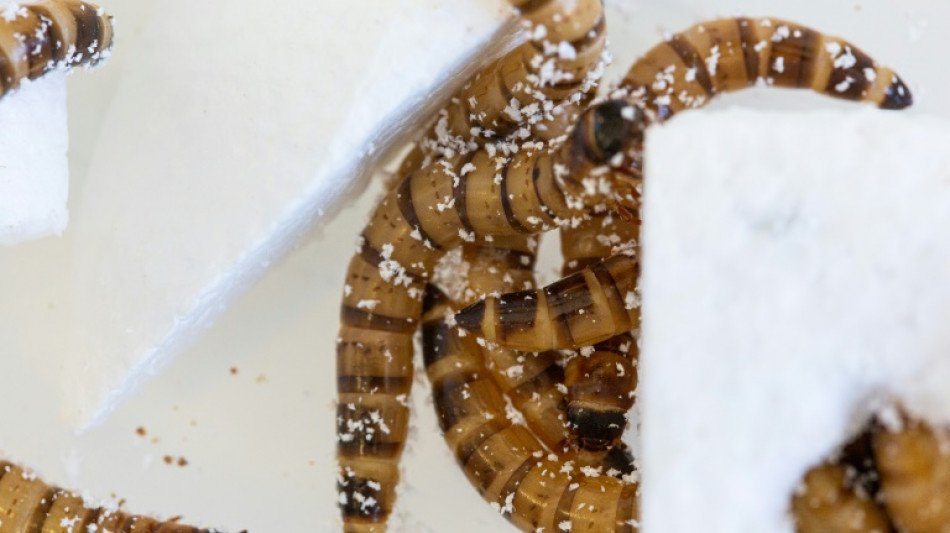
Styrofoam-munching superworms could hold key to plastic upcycling / Photo: Handout - The University of Queensland/AFP

 Bayern steamroll Stuttgart in Bundesliga opener

 England pace quartet might keep Archer going until he is 40

 Driven by distraction? Trump steps up stunts as US midterms loom

 Springboks a wounded beast, warns All Blacks captain Savea

 Trump announces new US 'Space Academy'

 Best Laser Printers in India: Top Options from HP, Brother and Canon

 US Monroe Doctrine Revival Risks Pushing Latin America Toward China
 Former Spain captain Morata joins second-tier Leganes

 Does the Nepal glacier collapse signal a new climate risk?

 Gianni Infantino’s FIFA Presidency Faces Unprecedented Governance Crisis

 SmartMarket Solutions Announces Its BBB Accreditation with an A+ Rating
 Greenland to open truth commission over forced contraception scheme

 Stocks, dollar rise after Fed chief lifts rate expectations

 'Game-changer': solar ambulance completes test run in Kenya

 Fernandez's Chelsea future uncertain as Alonso seeks commitment

 Four plead guilty to London arson attack on Jewish ambulances

 Meta's teen safety deal runs into an unsolved problem: proving age

 Windmills of change: Dutch raise mill in rare operation

 Netanyahu party in uproar as far-right refuses pleas to unite

 Stocks advance with all eyes on Fed chair's speech

 War criminal Ratko Mladic's death lays bare Bosnia's wounds

 Thieves buy tickets before plundering necklace from Vienna museum

 Swiss nuclear plant fully back online after heatwaves

 Bournemouth, Sunderland to face AC Milan in Europa League

 Once a legend, humpback whales make comeback in Brazil

Packing material, disposable cutlery, CD cases: Polystyrene is among the most common forms of plastic, but recycling it isn't easy and the vast majority ends up in landfills or finds its way to the oceans where it threatens marine life.
Scientists at Australia's University of Queensland have now discovered that superworms -- the larvae of Zophobas morio darkling beetles -- are eager to dine on the substance, and their gut enzymes could hold the key to higher recycling rates.
Chris Rinke, who led a study that was published in the journal Microbial Genomics on Thursday, told AFP previous reports had shown that tiny waxworms and mealworms (which are also beetle larvae) had a good track record when it came to eating plastic, "so we hypothesized that the much larger superworms can eat even more."
Superworms grow up to two inches (five centimeters) and are bred as a food source for reptiles and birds, or even for humans in countries such as Thailand and Mexico.
Rinke and his team fed superworms different diets over a three week period, with some given polystyrene foam, commonly known as styrofoam, some bran, and others not fed at all.
"We confirmed that superworms can survive on a sole polystyrene diet, and even gain a small amount of weight -- compared to a starvation control group -- which suggests that the worms can gain energy from eating polystyrene," he said.
Although the polystyrene-reared superworms completed their life cycle, becoming pupae and then fully developed adult beetles, tests revealed a loss of microbial diversity in their guts and potential pathogens.
These findings suggested that while the bugs can survive on polystyrene, it is not a nutritious diet and impacts their health.
Next, the team used a technique called metagenomics to analyze the microbial gut community and find which gene-encoded enzymes were involved in degrading the plastic.
- Bio-upcycling -
One way to put the findings to use would be to provide superworms with food waste or agricultural bioproducts to consume alongside polystyrene.
"This could be a way to improve the health of the worms and to deal with the large amount of food waste in Western countries," said Rinke.
But while breeding more worms for this purpose is possible, he envisages another route: creating recycling plants that mimic what the larvae do, which is to first shred the plastic in their mouths then digest it through bacterial enzymes.
"Ultimately, we want to take the superworms out of the equation," he said, and he now plans more research aimed at finding the most efficient enzymes, then enhancing them further through enzyme engineering.
The breakdown products from that reaction could then be fed to other microbes to create high-value compounds, such as bioplastics, in what he hopes would become an economically viable "upcycling" approach.
P.Mira--PC