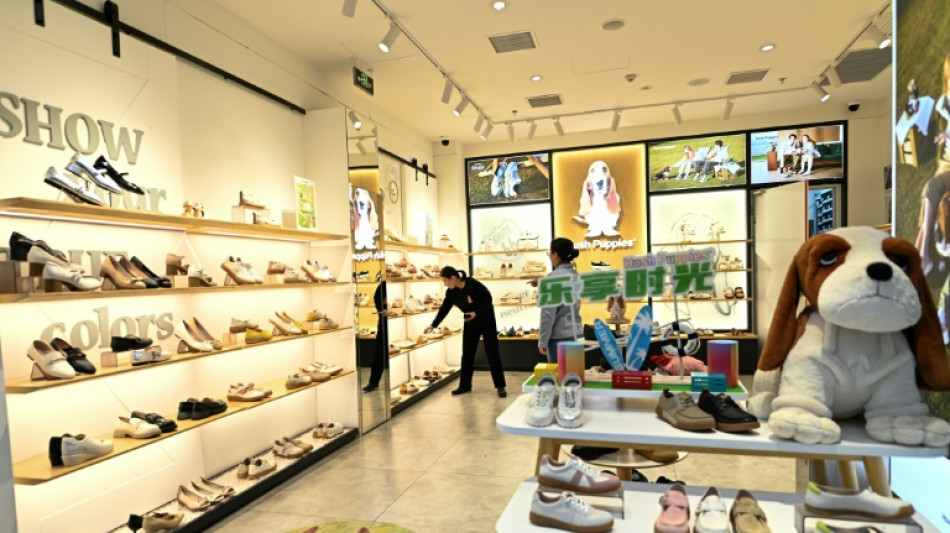
China seeks to 'tariff-proof' economy as trade war with US deepens / Photo: Pedro PARDO - AFP

 Taylor scores two tries in winning debut as New Zealand captain

 England defender Spence leaves Spurs for Inter Milan

 Moore double leads Spurs to 3-0 friendly win over Hoffenheim

 Man Utd beaten by former boss Amorim's AC Milan in friendly finale

 Villagers evacuate as Belgium battles record wildfire

 Despite booming economy, young Moroccans still dream of Europe

 South Korea president proposes talks with North to formally end Korean War

 Residents evacuate as Belgium wildfire scorches 1,600 hectares
 easyJet strike sees 100 French flights cancelled

 Monica Bellucci and Florin Serban win at Locarno Film Festival

 India's Padikkal hits unbeaten century in first Sri Lanka Test
 Liechtenstein places gender equality on its throne

 Street rallies held as Taliban govt marks five years ruling Afghanistan

 World Cup winner Ferran Torres signs for PSG from Barcelona
 Monsoon rains submerge villages, fields in Myanmar

 India's Padikkal, Rahul hit half-centuries in Sri Lanka Test

 UK-based Afghan writer pleads for country's 'abandoned' women

 Werro edges Hodgkinson in boost for world record-seeking 800m rivalry

 Mehidy claims Smith as Bangladesh sense historic upset in Australia

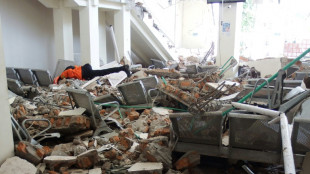 Indonesia rescuers search for survivors as quake death toll rises to 38

 Japan coach Jones says team should not get despondent after heavy loss

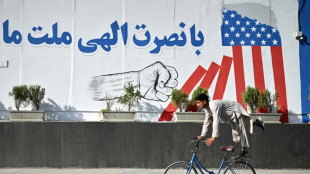 Flags, music as Taliban authorities mark five years ruling Afghanistan
 'Like we were on a trampoline': Indonesia quake kills 20, thousands flee
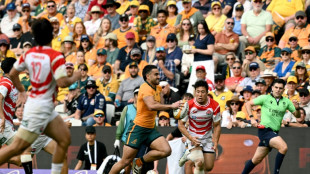 Australia run riot to crush Japan 56-17 in Townsville

 Stolen Matisse works tied to infamous art thief in Brazil

China is trying to tariff-proof its economy by boosting consumption and investing in key industries, but analysts say it remains critically vulnerable to the economic storm triggered by Donald Trump's 104 percent levies on its goods.
Beijing has vowed to "fight to the end" against Trump's aggressive trade policy, with number two leader Li Qiang saying authorities were "fully confident" in the resilience of the Chinese economy.
But even before the tariffs hit, weakness in the post-Covid domestic market, rising unemployment and a long-running property crisis had all dampened consumption.
"The Chinese economy has been significantly weakened since Trump's first term and can't really withstand the impact of sustained high tariffs," said Henry Gao, an expert on the Chinese economy and international trade law.
Overseas shipments had represented a rare bright spot last year, with the United States the top single country buyer of Chinese goods.
US figures put Chinese exports to the United States at around $440 billion in 2024, almost three times the $145 billion worth of imports.
Machinery and electronics -- as well as textiles, footwear, furniture and toys -- make up a majority of the goods sent, and a supply glut could squeeze already crowded domestic consumer markets.
Although China's domestic market is stronger now than in Trump's previous term, there would inevitably be pain ahead, said Tang Yao from Peking University's Guanghua School of Management.
"Certain products are specifically designed for American or European markets, so efforts to redirect them to domestic consumers will have only a limited effect," he said.
- 'Strategic opportunity' -
However, a weekend editorial in the Communist Party-backed People's Daily described the tariffs as a "strategic opportunity" for China to cement consumption as the main driver of economic growth.
We must "turn pressure into motivation", it read.
Beijing has been seeking to "recast structural external pressure as a catalyst for long-intended reforms", said Lizzi Lee from the Asia Society Policy Institute's Center for China Analysis.
Authorities are "projecting confidence", she said.
China's quick and coordinated response to tariffs reflect lessons learned from Trump's first term, she added.
For example, in addition to readying reciprocal tariffs on US goods set to come into effect Thursday, Beijing's commerce ministry the same day announced export controls on seven rare earth elements -- including ones used in magnetic imaging and consumer electronics.
Beijing's response to any further escalation may no longer be confined to tit-for-tat levies, as China is "refining its retaliatory approach", Lee said.
Since Trump's first term, China has diversified and fortified relationships with countries in Europe, Africa, Southeast Asia and Latin America, as well as South Korea and Japan.
Beijing could also expand government support for the private sector as entrepreneurs fall back into President Xi Jinping's good graces, added ANZ's Raymond Yeung.
China's leaders have been trying to promote domestic self-reliance in technology for some time, offering explicit support and reinforcing supply chains in key areas like AI and chips.
- 'No real protection' -
While this time round Beijing has more experience with Trump, it "doesn't mean the Chinese economy can easily shake off the effects of soaring tariffs", said Frederic Neumann, chief Asia economist at HSBC.
Authorities will be looking to quickly offset falling US demand for Chinese goods, he said.
That could look like trade-in schemes or more consumer subsidies that make it easier for Chinese shoppers to buy common household items, from water purifiers to electric vehicles.
"By creating demand and trade opportunities for China's partners in Asia and Europe, the country could help shore up what's left of the liberal global trading order," Neumann said.
But whether or not Beijing can do that is yet to be seen.
The government has "been very reluctant to introduce real consumption stimulus, which is why there's such low confidence in any so-called consumption-boosting measures", Gao said.
"I don't think China has any real protection against a trade war," he added.
Success also goes beyond words, and ultimately hinges on Beijing's ability to deliver the long-awaited consumption boost, HSBC's Neumann warned.
"This is China's moment to seize economic leadership of the world," he said.
"But that leadership will only come about if domestic demand rebounds and fills the void left by an absent US."
L.Torres--PC