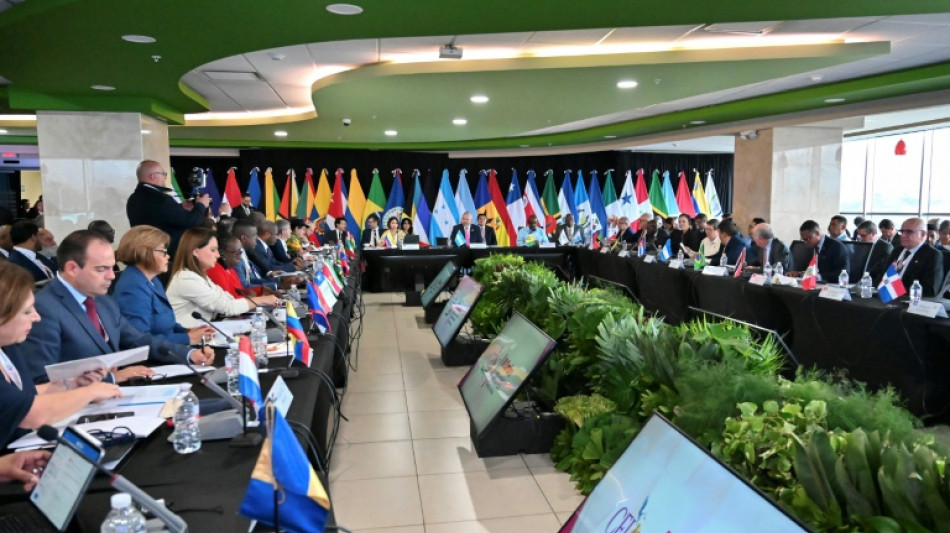
Strength in numbers: Latin America urges unity in face of Trump tariffs / Photo: Orlando SIERRA - AFP

 ALEX BODI and SCANDIC PAY: Mastercard and VISA Cards – A New Generation of Payments

 Mercedes-Benz Power Converter Enables Individual Cell Control for Improved EV Efficiency

 Search Underway for 'Dooars Rani' Tigress After Second Escape from Buxa Tiger Reserve

 IIM Indore Announces IPMAT 2027 Exam Date for April 24

 The Dilemma of Recording Live Music: Preserving Memories vs. Being Present

 ANC’s Renewal Rhetoric Fades as Voters Reject Party in 2026 Local Elections

 Foreign Investors Return to Indian Markets After 10-Month Selloff

 Honda CR-V and Toyota RAV4 Lead Canada’s Most Stolen Vehicles List for 2025
Latin American leaders on Wednesday urged a united front to tackle US President Donald Trump's tariff onslaught and the economic uncertainty it has brought.
The calls for unity of purpose were made in Honduras at a meeting of the 33-member Community of Latin American and Caribbean States (CELAC), also attended by China -- seeking to replace the United States as the main political and economic influence in the region.
Eleven CELAC heads of state attended the deliberations, including leftist leaders Luiz Inacio Lula da Silva of Brazil and Claudia Sheinbaum of Mexico -- Latin America's biggest economies -- as well as Colombia's Gustavo Petro and host Xiomara Castro.
"We cannot continue walking separately when the world is reorganizing," Castro said as the talks got underway in the capital Tegucigalpa.
"The United States is redrawing its economic map without asking which peoples are left behind," she said.
Sheinbaum, for her part, said economies in the region must diversify their markets and focus more on "integration and helping each other."
Trump's tariffs on imports of non-US products, some of them suspended and altered numerous times, threaten economic disruption for CELAC economies.
Mexico is the United States' biggest trading partner while Brazil is its second-biggest provider of steel.
And while Washington is increasingly seen as a volatile associate, China has been making inroads in the region.
Two-thirds of Latin American countries have joined President Xi Jinping's trillion-dollar Belt and Road infrastructure program, and China has surpassed the United States as the biggest trading partner of Brazil, Peru and Chile, among others.
In Honduras, a Chinese delegation led by Qu Yuhui, Beijing's number two for Latin American Affairs, has been holding bilateral meetings with CELAC delegates since Monday -- including envoys from Argentina, Brazil, Colombia, Chile, Mexico, Venezuela and Cuba.
Beijing also plans to host a China-CELAC ministerial conference on May 13, to be attended by Xi.
"China is set to increase its influence in Latin America; it is a gift from the United States," Peruvian international relations analyst Francisco Belaunde told AFP.
"China wants to appear now as a reliable partner that is in favor of free trade, it wants to take advantage of the mess generated by Trump and the annoyance of all countries over these tariffs," he added.
A.Magalhes--PC
