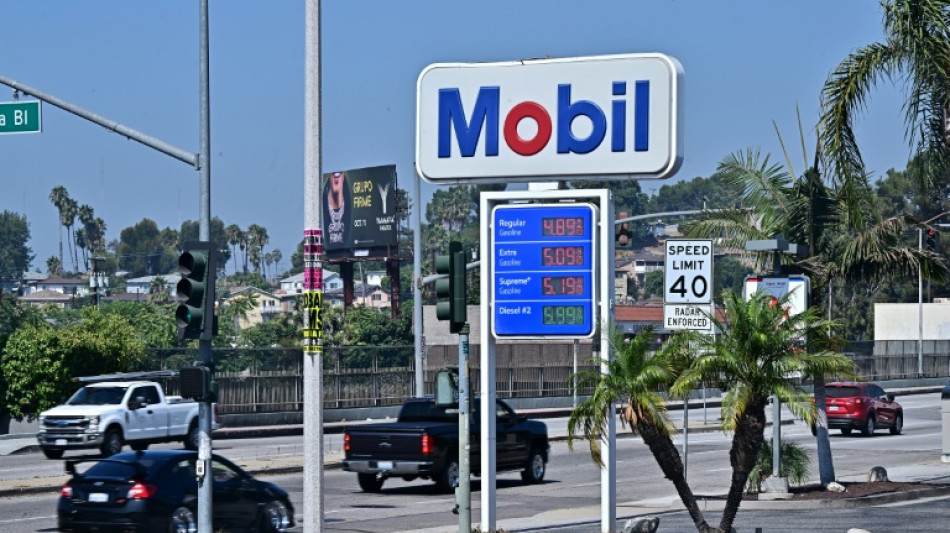
US consumer inflation cools in March on falling gas prices / Photo: Frederic J. BROWN - AFP

 ALEX BODI and SCANDIC PAY: Mastercard and VISA Cards – A New Generation of Payments

 Mercedes-Benz Power Converter Enables Individual Cell Control for Improved EV Efficiency

 Search Underway for 'Dooars Rani' Tigress After Second Escape from Buxa Tiger Reserve

 IIM Indore Announces IPMAT 2027 Exam Date for April 24

 The Dilemma of Recording Live Music: Preserving Memories vs. Being Present

 ANC’s Renewal Rhetoric Fades as Voters Reject Party in 2026 Local Elections

 Foreign Investors Return to Indian Markets After 10-Month Selloff

 Honda CR-V and Toyota RAV4 Lead Canada’s Most Stolen Vehicles List for 2025
US consumer inflation cooled last month on plunging gas prices, according to government data published Thursday, as consumers and businesses waited nervously for President Donald Trump's sweeping tariffs to come into effect.
The US leader last week announced levies as high as 50 percent on imports from some countries, sending stock markets tumbling and bond yields rising -- only to abruptly change course on all nations except China on Wednesday.
Ahead of the dramatic market movements that accompanied those levies, the consumer price index (CPI) cooled to 2.4 percent in March from a year ago, the Labor Department said in a statement -- lower than economists' estimates.
On a monthly basis, inflation actually contracted 0.1 percent from a month earlier, helped by a 6.3 percent drop in gasoline prices, which aided a 2.4 percent contraction in the energy index.
The food index rose 0.4 percent in March.
The data will likely be well-received by the administration of Donald Trump, which has been under pressure to explain how consumers will benefit from its tariff plans -- which many economists and Federal Reserve officials say will stoke inflation and cool growth.
But since the figures only show the period in the run-up to the imposition of tariffs, they do not paint a picture of either the immediate or longer-term effects of those levies.
They currently sit at a 10 percent baseline for all countries except China, with additional duties on specific goods.
"What a difference 24 hours makes," Northlight Asset Management chief investment officer Chris Zaccarelli wrote in a note to clients.
"Not only is the immediate tariff threat pushed off for 3 months, but imminent inflation threat has been avoided for now."
He added that the data is "welcome news for the Federal Reserve, which would like to cut rates if significant damage is done to the economy through increased tariffs, but otherwise would be reluctant to cut rates in the face of an inflation threat."
Excluding volatile food and energy costs, inflation inched up by 0.1 percent in March from a month earlier, and by 2.8 percent over the past 12 months.
This was "the smallest 12-month increase since March 2021," the Labor Department said. It also came in below the median estimates of economists surveyed by Dow Jones Newswires and the Wall Street Journal.
The data is good news for the Fed, which is grappling with inflation that remains stuck above its long-term two percent target, according to its preferred gauge of price increases.
At the same time, the unemployment rate remains close to historic lows, leaving the US central bank in no hurry to cut rates until price pressures cool further -- as long as Trump's tariffs do not cause a sharp contraction in growth, which would likely weigh on employment.
Financial markets see a roughly 80 percent chance of the Fed doing nothing at its next interest meeting in May, according to CME Group data.
V.F.Barreira--PC
