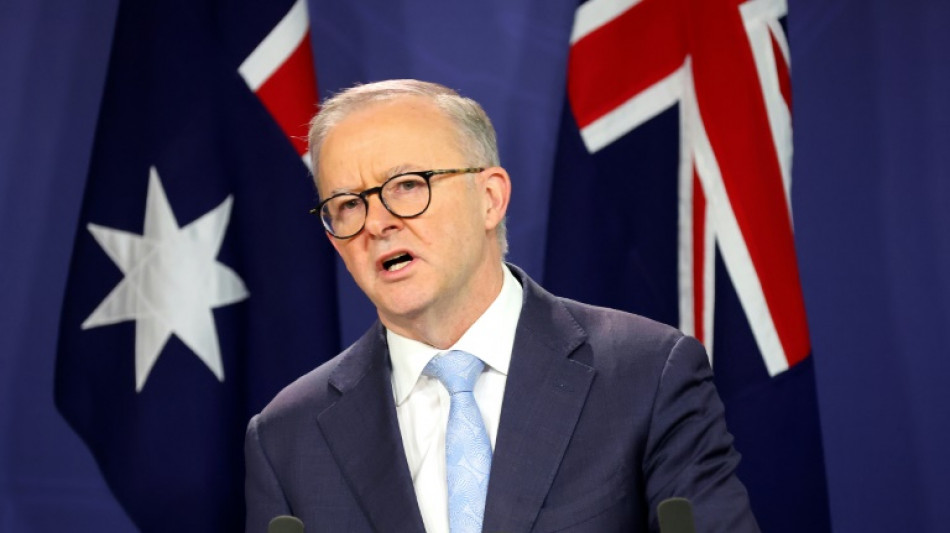
Australia agrees Naval payout, ending France sub dispute / Photo: DAVID GRAY - AFP/File

 $1.8 Billion Pledged for Biodiversity at COP17 as Monaco Reaffirms Commitment

 Phoenix Symphony Resumes Performances Amid Financial Uncertainty

 Turkish Energy Minister Highlights Qatar as Key Partner for Regional and Global Energy Security

 London Museum Granted 24/7 License Ahead of November Opening

 Dana White Confirms Flight to Washington for Trump Meeting on Press Secretary Role

 Dengue Fever Expands Into High Himalayas as Climate Change Warms Nepal

 IoT Refrigerator Hacks Disrupt Blood Labs and Supermarkets Across Europe and US
Australia unveiled a massive compensation deal with French submarine maker Naval Group Saturday, ending a contract dispute that soured relations between Canberra and Paris for almost a year.
Prime Minister Anthony Albanese said the French firm had agreed to a "fair and an equitable settlement" of 555 million euros (US$584 million) for Australia ending a decade-old multi-billion-dollar submarine contract.
The deal draws a line under a spat that derailed relations between both countries and threatened to torpedo talks on an EU-Australia trade agreement.
In September 2021, then-Australian prime minister Scott Morrison abruptly ripped up the French contract to build a dozen diesel-powered submarines.
He also stunned Paris by announcing a secret deal to buy US or British nuclear-powered submarines, a major shift for a country with little domestic nuclear capability.
The decision drew fury from French President Emmanuel Macron, who publicly accused Morrison of lying and recalled his ambassador from Australia in protest.
Relations were on ice until this May when Australia elected centre-left leader Albanese.
Since coming to office, Albanese has rushed to fix strained relations with France, New Zealand and with Pacific Island nations, who objected to the previous conservative government's foot dragging on climate change.
He has also made tentative steps to conduct the first ministerial-level talks with China in over two years, after a range of bitter political and trade disputes.
"We are re-establishing a better relationship between Australia and France," Albanese said, after speaking to Marcon about the settlement.
"I'm looking forward to taking up President Macron's invitation to me to visit Paris at the earliest opportunity," he added.
- Arms race -
The submarine contract had been the centrepiece of Australia's race to develop its military capabilities, as it fears the threat from a more bellicose China under President Xi Jinping.
In total the failed French submarine contract will have cost Australian taxpayers US$2.4 billion, Albanese said, with almost nothing to show for it.
The promised nuclear-powered submarines are likely to give Australia the ability to operate more stealthily and -- armed with sophisticated cruise missile capabilities -- pose much more of a deterrent to Beijing.
But there remains deep uncertainty about how quickly they can be built.
The first US or British submarines likely will not be in the water for decades, leaving a long capability gap as Australia's existing fleet ages.
The choice of contractor will have a significant economic impact and strategic implications, closely enmeshing the Australian navy with that of the chosen nation.
Former defence minister and now opposition leader Peter Dutton said this week that he had decided to source the submarines from the United States, an unusual revelation given the sensitivity of ongoing talks.
The current government has insisted no decision has yet been reached.
F.Moura--PC

