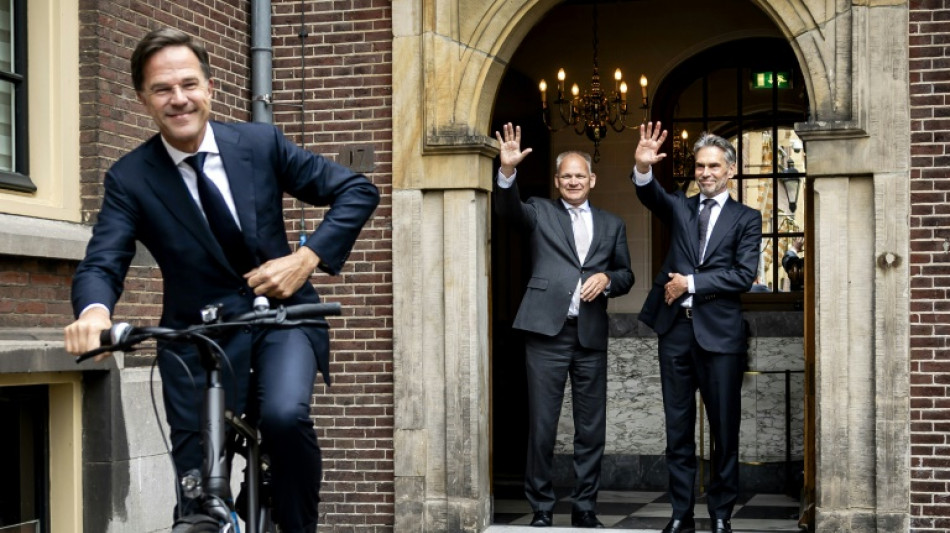
'Put it on': Dutch drive for bike helmets / Photo: Remko de Waal - ANP/AFP

 ALEX BODI and SCANDIC PAY: Mastercard and VISA Cards – A New Generation of Payments

 Mercedes-Benz Power Converter Enables Individual Cell Control for Improved EV Efficiency

 Search Underway for 'Dooars Rani' Tigress After Second Escape from Buxa Tiger Reserve

 IIM Indore Announces IPMAT 2027 Exam Date for April 24

 The Dilemma of Recording Live Music: Preserving Memories vs. Being Present

 ANC’s Renewal Rhetoric Fades as Voters Reject Party in 2026 Local Elections

 Foreign Investors Return to Indian Markets After 10-Month Selloff

 Honda CR-V and Toyota RAV4 Lead Canada’s Most Stolen Vehicles List for 2025
It's a world-famous scene: a steady and slightly chaotic stream of cyclists pedalling out of Amsterdam's Centraal Station, heading for the canals and cafes of the Dutch capital. Almost no one is wearing a helmet.
Now the government is trying to persuade the reluctant Dutch to strap on headgear when riding their beloved bikes, with an awareness campaign kicking off on Wednesday.
The campaign "Zet 'em op" literally means "Put it on", but the phrase is also slang for "Good Luck", which authorities will need to change attitudes in a country where only one cyclist in 25 wears a helmet.
Infrastructure Minister Barry Madlener hopes to push up the rate from four percent to 25 percent within 10 years, he said in a letter to parliament.
Research shows that 25 percent is a "social tipping point" when peer pressure kicks in and the rate of helmet wearing increases significantly, Madlener said.
The stakes are high: government statistics estimate around 50 road deaths a year could be prevented if half the Dutch biking population wore a helmet.
Last year, 74,300 cyclists were rushed to emergency hospital departments, nearly 50,000 of them with serious injuries, according to the Veiligheid safety organisation.
If nothing is done, the number of seriously injured cyclists is expected to double by 2040, the infrastructure ministry estimates.
On the streets of Amsterdam, the message did not appear to be getting through to everyone.
"I'd rather stop biking and go walking than wear a helmet," Roos Stamet, a 48-year-old writer, told AFP.
"It will ruin my hair. I will look like a 70-something," she added. "It's nonsense. Do you go into the supermarket wearing a helmet? It's just not an option."
- 'Fatbikes' -
Alongside subsidised helmets and an ad campaign, Dutch transport apps have sought to raise awareness, and that persuaded Marijn Visser to don one for the first time.
In the countryside where she lives, she never wears a helmet, because "it's nice to feel the wind through your hair. And it's not necessary, I think," she said.
"But it's very crowded in Amsterdam," said the 45-year-old librarian, which persuaded her to wear the helmet.
One of the main topics of conversation -- and annoyance -- in the Netherlands is the rise of the "fatbike", high-speed electric bikes whose drivers often terrorise traditional bikers on the paths.
It certainly takes nerves of steel to navigate bike travel in Amsterdam, with mopeds, scooters, fatbikes and pedestrians all jostling for space.
"Bike traffic has become gradually more dangerous in the past five to 10 years... with the electric bikes, with the fatbikes," said Kenji Stamet, a part-time barista and Roos's husband.
An additional hazard, especially in Amsterdam, is tourists wandering around oblivious to high-speed bike traffic, Stamet said.
All things considered, the 50-year-old said he might consider buying a helmet one day.
"I thought about it once or twice last year for the first time in my life," he told AFP.
"Maybe when I'm older, maybe in five years or ten years, and if I'm still in Amsterdam, then maybe it won't be such a bad idea."
L.Henrique--PC
