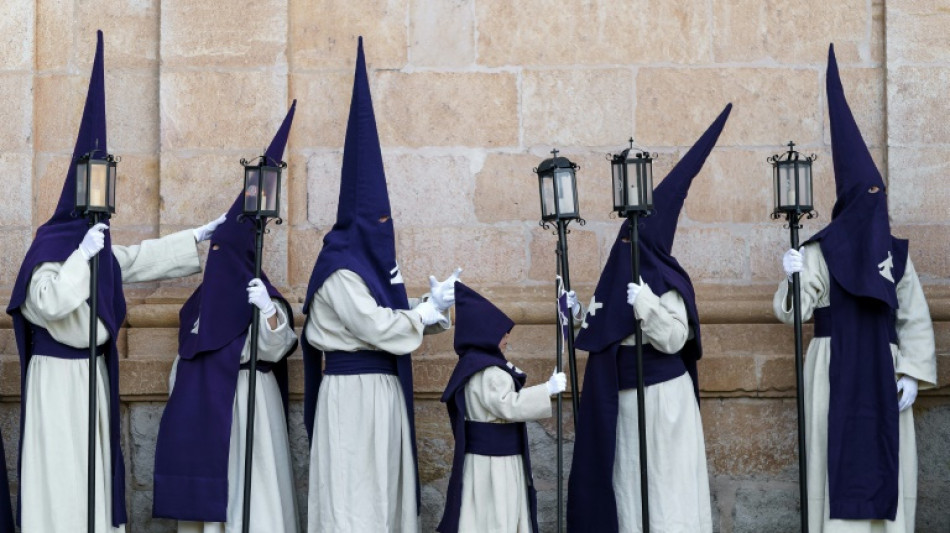
Spanish youth keep vibrant Holy Week processions alive / Photo: CESAR MANSO - AFP

 ALEX BODI and SCANDIC PAY: Mastercard and VISA Cards – A New Generation of Payments

 Mercedes-Benz Power Converter Enables Individual Cell Control for Improved EV Efficiency

 Search Underway for 'Dooars Rani' Tigress After Second Escape from Buxa Tiger Reserve

 IIM Indore Announces IPMAT 2027 Exam Date for April 24

 The Dilemma of Recording Live Music: Preserving Memories vs. Being Present

 ANC’s Renewal Rhetoric Fades as Voters Reject Party in 2026 Local Elections

 Foreign Investors Return to Indian Markets After 10-Month Selloff

 Honda CR-V and Toyota RAV4 Lead Canada’s Most Stolen Vehicles List for 2025
Clad in a traditional white tunic and purple sash, four-year-old Thiago could barely contain his excitement before taking part as a drummer in a Spanish Easter procession thronged by thousands.
He and other members of the younger generations belie the belief that the elderly are custodians of the centuries-old rite, defying a secular trend in the historically Catholic country.
Parading with family in the northwestern city of Zamora is what most excites Thiago during Holy Week, when Catholics commemorate the passion, death and resurrection of Jesus Christ in solemn processions organised by religious brotherhoods.
"As soon as we had the first grandchild in the family, the first thing we do here, rather than go to the court to register him, is sign him up to a brotherhood," Thiago's grandfather Jose Luis Temprano, 72, told AFP.
On Holy Tuesday, a delighted Thiago prepared to mark the rhythm of the parade with his small drum.
His other grandfather "hands out almonds, my father goes with the cross and I give out sweets" to other children, he recalled of another procession in which he participated.
- Week of tradition -
Zamora is home to 16 brotherhoods which each have hundreds or thousands of members. Several have long waiting lists to join, some lasting years, said Israel Lopez, president of the city's Holy Week board.
"People sign up because they want that moment to be able to go out" in the processions with schoolmates and relatives, he added.
As the clock struck midnight on a chilly evening, a group of teenagers stood ready when the street lights were turned off and Zamora was plunged into silence.
The young members of the Santisimo Cristo de la Buena Muerte brotherhood then slowly descended a steep cobbled street, some wearing sandals and others barefoot, bearing torches aloft in a moving spectacle of devotion.
Laura Borrego, 34, had spent hours in the street with her friends waiting for the procession to start. All live outside Zamora but never miss Holy Week in the city of 60,000 souls.
"It is a week of tradition, family, friends, being in the street all week," said Borrego, a member of two brotherhoods who braved the elements in a thick winter coat.
Borrego and her friends had already witnessed another parade that evening in which parents walked with children or cradled babies in their arms, donning white tunics and the trademark "capirote", a long pointy hood.
Cristina Garcia, a 44-year-old teacher dressed in a white tunic and green capirote, says she joined the Holy Tuesday procession to continue a tradition inherited from her late father.
Her two children are also taking part, thanks to "what I have been inculcating into them", she added.
- 'A lot of emotion' -
Borrego's atheist friend Manuel Rodriguez, a 34-year-old psychologist, also cannot resist being drawn to Holy Week.
It is like visiting "Roman churches... you do not have to be exclusively religious, because you can see the (historical) value," he told AFP.
According to a March survey by state polling body CIS, 39.2 percent of Spaniards described themselves as atheist, agnostic or non-believers, highlighting a secularising trend common to much of Europe.
Of the 54.4 percent who identified as Catholic, only 18.6 percent said they were practising.
For Manuel Jesus Roldan, a historian who has written books about Holy Week, the brotherhoods reflect society as a whole and "have no political ideology".
"There are people from the left, the right, the centre. What's more, we could say there are even atheist people within the religious gatherings," he said.
In the southern city of Seville, Luis Alvarez-Ossorio said his atheist parents were stunned when he told them he wanted to enter a brotherhood to which several relatives already belong.
"They made it clear that they didn't share my belief... but that I would have their support at all times," he told AFP.
Holy Week embodies "a lot of emotion. I have loads of emotions at the same time, even personal reflection", he added.
H.Silva--PC
