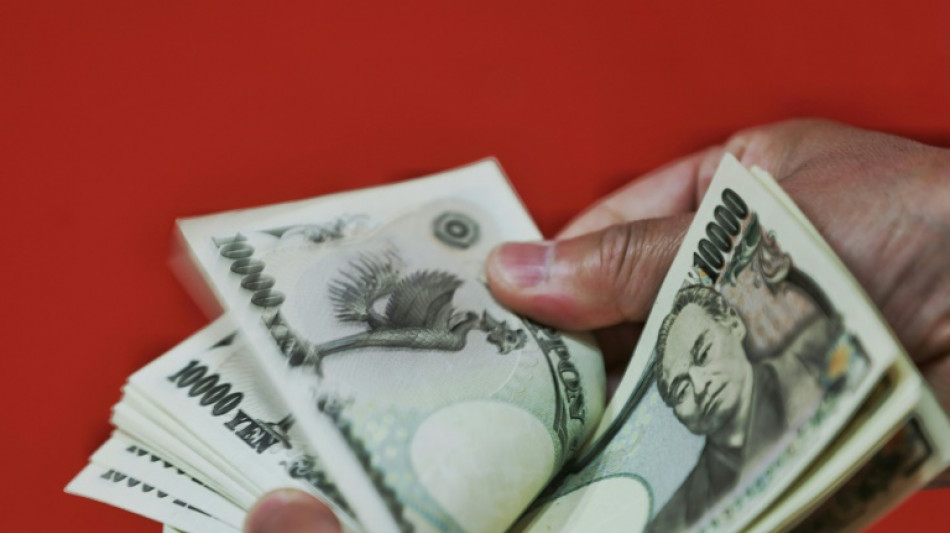
Yen slides to 24-year low against dollar / Photo: Behrouz MEHRI - AFP/File

 Nepal floods leave trail of destruction, aid challenge

 Experts outline sustainable ways to declutter Australian homes

 Bulk book purchases feed AI training through destructive scanning

 George and Amal Clooney attend Lake Como event after France evacuation

 Michelle Obama describes relief and adjustment after daughters leave home

 Very strong El Niño forecast to peak during southern African summer

 SAFA opens tender for dressing rooms, ablutions and grandstands

 TEEKS brings Māori-rooted soul and a new view of masculinity to South Africa

 Saudi customs seize 1.95 million amphetamine pills in lentil shipment

 Trump says Russia will not attack NATO as CIA chief visits Moscow

 British Museum schedules new Bayeux Tapestry ticket release

 From forced labour to living heritage: Sao Tome's colonial plantations

 Motorola September 2026 Deals: Up to $700 Off Razr Ultra and Moto G

 In war-split Myanmar 'spirit consorts' commune across divide

 Leaders of Russia, China, Iran to attend summit in Kyrgyzstan

 Hovland and Gerard share lead at Tour Championship

 Maresca salutes 'unbelievable' Cherki after Man City star sinks Palace

 Marquinhos rescues last-gasp draw for PSG at Lille in Ligue 1

 ICE detains British far-right activist Milo Yiannopoulos in Louisiana

 Milo Yiannopoulos held by ICE after missing immigration hearing

 Six Flags closes X2 rollercoaster after reports of severe brain injuries

 Jury ends second day without verdict in Lindsay Clancy murder trial

 Artist says criticised Ronnie O'Sullivan mural is unfinished

 UAE grants Starlink 10-year satellite broadband licence

 US says Hormuz mines cleared as diplomacy and military deployments continue

The yen plunged to its lowest level against the dollar since 1998 on Monday as sky-high US inflation fuels a widening monetary policy gap between Japan and the world's largest economy.
Japan's currency has been weakening for months, accelerated by the US Federal Reserve's aggressive monetary tightening to tackle soaring inflation caused by the war in Ukraine and other factors.
But unlike the Fed, the Bank of Japan has said it will stick with its long-standing monetary easing programme which it hopes will lead to stable growth.
The increasingly polar policies have strengthened the greenback, and on Monday one dollar bought 135.19 yen.
It's a level not seen since October 1998 during the Asian currency crisis, and marks a dramatic drop from January rates of around 115 yen per dollar.
"The ongoing backdrop to the yen's fall is the growing gap between long-term interest rates in Japan and the United States," Takahide Kinouchi, executive economist at Nomura Research Institute, said in a recent commentary.
And as higher oil prices fuel US inflation, "expectations are growing stronger that aggressive US monetary tightening will continue for the time being, causing US yields to rise further."
US consumer prices for May hit a new four-decade high, rising 8.6 percent and topping what economists thought was the peak in March.
In Japan however, inflation has only just hit the central bank's long-term target of two percent.
And while the figure represents a seven-year high, the BoJ sees current inflationary pressures as temporary, and believes its monetary policy is necessary to produce more long-lasting growth.
- Benefits for tourism, exporters -
As the war in Ukraine pressures global fuel and food prices, household brands from Uniqlo to 7-Eleven have anounced price hikes, with budget sushi chain Sushiro causing shock when it said it would no longer offer plates for 100 yen ($0.75).
But BoJ governor Haruhiko Kuroda said last week that "monetary tightening is not at all a suitable measure" for Japan, whose economy is still recovering from the pandemic, according to Kyodo News.
He also pointed to the benefits of a weaker yen for Japanese exporters, whose overseas profits are inflated when they are repatriated and have seen their stock prices rise in recent months.
The weaker yen could also be a boon for the tourism sector, with Japan cautiously reopening to foreign visitors now allowed in on group tours.
"The weak yen helps to support Japan's export sector directly, and a weaker exchange rate also contributes to looser monetary conditions domestically," said Alvin Tan, head of Asia forex strategy at RBC Capital Markets in Singapore.
"These will help drive the economic recovery further," he told AFP.
Although "higher import prices will negatively affect consumers" and the weaker yen will contribute to inflation, particularly given Japan's reliance on energy imports, this could also be "seen as a positive", he said.
"It could help to deepen more persistent inflation expectations in a country that has suffered under deflation for so many years."
The yen's trajectory may depend on how the US Fed acts in its September meeting, with worse-than-expected inflation figures for May raising expectations of further rate hikes.
But "there is still a lot of time left until then," said Kinouchi, and other factors may also be at play including energy prices rising further after a European Union ban on most Russian oil imports.
P.Cavaco--PC