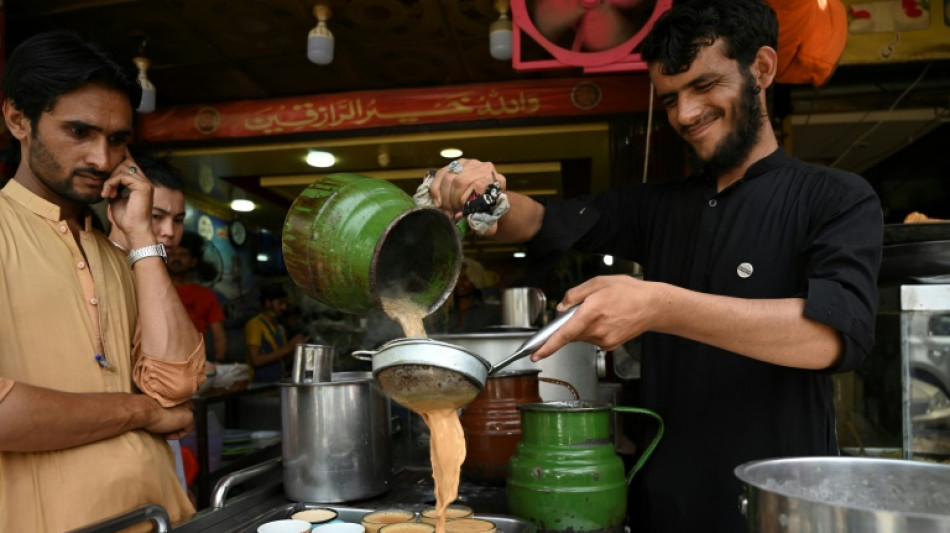
Storm in a teacup as minister urges Pakistanis to cut back on 'chai' / Photo: Aamir QURESHI - AFP

 KUFOS Signs MoU With Old Dominion University to Expand Academic Ties

 Karen Wazen Launches First Standalone Boutiques in Cairo

 Municipal Elections: How Service Failure Becomes a Public Health Crisis in South Africa

 Rene Eyre Revisits Autobiographical Performance 'Say A Little Prayer' in London

 UAE's HCT Holds Record Graduation and Announces Major Training Expansion

 NASA Awards $10B Lunar Contract Framework to SpaceX, Blue Origin

 Katy Perry Tells Fans Ex-Husband Russell Brand 'Should Be in Jail' During UK Concert
A Pakistani minister has caused a storm in a teacup by urging citizens to cut back on drinking "chai" as a way to preserve foreign currency that pays to import the leaves used in brewing the popular beverage.
Pakistan is the world's biggest importer of tea -- known locally as "chai" -- with the latest government figures showing it pays over $515 million a year to bring in the commodity, mostly from Kenya.
The country is suffering a long-brewing economic crisis, however, with dwindling foreign reserves used to pay crippling debt.
"I would also appeal to the nation to cut down one or two cups of tea because the tea we import is also imported on credit," Ahsan Iqbal, minister for planning and development, said Tuesday.
Pakistanis drink tea in many forms -- black, green, hot, cold, sweet, salted and spiced -- but the most popular is made by brewing the leaves in boiled sweetened milk.
Iqbal's comments prompted outrage Wednesday on social media and in tea rooms across the country.
"Why should we reduce the use of tea... we drink at our own expense, we don't drink with government money," said Jan Muhammad, 45, a truck driver who says he drinks between 15 to 20 cups a day.
"When you drive and you can't see the road... then there is a risk of an accident. That's why 20 cups are compulsory," he told AFP.
At a tea stall in Islamabad's Aabpara market, baker Muhammad Ibrahim said he drank 12 cups every day.
"I take three, four cups in the morning, then three in the afternoon and three, four late night," he said. "This is my addiction."
At the same restaurant, Tanveer Iqbal agreed that people should cut down -- even as he and his four children sipped piping hot cups of the drink.
The university professor noted tea was routinely served at almost every meeting -- especially those held by government officials.
"How will we reduce the use of tea when tea is the main drink in all the official meetings?" he asked.
"Chai" usually sells for around 45 Pakistani rupees (20 cents) a cup at stalls across the country.
"The government has increased its expenditure. They travel in big cars with protocol but we only enjoy tea," said driver Muhammad.
P.Queiroz--PC

