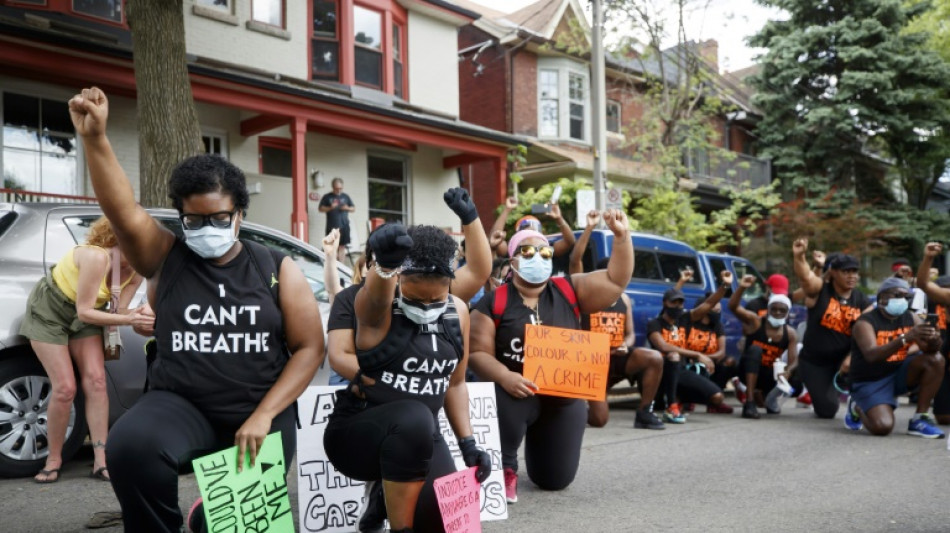
Toronto police chief apologizes to Black community for discrimination / Photo: Cole Burston - GETTY IMAGES NORTH AMERICA/AFP/File

 KUFOS Signs MoU With Old Dominion University to Expand Academic Ties

 Karen Wazen Launches First Standalone Boutiques in Cairo

 Municipal Elections: How Service Failure Becomes a Public Health Crisis in South Africa

 Rene Eyre Revisits Autobiographical Performance 'Say A Little Prayer' in London

 UAE's HCT Holds Record Graduation and Announces Major Training Expansion

 NASA Awards $10B Lunar Contract Framework to SpaceX, Blue Origin

 Katy Perry Tells Fans Ex-Husband Russell Brand 'Should Be in Jail' During UK Concert
Toronto's police chief apologized Wednesday for his officers' excessive use of force against Blacks, and released data backing up community claims of discrimination by law enforcement in Canada's largest metropolis.
"As an organization, we have not done enough to ensure that every person in our city receives fair and unbiased policing," Chief James Ramer told a news conference.
"For this, as chief of police and on behalf of the service, I am sorry and I apologize unreservedly."
Police forces across Ontario province were mandated in 2019 to start collecting data on the race of people against whom officers used physical force or drew their weapons.
This came after a human rights commission found that Blacks, who represent 8.8 percent of the city's population of six million, were nearly 20 times more likely than whites to be shot by Toronto police officers.
The new police data was for 2020, the same year George Floyd was murdered by a Minneapolis policeman in the US state of Minnesota, sparking global outrage and protests across the continent.
It showed that Blacks were 2.2 times more likely to have interactions with officers and 1.6 times more likely to have force used against them.
Ramer said the policing data is "difficult and uncomfortable," and "confirms what for many decades, racialized communities, particularly Black and Indigenous communities, have been telling us, that they are disproportionately over-policed."
He said the force has been grappling with "the complexities of systemic racism," and recognized that run-ins with authorities can have "a profound impact" on a person's life and erode trust in policing.
"We will do all we can to fix this mess," he said.
In a tense moment during the news conference, activist Beverly Bain of the No Pride in Policing Coalition responded directly to the chief: "We do not accept your apology," while renewing calls to defund the police service.
"What we have asked for you to do is to stop brutalizing us, to stop killing us, to stop carding us, to stop continuously stopping us and harassing our children, our Black sons and Black daughters," she said.
"What we have gotten instead is much more police."
V.Dantas--PC

