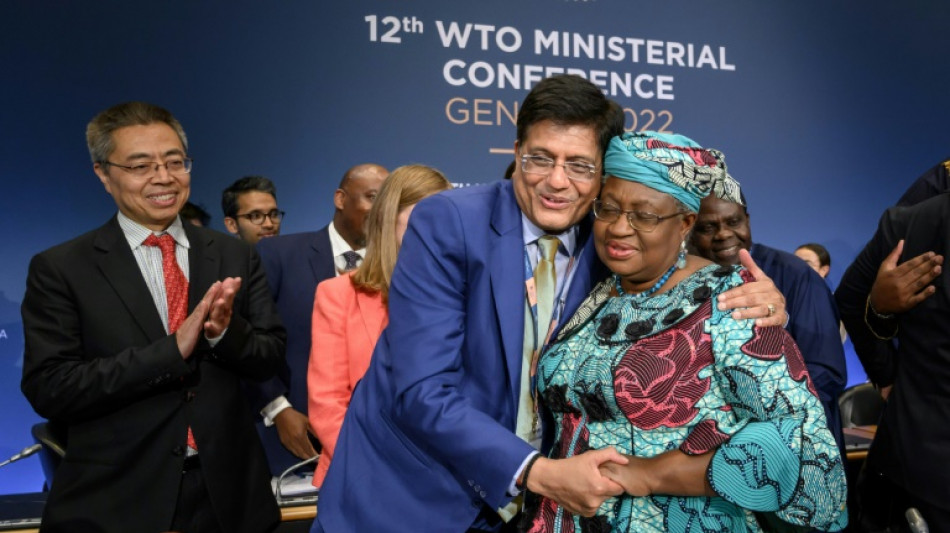
WTO strikes landmark deals package after marathon talks / Photo: Fabrice COFFRINI - POOL/AFP

 KUFOS Signs MoU With Old Dominion University to Expand Academic Ties

 Karen Wazen Launches First Standalone Boutiques in Cairo

 Municipal Elections: How Service Failure Becomes a Public Health Crisis in South Africa

 Rene Eyre Revisits Autobiographical Performance 'Say A Little Prayer' in London

 UAE's HCT Holds Record Graduation and Announces Major Training Expansion

 NASA Awards $10B Lunar Contract Framework to SpaceX, Blue Origin

 Katy Perry Tells Fans Ex-Husband Russell Brand 'Should Be in Jail' During UK Concert
The World Trade Organization concluded a landmark bundle of deals Friday covering fishing subsidies, food insecurity and Covid-19 vaccines following hectic round-the-clock talks.
WTO director-general Ngozi Okonjo-Iweala said trade ministers had struck an "unprecedented package of deliverables" which would make a difference to people's lives across the planet.
The talks at the global trade body's Geneva headquarters began Sunday and were due to wrap up on Wednesday.
But instead the WTO's 164 members went through two straight nights before getting the package over the line at around 5:00 am (0300 GMT) Friday.
The WTO's 12th ministerial conference (MC12) reeled in a deal to halt harmful fisheries subsidies after more than two decades of negotiations, and also reached agreements on e-commerce, responding to pandemics and reforming the organisation itself.
"Not in a long while has the WTO seen such a significant number of multilateral outcomes," Okonjo-Iweala said.
"The package of agreements you have reached will make a difference to the lives of people around the world. The outcomes demonstrate that the WTO is in fact capable of responding to the emergencies of our time."
With ministers struggling to conclude agreements on each separate issue, countries began making trade-offs across the topics that ultimately kept several measures alive.
"There were many moments when I feared we would come out of MC12 with nothing at all," Okonjo-Iweala later admitted.
But after the conference went nearly 36 hours into overtime, EU trade commissioner Valdis Dombrovskis tweeted "DEAL!"
The "ministerial succeeded in delivering important outcomes, despite unprecedented challenges."
- Big fish deal netted -
The fisheries deal -- the flagship issue thrashed out at the conference -- was the last one to get over the line.
Delegations were hammering out the final points into the early hours of Friday.
Negotiations towards banning subsidies that encourage overfishing and threaten the sustainability of the planet's fish stocks had been going on at the WTO since 2001.
The text was watered down compared to what had originally been envisaged, but Okonjo-Iweala insisted it was better to get an agreement rather than keep negotiating for years to come.
The last ministerial conference in Buenos Aires in December 2017 was seen as a flop after failing to strike any heavyweight deals.
Okonjo-Iweala, who took over in March 2021, hinged her leadership on breathing new life into the sclerotic organisation.
She wanted to prove that the organisation could still make itself relevant in tackling the big global challenges.
The former foreign and finance minister of Nigeria positioned herself as someone who can bang heads together and get business done.
"I prefer to talk less and do more," she said Friday.
As for why the discussions went on so long, some delegations accused India of being intransigent on every topic under discussion at the WTO -- where decisions can only pass with the agreement of every member.
But Indian Commerce and Industry Minister Piyush Goyal insisted: "India is not a roadblock on anything... People are realising that we were the ones who actually helped create the sole consensus."
- Patents waiver -
The second major issue on the table was the plan for a Covid-19 vaccine patents waiver.
Some countries that host major pharmaceutical companies, like Britain and Switzerland, found the initial draft wording worrisome.
But once Britain got on board after securing clarifications, it was left to the United States and China, who agreed language that captured Beijing's voluntary output.
US Trade Representative Katherine Tai hailed the deal, saying it would "get more safe and effective vaccines to those who need it most".
The pharmaceutical industry organisation IFPMA however voiced "deep disappointment" at the deal, warning that "dismantling" patent protections would strangle innovation.
Public interest groups meanwhile slammed the deal for not going far enough, with the medical charity Doctors Without Borders calling it a "devastating global failure" that would not help people access medical tools to fight the pandemic.
WTO members also agreed to help ease supply shortages that some countries faced during the pandemic.
With Russia's war in Ukraine fuelling a global food security crisis, ministers agreed on the importance of not imposing export restrictions, while food purchases by the UN's World Food Programme will be shielded from export bans.
Ministers also agreed to extend the moratorium on imposing customs duties on e-commerce transactions, seen by some countries as fundamental to protecting the digital economy.
F.Moura--PC

