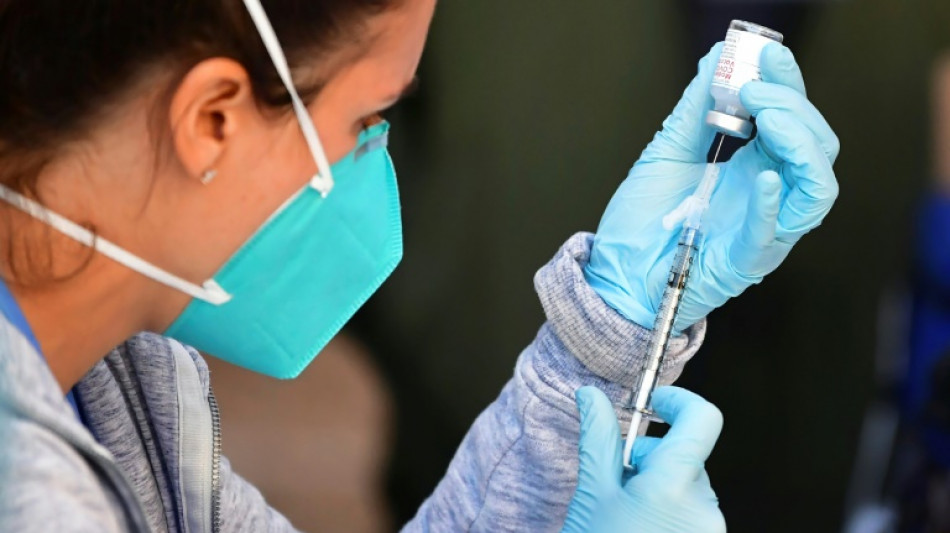
US approves Covid vaccines for youngest kids / Photo: Frederic J. BROWN - AFP/File

 KUFOS Signs MoU With Old Dominion University to Expand Academic Ties

 Karen Wazen Launches First Standalone Boutiques in Cairo

 Municipal Elections: How Service Failure Becomes a Public Health Crisis in South Africa

 Rene Eyre Revisits Autobiographical Performance 'Say A Little Prayer' in London

 UAE's HCT Holds Record Graduation and Announces Major Training Expansion

 NASA Awards $10B Lunar Contract Framework to SpaceX, Blue Origin

 Katy Perry Tells Fans Ex-Husband Russell Brand 'Should Be in Jail' During UK Concert
US health authorities on Saturday cleared the Pfizer and Moderna Covid-19 vaccines for children aged five and younger, in a move President Joe Biden greeted as a "monumental step" in the fight against the virus.
The United States thus became the first country to approve use of the so-called mRNA vaccines for children as young as six months.
The US Food and Drug Administration (FDA) had on Friday authorized their emergency use for young children -- who previously had to be at least five to receive the vaccine.
But the vaccines required further clearance from the US Centers for Disease Control and Prevention (CDC), the country's leading public health agency -- and they received that on Saturday.
"We know millions of parents and caregivers are eager to get their young children vaccinated, and with today's decision, they can," CDC Director Rochelle Walensky said in a statement Saturday.
Once the green light was received from the FDA, the US government began distributing millions of doses of the vaccine across the country.
Biden promised that parents could begin scheduling appointments as early as next week to have their young children vaccinated at hospitals, clinics, pharmacies and doctor's offices.
In a statement Saturday, he touted the vaccines as "safe (and) highly effective," and said that "for parents all over the country, this is a day of relief and celebration."
In coming weeks, with more and more doses shipped out, "every parent who wants a vaccine will be able to get one," he said.
The Moderna vaccine, administered in two doses a month apart, will be available to children aged six months to five years in reduced doses of 25 micrograms (half the amount given children aged six to 11, and a quarter the dose for those 12 and older).
The Pfizer-BioNTech vaccine is now authorized for children aged six months to four years, and will be given in doses of three micrograms per injection -- one-tenth the adult dosage.
The difference, however, is that children will receive three shots -- the first two three weeks apart, followed by a third eight weeks later.
So, children receiving it will not have full protection for the first few months.
Its side effects, however, have appeared less serious in drug trials than those of the Moderna vaccine.
About a quarter of young children receiving Moderna have developed fevers, particularly after the second dose -- but they generally lasted no more than a day.
About 20 million US children are now eligible, by age, for the new vaccines.
While children have generally proved less vulnerable to Covid-19, some 480 in the US in this age group have died of the virus.
So-called long Covid is also a concern, as is multisystem inflammatory syndrome, a rare but serious post-viral condition.
Pfizer has said it hopes to apply in early July to the European Medicines Agency for authorization to provide its vaccines to children in this youngest age group.
A.Silveira--PC

